

·
28 min read
On this page
Quick answer:
AI agent memory is the system that lets an AI agent store, retrieve, and update information across interactions. It can include short-term working context and persistent long-term memory for user preferences, past decisions, events, and learned procedures.
Imagine talking to a friend who forgets everything you’ve ever said. Every conversation starts from zero. No memory, no context, no progress. It would feel awkward, exhausting, and impersonal. Unfortunately, that’s exactly how most AI systems behave today. They’re smart, yes, but they lack something crucial: memory.
Let’s start with what memory really means in AI and why it matters.
Introduction: The Illusion of Memory
Tools like ChatGPT or coding copilots feel helpful until you find yourself repeating instructions or preferences, again and again. You re-explain your tech stack to a coding assistant every single session, because it has no memory of the last one. You tell a support bot the same account details three times in one call, because it forgot what you said two messages ago. You watch an agent make the same mistake it made last week because nothing about that failure carried forward to correct the next attempt. To build agents that learn, evolve, and collaborate, real memory isn’t just beneficial - it’s essential.
This illusion of memory created by context windows and clever prompt engineering has led many to believe agents already “remember.” In reality, most agents today are stateless and can't learn from past interactions or adapt over time.
To build agents that maintain useful state across sessions, we need memory, not simply larger prompts or retrieval alone.
What Is AI Agent Memory?
AI memory, or AI agent memory, is an agent's ability to retain and recall relevant information over time, across tasks, and through multiple user interactions. Memory allows AI agents to remember past events and use that information to improve their behavior in the future.
Memory is not about storing just the chat history or pumping more tokens into the prompt. It's about building a persistent internal state that evolves and informs every interaction the agent has, even weeks or months apart. Without an AI memory system sitting outside the model itself, none of this persists past the current context window. Optimized memory management helps ensure that AI systems store only the most relevant information while maintaining low-latency processing for real-time applications.
Three pillars define memory in agents:
State: Knowing what’s happening right now
Persistence: Retaining knowledge across sessions
Selection: Deciding what’s worth remembering
Together, these enable something we’ve never had before: continuity.
The Stateless LLM Problem
Let’s place memory within the architecture of a modern agent. Typical components:
An LLM for reasoning and answer generation
A policy or planner (e.g., ReAct, AutoGPT-style)
Access to tools/APIs
A retriever to fetch documents or past data

Fig: Stateless Agents (Without Memory) vs Stateful Agents (With Memory)
Here’s the problem: none of these components remember what happened yesterday. No internal state. No evolving understanding. No memory.

Fig: AI Memory Layer in the AI Agent Architecture
This transforms agents from single-use assistants to evolving collaborators.
Is a Context Window the Same as Memory?
A context window is the amount of information an LLM can process in a single request. AI memory is a persistence and retrieval layer that lets an agent retain useful information and bring it back when relevant, including across sessions. A larger context window can hold more information, but it doesn’t by itself determine what should be remembered or retrieved later.
A common misconception is that large context windows will eliminate the need for memory.
But this approach falls short due to certain limitations. One of the major drawbacks of calling an LLM with more context is they can be expensive: more tokens = higher cost and latency
Feature | Context Window | Memory |
|---|---|---|
Retention | Prompt-scoped – persists only if the application resends it; the model itself has no built-in persistence | Persistent – retained across sessions |
Scope | Prompt-based – relevance depends on what is included and how the model attends to it | Hierarchical and structured – prioritizes important details |
Scaling Cost | High – increases with input size | More efficient – retrieves relevant information instead of repeatedly sending the full history |
Latency | Slower – larger prompts add delay | Can reduce prompt size and associated latency |
Recall | Attention-based – the model can technically attend to distant tokens, but retrieving the right ones gets harder and more expensive as context grows | Intent or relevance-based |
Behavior | Reactive – lacks continuity | Persistent and adaptive – can update based on relevant interactions |
Personalization | Limited to information supplied in the current prompt; personalization must be re-supplied by the application. | Deep – remembers preferences and history |
The distinction is simple: context provides information for the model to use now; memory provides information an agent can retain and retrieve later.
Context windows help agents stay consistent within a session. Memory in AI allows agents to be intelligent across sessions. Even with context lengths reaching 100K tokens, the absence of persistence, prioritization, and salience limits what a context window alone can do across sessions.
Chat history isn’t memory either, even though the two get confused constantly. Chat history is a raw transcript: every message, in order, unfiltered. Memory is a distilled, structured layer built from that history: the preferences, facts, and outcomes worth keeping, indexed so an agent can retrieve the relevant piece instead of rereading everything. A transcript grows linearly and never gets smaller. Memory is designed to stay useful precisely because it doesn’t. In short: context gives an agent information to work with now. Memory gives it relevant information to carry forward.
Why AI Agents Need Memory?
Memory isn’t a nice-to-have layered on top of a working agent. It’s what turns a one-off interaction into a relationship the agent can build on, and it’s what keeps costs from spiraling as agents run longer and do more. For AI agents, memory matters for a few key reasons:
Personalization Across Sessions
An agent without memory treats every session as a first meeting. It has no idea you prefer terse answers, that you always deploy to staging before production, or that you already rejected a suggestion it’s about to make again. Memory closes that gap. The agent carries your preferences, your past decisions, and the context of your ongoing work from one session into the next, so the tenth conversation feels like a continuation, not a cold open.
This matters most in agents that are supposed to feel like collaborators rather than tools: coding copilots, support agents, personal assistants. Memory of what came before is often the biggest factor separating a generic response from a genuinely useful one, though tool access, reasoning quality, and instructions matter too.
Reducing Token Cost and Context Bloat
The naive fix for a forgetful agent is to stuff more history into the prompt. That doesn’t scale. Every additional token in the context window adds some latency and cost, though the exact impact depends on the model and provider, and past a certain point the model starts losing track of what matters in all that noise.
Memory solves this by moving the burden from the prompt to a retrieval step. Instead of replaying an entire conversation history on every call, the agent pulls back only the specific facts relevant to the current turn. The prompt stays small and focused, and cost scales with what’s relevant, not with how long the relationship has been running.
Maintaining Continuity in Long-Running Tasks
Some agent work doesn’t fit inside a single session: a multi-day migration, a research project spanning several conversations, an onboarding flow that unfolds over weeks. Memory lets an agent pick up exactly where a task left off, rather than needing the user to re-establish the plan, the constraints, and the progress made so far every time work resumes.
Learning From Past Interactions
An agent that remembers what worked and what didn’t can avoid repeating the same failed approach. If a suggested fix broke a build last week, or a particular tone consistently gets a poor reaction, memory lets that outcome inform future behavior instead of being rediscovered from scratch each session.
Coordinating Across Tools and Workflows
Agents rarely operate through a single interface anymore; they call tools, trigger workflows, and hand off to other agents. Shared memory means a decision made through one tool or workflow step is visible to whatever comes next, instead of each tool operating on its own incomplete view of what’s happened so far.
AI Agent Memory vs. RAG: What's the Difference?
RAG helps the agent answer better. Memory helps the agent behave smarter.
What RAG Does Well
While both RAG (Retrieval-Augmented Generation) and AI agent memory systems retrieve information to support LLMs, they solve very different problems. RAG brings external knowledge into the prompt at inference time. It’s useful for grounding responses with facts from documents.
What RAG Doesn’t Solve
RAG is a retrieval technique, not a full architecture, so its statelessness depends on how it's used. On its own, a RAG index is typically a static external corpus with no awareness of a specific user's identity or history. It doesn't have to stay that way, RAG can be combined with conversation history or a user profile, but that combination is exactly what memory is built to provide by default.
What Memory Adds
Memory, on the other hand, brings in continuity. It captures user preferences, past queries, decisions, and failures, and makes them available in future interactions. Where a RAG index is usually a static external corpus, a memory store is an evolving per-user record built from past interactions.
Aspect | RAG: Retrieval-Augmented Generation | AI Agent Memory |
|---|---|---|
Temporal Awareness | No concept of time or sequence | Tracks order, timing, and evolution of interactions |
Statefulness | Depends on application architecture; typically retrieves from an external corpus and can be combined with conversational or persistent state | Designed to maintain and retrieve evolving state from prior interactions |
User Modeling | Task-bound; agnostic to user identity | Learns and evolves with the user |
Adaptability | Cannot learn from past interactions on its own | Adapts based on what worked or failed |
You want both: RAG to inform the LLM, memory to shape its behavior.
Read more about RAG vs AI Memory
Do AI Agents Need Both RAG and Memory?
Most production agents use both, because they answer different questions. RAG answers “what does the documentation, codebase, or knowledge base say about this?” Memory answers “what do I already know about this specific user or task?”
Consider a coding agent:
RAG retrieves the relevant section of a library’s documentation when the agent needs to call an unfamiliar API
Memory recalls that this particular user always prefers type hints and pytest over unittest, regardless of which library is involved
Combining the two means the agent grounds its answer in accurate, current documentation while still applying what it already knows about how this user likes their code written. Neither one replaces the other.
What are The Types of AI Agent Memory?
Researchers categorize agentic memory in much the same way that psychologists categorize human memory. The influential Cognitive Architectures for Language Agents (CoALA) paper (Sumers et al., 2023) from a team at Princeton University describes different types of memory as:
Short-Term Memory
Short-term memory, also called working memory, holds the information an agent needs for its immediate decision-making within the current interaction. It exists only for the duration of a single session or task and disappears once that session ends, functioning much like a person’s working memory when following a conversation in real time.
For example, if a user tells a customer support chatbot their order number at the start of a conversation, short-term memory is what lets the bot reference that same order number three messages later without asking again, so long as the conversation is still active. The moment the session ends, that context is gone unless something has explicitly promoted it into long-term storage.
Long-Term Memory
Long-term memory persists knowledge across sessions, tasks, and time, well beyond the lifespan of any single conversation. In practice, this usually means storing information in databases, knowledge graphs, or vector embeddings, structures built to hold facts and relationships indefinitely and retrieve them efficiently later. Retrieval-augmented generation (RAG) is frequently used as the mechanism that pulls relevant pieces of this long-term store back into the prompt when needed, though RAG itself is a retrieval technique rather than the storage layer.
For example, a project-management agent that remembers a team’s sprint cadence, its recurring blockers, and which teammate owns which component draws on long-term memory every time it’s reopened weeks later, without the team needing to re-explain any of it.
Long-term memory breaks down further into three subtypes. The CoALA paper names the same three: episodic, semantic, and procedural.
What Is Episodic Memory in AI Agents?
Episodic memory stores specific past experiences: what happened, in what order, and what the result was. Each record is tied to a particular time or task, such as an earlier conversation, a tool call, or a failed attempt. In the CoALA framework, episodic memory holds experience from earlier decision cycles. The agent reads these records to avoid a repeated mistake or to continue earlier work. Because each record belongs to one moment, old records can go out of date, so teams prune or summarize them over time.
Example: "Last time we deployed this model, latency increased after the cache change." Before the next deploy, the agent checks the cache settings first.
What Is Semantic Memory in AI Agents?
Semantic memory stores general facts and knowledge, separate from the event where the agent learned them. It holds items such as a user's role, their preferences, product details, or domain rules. In CoALA, semantic memory stores an agent's knowledge about the world and about itself. Teams usually keep it in databases, knowledge graphs, or vector stores, and the agent retrieves a fact when it matters for the current task. A semantic fact stays useful until something replaces it, so the system must update it when new information arrives.
Example: "This user works in fintech and prefers markdown answers." The agent applies both facts in every later session.
What Is Procedural Memory in AI Agents?
Procedural memory stores how to do something: skills, rules, and workflows, not facts. In CoALA, procedural memory covers two forms: implicit knowledge in the LLM weights, and explicit knowledge in the agent's code. In practice, teams often store learned procedures as instructions, prompts, or reusable skills that the agent can update over time. This type shows up most in coding agents and workflow automation. There, the value is a reliable sequence of steps, not a fact about the user.
Example: "Always run the tests before you suggest a deploy for this user's projects." The agent follows this rule at each deploy step without a reminder.
Just like in humans, these AI agent memory types serve different cognitive functions. Short-term memory helps the agent stay coherent in the moment. Long-term memory helps it learn, personalize, and adapt.
For the underlying research, Memory Papers tracks new papers on agent memory as they appear.
Memory Storage & Retrieval Approaches
How memory gets stored determines how it can be retrieved, and different storage approaches make different tradeoffs between speed, precision, and the kinds of relationships they can represent.
Vector-Based Approach
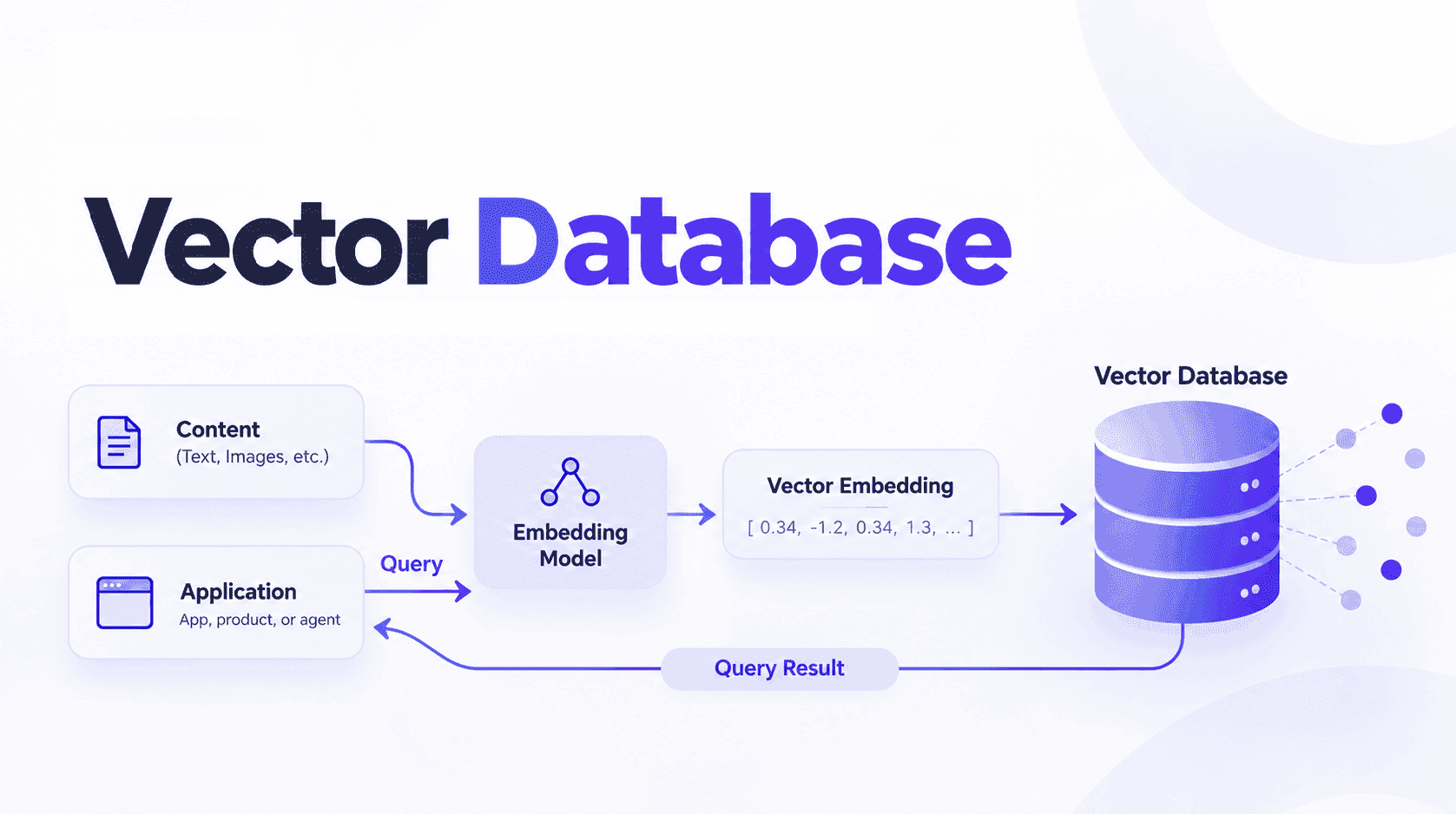
Vector-based memory converts text into embeddings, numerical representations that place similar meanings close together in vector space. Retrieval works by similarity search: given a query, the system finds the stored memories whose embeddings sit nearest to it. This is fast, scales well, and is the default approach behind most memory and RAG systems today, backed by vector databases and libraries built specifically for approximate nearest-neighbor search.
Its limitation is that similarity isn’t the same as relationship. Two memories can be semantically distant but causally connected, and pure vector search has no native way to represent that connection.
Graph-Based Approach & Temporal Knowledge Graphs
Graph-based memory stores information as entities and the relationships between them, rather than as isolated chunks of text. This makes it possible to answer questions vector search struggles with, like tracing how a decision changed over time or connecting two facts that were never mentioned in the same sentence.
Temporal knowledge graphs add a time dimension to this structure, tracking not just that a relationship exists but when it was true. That distinction matters for agents operating over weeks or months, where a fact from three months ago may no longer be current.
Hybrid Storage
Most production memory systems don’t pick one approach; they combine them. A common pattern pairs vector search for fast semantic retrieval with a graph layer for relationship and temporal reasoning, sometimes backed further by a SQL layer for structured facts that don’t need embedding at all. The vector layer answers “what’s related to this,” the graph layer answers “how are these things connected and when,” and the SQL layer answers precise lookups efficiently.
Choosing the Right Approach
Use Case | Approach | Why |
|---|---|---|
Fast semantic recall of preferences or facts | Vector-based | Low latency, scales well, no explicit relationship modeling needed |
Multi-hop reasoning across connected facts | Graph-based | Captures relationships vector similarity can’t represent |
Tracking how facts or decisions change over time | Temporal knowledge graph | Preserves when something was true, not just that it was |
Production agents with mixed retrieval needs | Hybrid | Combines strengths without forcing one structure to do everything |
Precise structured lookups (IDs, timestamps, counts) | SQL / structured store | Exact retrieval beats approximate search for this kind of data |
How AI Agent Memory Works (Architecture)
If you’re asking how AI memory works in practice, the short answer is: two paths, running continuously. A write path decides what’s worth keeping from each interaction, and a read path decides what to bring back at the moment it’s needed. Everything else in this section is a variation on getting those two paths right.
Every memory system, regardless of vendor, has to solve two problems: how new information gets captured and stored, and how the right piece of it gets retrieved later. Everything else is a variation on these two paths.
The Write Path
The write path starts the moment a new interaction happens. The raw exchange gets passed through an extraction step that pulls out what’s actually worth remembering: a stated preference, a decision, a fact about the user, a correction to something the agent got wrong. Not every message produces a memory. Most of a conversation is scaffolding around the one sentence that matters.
Once extracted, that information gets structured, often tagged with metadata like recency, source, and user identity, and stored in whatever backend the system uses- vector, graph, or hybrid- as covered above. This is also where deduplication and conflict resolution happen: if a new fact contradicts an old one, the write path has to decide whether to update, merge, or keep both.
The Read Path
The read path runs at inference time, right before the agent generates a response. Given the current query or task, the system searches stored memory for what’s relevant, ranks the candidates, and injects the top results into the prompt as context.
The quality of this step is often the real differentiator between memory systems. Retrieving too much reintroduces the token bloat memory was supposed to solve. Retrieving too little means the agent answers as if it never learned anything. Good read paths balance relevance against recency, so a stale preference doesn’t outrank a fact the user corrected yesterday.
Consolidation, Ranking & Relevance
Memory that only grows becomes as unusable as no memory at all. Consolidation is the general process of managing that growth: merging duplicate or overlapping memories, adjusting the weight given to older information as it ages, and moving frequently accessed memories into faster-to-retrieve storage while less relevant ones decay. This isn’t unique to any one vendor’s implementation; it’s a structural requirement of any memory system meant to run for months rather than a single session.
Ranking determines what gets surfaced on the read path, typically weighing some combination of semantic relevance, recency, and how often a given memory has proven useful in the past. Get this wrong, and an agent either drowns in irrelevant context or misses the one memory that would have made its answer correct.
See how eviction and forgetting fit into this from the other direction: check out our blog on memory eviction and forgetting in AI agents.
Memory Tools & Frameworks
Once you understand how memory works, the practical question becomes whether to build it yourself inside an existing agent framework or adopt dedicated memory infrastructure built for exactly this problem.
Frameworks for Agentic AI Memory
Most teams building agents today aren’t starting from a blank page. They’re working inside an existing orchestration framework, and how that framework handles memory shapes what’s easy to build and what requires extra infrastructure.
LangChain is a widely used framework for building LLM applications and agents. Its older memory classes, such as buffer memory and summary memory, are deprecated, and the LangChain docs now point developers to LangGraph persistence instead. Current LangChain agents run on LangGraph, so their short-term memory comes from a checkpointer that saves the state of one conversation thread. That persistence stops at the thread boundary: a new thread does not see what happened in an earlier one. Dedicated memory infrastructure becomes worth adding when the agent must extract facts from conversations, keep them current, and retrieve them across many users and sessions.
LangGraph is LangChain's framework for stateful, graph-based agent workflows. It has two persistence systems. Checkpointers save a thread's graph state, which gives short-term memory, human-in-the-loop pauses, and fault recovery. Stores keep application-defined data across threads, such as user preferences and facts, which gives long-term memory. The in-memory versions of both lose data on restart, so production systems need a persistent backend. A store holds only what your code writes to it: your application must decide what to extract, how to update it, and how to retrieve it. Dedicated memory infrastructure becomes worth adding when you do not want to build and maintain that extraction, update, and retrieval logic yourself.
Framework-Native vs. Dedicated Memory Infrastructure
Most agent frameworks ship with some form of built-in memory, usually a simple buffer or summarization mechanism layered on top of chat history. This works fine for short-lived, single-session use cases and has the advantage of zero extra setup.
It tends to break down once agents need to persist context across sessions, users, or weeks of operation. At that point, framework-native memory starts requiring the same infrastructure work- extraction, storage, ranking, decay- that dedicated memory tools already handle.
See how specific tools compare: Mem0 vs Zep and Mem0 vs Letta
Do You Need a Memory Layer?
Not every agent does. If your agent only ever handles single-turn requests, if nothing about a user’s history should change how it responds tomorrow, or if you’re prototyping and correctness matters more than persistence right now, a memory layer is overhead you don’t need yet. The signal that you do need one is simpler than most evaluation checklists suggest: the moment a user has to repeat themselves, or the moment two sessions with the same user should have felt connected and didn’t, that’s the point a memory layer starts paying for itself.
Where does Cloudflare’s Agent Memory fit?
Cloudflare announced Agent Memory in private beta in April 2026, a managed service built around the same extraction-and-retrieval pattern covered in this guide: pull durable facts out of agent interactions, store them, and serve them back through parallel retrieval rather than replaying raw history. It’s worth knowing about if you’re already running on Cloudflare’s Workers platform and want memory to live at the edge alongside your existing infrastructure. As of this writing, it’s still in private beta, so treat it as an option to watch rather than a production dependency, and evaluate it against dedicated memory layers on the same criteria below: latency, accuracy under real multi-session load, cost at scale, and whether you need it to run somewhere other than Cloudflare’s own edge.
How to Evaluate a Memory Tool
Use this checklist when comparing options:
Latency: How much time does memory retrieval add to a single turn? This compounds fast in production.
Accuracy: Does the tool have published benchmark results, and do those benchmarks reflect realistic, long-running conversations rather than short synthetic tests?
Cost: How does pricing scale with the number of users, memories stored, and retrieval volume?
Self-hosting: Can you run it in your own infrastructure if data residency or compliance requires it, or are you locked into a hosted-only offering?
Enterprise Context & Governance
Conversation memory and organizational context solve different problems, and conflating them is where a lot of “just add memory” advice falls apart for enterprise use cases.
Session Memory vs. Organizational Context
Session memory tracks what an individual user told an agent: their preferences, their past requests, the decisions made in prior conversations. It’s inherently personal and interaction-scoped.
Organizational context is different in kind, not just scale. It’s the governed body of knowledge a company maintains about its own data, processes, and policies, access-controlled, versioned, and often subject to compliance requirements that have nothing to do with any single conversation. A support agent remembering that a customer prefers email over chat is session memory. A support agent knowing which refund policy applies to that customer’s contract tier is organizational context. Both matter. They are not the same system, and treating conversation-history memory as if it can also serve as a governed system of record is where problems start.
Where Memory and Governance Overlap
The overlap happens at the point of retrieval: an agent answering a user often needs both layers at once, personal memory of the user’s history and governed organizational data relevant to the task. A well-designed agent stack keeps these as separate sources with separate access controls, then merges them at the point where a response gets generated. Blurring the two, storing governed organizational facts inside a general-purpose conversation memory layer with no access control model, is a real risk, not a hypothetical one.
Why You Often Need Both Layers
Memory alone gives you personalization and continuity for individual users. It doesn’t give you audit trails, role-based access, data lineage, or the compliance guarantees an enterprise deployment needs around shared organizational knowledge. Governance tools solve for the latter, but they’re not built for the low-latency, per-user personalization memory handles well.
The practical answer isn’t choosing one over the other. It’s architecting agents that draw on personal memory for continuity and a governed context layer for organizational truth, with a clear boundary between what’s user-specific and what’s shared, access-controlled, and audited.
Use Cases for AI Agent Memory
The clearest way to understand what memory changes is to see how it plays out in agents actually running in production.
Customer Support Agents
Instead of treating each complaint as new, it remembers past issues and resolutions - enabling smoother, more personalized support.
See how this plays out in practice: Customer support use case
Coding Agents
It learns your coding style, preferred tools, and even avoids patterns you dislike.
See it applied here: Coding agents
Multi-Agent Systems
In multi-agent systems, memory does more than personalize a single conversation; it becomes the shared context multiple agents coordinate through. Without it, each agent in a pipeline operates blind to what the others have already discovered, decided, or attempted, leading to duplicated work or contradictory outputs.
With shared memory, a research agent’s findings become immediately available to the agent responsible for drafting, and a planning agent’s decisions persist for the execution agent that acts on them later, even if those steps happen in separate sessions or are handled by entirely different agent instances.
The Memory Advantage: How Mem0 Is Different
Everything above describes memory as a general architecture. Here’s specifically how Mem0 implements it.
At Mem0, AI memory is the core of what we do. While other AI systems treat memory as an afterthought, we’ve built our entire architecture around creating true, human-like memory capabilities:
Intelligent Filtering: Not all information is worth remembering. Mem0 uses priority scoring and contextual tagging to decide what gets stored. This avoids memory bloat and keeps agents focused on the important stuff, just like humans subconsciously filter out noise.
Dynamic Forgetting: Good memory systems need to forget effectively. Mem0 doesn’t treat memory as a static dump. Instead, it decays low-relevance entries over time, freeing up space and attention. Forgetting isn’t a flaw; it’s a feature of intelligent memory.
Memory Consolidation: We move information between short-term and long-term memory storage based on usage patterns, recency, and significance, optimizing both recall speed and storage efficiency. This mimics how we internalize knowledge. See the general mechanics behind this in “How AI Agent Memory Works (Architecture)” above.
Cross-Session Continuity: Most agents reset at the end of a session. Mem0 doesn’t. Our memory architecture maintains relevant context across sessions, devices, and time periods.
For a broader view of how the field categorizes memory beyond any single vendor’s implementation, the recent survey “Memory in the Age of AI Agents” (arXiv:2512.13564) maps the current landscape across token-level, parametric, and latent memory forms; Memory Papers tracks new research like this as it appears.
Frequently Asked Questions
Quick answers to the questions that come up most when teams start evaluating AI agent memory.
Q. Is AI agent memory the same as RAG?
No. RAG retrieves external documents to ground a single response in facts. Memory retrieves an agent’s own history with a specific user to inform behavior across sessions. They solve related but different problems, and most production agents use both.
Q. What’s the difference between short-term and long-term agent memory?
Short-term (working) memory holds context for the current interaction and disappears once the session ends. Long-term memory persists across sessions, storing facts, preferences, and outcomes an agent can draw on weeks or months later.
Q. Do I need a vector database for agent memory?
Not necessarily. Vector search is the most common retrieval method and works well for semantic recall, but graph-based and hybrid approaches are often better suited to relationship-heavy or time-sensitive use cases. The right choice depends on what your agent needs to retrieve.
Q. How is agent memory different from a context window?
A context window is the information an LLM can process in a given request. It has no built-in persistence across requests unless the application supplies prior information again. Memory is a persistence layer: it stores selected information, retrieves it when relevant, and can carry it across sessions.
Q. How do I delete specific data from an AI agent’s memory for GDPR compliance?
A memory layer built for production should expose a direct delete operation scoped to a specific user, fact, or memory ID, not just a database you’d have to query manually. In practice, this means being able to remove everything tied to a user ID on request, or delete a single memory entry when a specific piece of information needs to go, without needing to rebuild or reindex the rest of the store.
Q. Can an AI memory layer be deployed on-premises or in a private VPC?
Yes, if the memory layer ships as a self-hostable package rather than only a managed cloud service. Running self-hosted inside a private VPC means the vector or graph backend and the memory data itself never leave your own infrastructure, which matters for regulated industries or any deployment where data residency is a hard requirement.
Q. How does an AI memory layer reduce token costs across multiple agents on the same team?
When multiple agents share a memory layer instead of each maintaining their own context, a fact only has to be extracted and stored once, then retrieved by whichever agent needs it, instead of every agent re-processing the same raw history independently. This matters most in multi-agent systems, where, without shared memory, each agent redundantly re-derives context the others already have.
Q. What’s the difference between an AI memory layer and a session layer?
A session layer holds state for the duration of a single active session, active tasks, temporary variables, the current conversation, and it’s typically discarded once that session ends. A memory layer is what persists past that boundary: the facts, preferences, and history that need to be available in the next session, not just the current one. Most production agents need both, a session layer for what’s happening right now and a memory layer for what should carry forward.
Q. How is Mem0’s memory architecture different from Cloudflare’s Agent Memory?
Both follow an extraction-and-retrieval pattern rather than replaying raw history, but they target different deployment contexts. Cloudflare’s Agent Memory is built specifically for agents already running on Cloudflare’s Workers platform and is still in private beta as of this writing. Mem0 is framework- and platform-agnostic, deployable as a managed platform, self-hosted package, or local MCP server regardless of where your agent runs, with production benchmarks already published (92.5% LoCoMo, 94.4% LongMemEval).
More on Agent Memory

How to Read Memory Benchmarks
How to read AI memory benchmarks: what LoCoMo, LongMemEval, BEAM, and agentic tests measure, where scores go wrong, and how to find the correct benchmark for your use case.
20 min read

The Problem After Retrieval: Why Agents Misuse the Memories They're Given
Five papers show LLM agents often misuse the memories they retrieve. What the research says, how much to trust it, and what builders can do.
13 min read

What Is Memory Staleness in AI? Causes, Risks & Solutions
Understand memory staleness in AI agents, why outdated information leads to errors, and the best techniques to maintain accurate long-term memory.
9 min read



Taranjeet Singh
Taranjeet is the co-founder of mem0. His work centers on a question most LLM teams hit but few solve well: how do you give an agent durable, structured memory without ballooning context windows or sacrificing latency? His writing focuses on the practical architecture of memory-augmented agents, the tradeoffs between long context and retrieval, fact extraction at scale, schema design for episodic memory, and why benchmarks like LoCoMo and MemGPT often show such different results in lab vs production environments. He has spoken on these themes at the AI Engineer Summit, LangChain's Interrupt, and other developer conferences.
Start building with memory
Free tier, no card