


You've called mem0.add() before. You've probably never touched the infer parameter. You've never had to. It defaults to True. You just call add(), something gets saved, and you move on.
Here's the thing: Two completely different things can happen inside that call, and you've probably only ever seen one of them run.
A "memory" in Mem0 doesn't mean RAM. It doesn't mean the thing your laptop runs out of when you have forty tabs open. In Mem0, a memory is one saved fact, sitting in a database that also happens to be a vector index. The word gets reused a lot, and that's not your fault.
infer is the switch that decides how that fact gets written. infer=True is a smart assistant, listening to what was said and writing down a tidy note in its own words. infer=False is a tape recorder, saving exactly what it heard, word for word. Same function call. Completely different output.
By the end of this, you'll be able to look at an add() call and predict, before running it, roughly what comes out the other side, and whether you can trust it to have kept the one fact you actually needed. That sounds like a small trick. It is. It's also the first step to shaking the feeling that Mem0 either remembers things or it doesn't, no in-between, because there very much is an in-between, and it's this parameter.
👉Get a free API key at app.mem0.ai to follow along (free tier, no credit card, includes all the
add()andsearch()calls shown below).
Your first add()
Start small. One message, one customer, infer=False.
What happens is almost nothing. The message goes straight to the embedding model and gets stored as its own record. No LLM reads it. Nothing gets compared against what's already saved. Mem0's own docs describe the payload as stored exactly as provided, and that's the whole story: what you typed is what you get back later.
Now the same message, same customer, infer=True instead.
This time something actually runs. An LLM reads the message and pulls out whatever facts it thinks are worth remembering. Mem0 checks its vector store for anything already saved that's related. Then the LLM decides, fact by fact, whether to add something new, update something that's now out of date, delete something that's been contradicted, or do nothing at all.
That last option, do nothing, is easy to skip past reading the docs. Hold onto it. It's going to matter in about two paragraphs.
What happened when we actually ran this
Here's a real conversation:
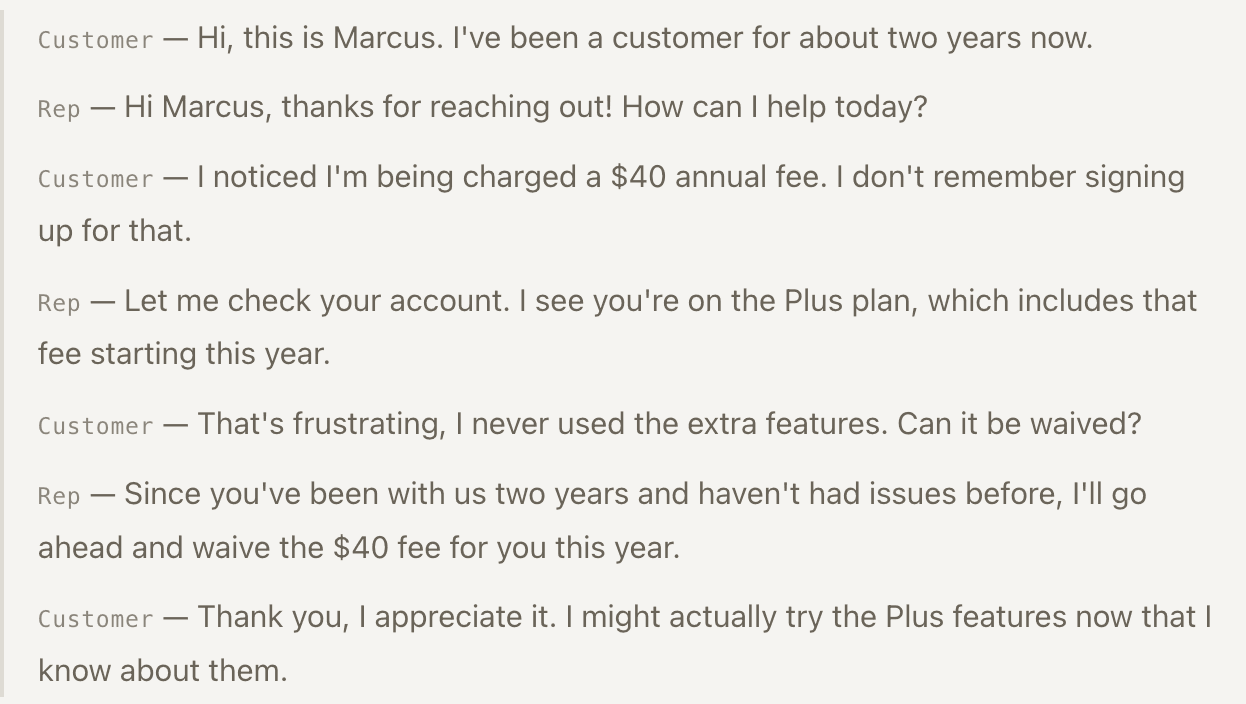
Sent with infer=False, one of the seven saved records is this, verbatim. Sent with infer=True, from the exact same seven lines, here is the complete list of what got saved:
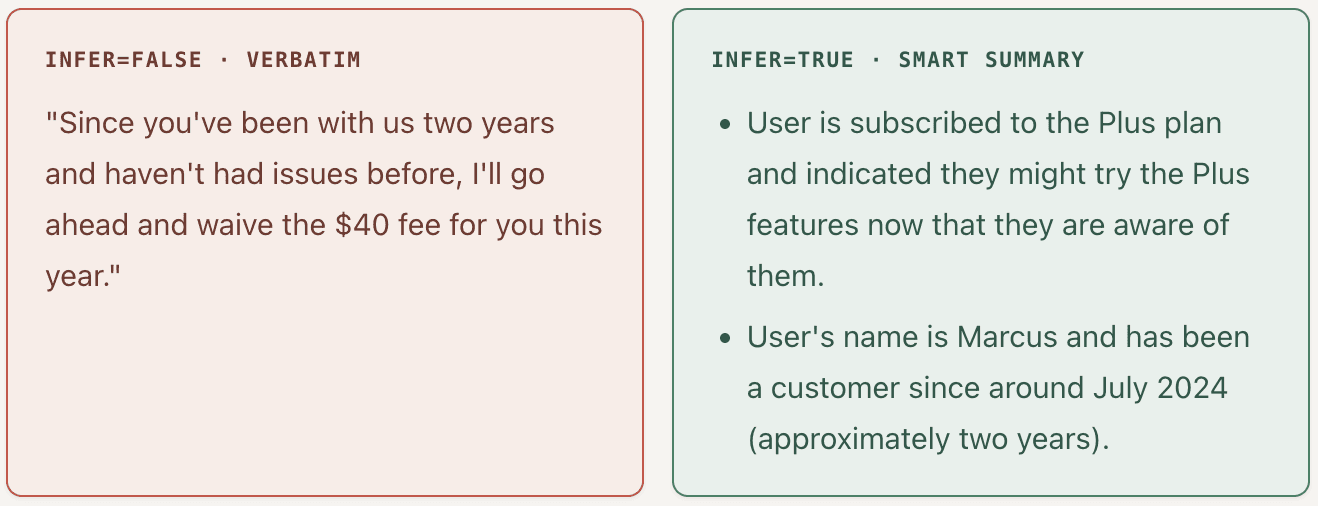
Fig: infer= False vs infer = True
Read that list again. Somewhere between "I noticed I'm being charged a fee" and "I appreciate it," a fee got waived. That's the one fact a support agent would actually need three weeks later if Marcus called back disputing the charge.
Counting what got stored
This is the habit worth building: before you trust infer=True with something, count what you'd actually get back.
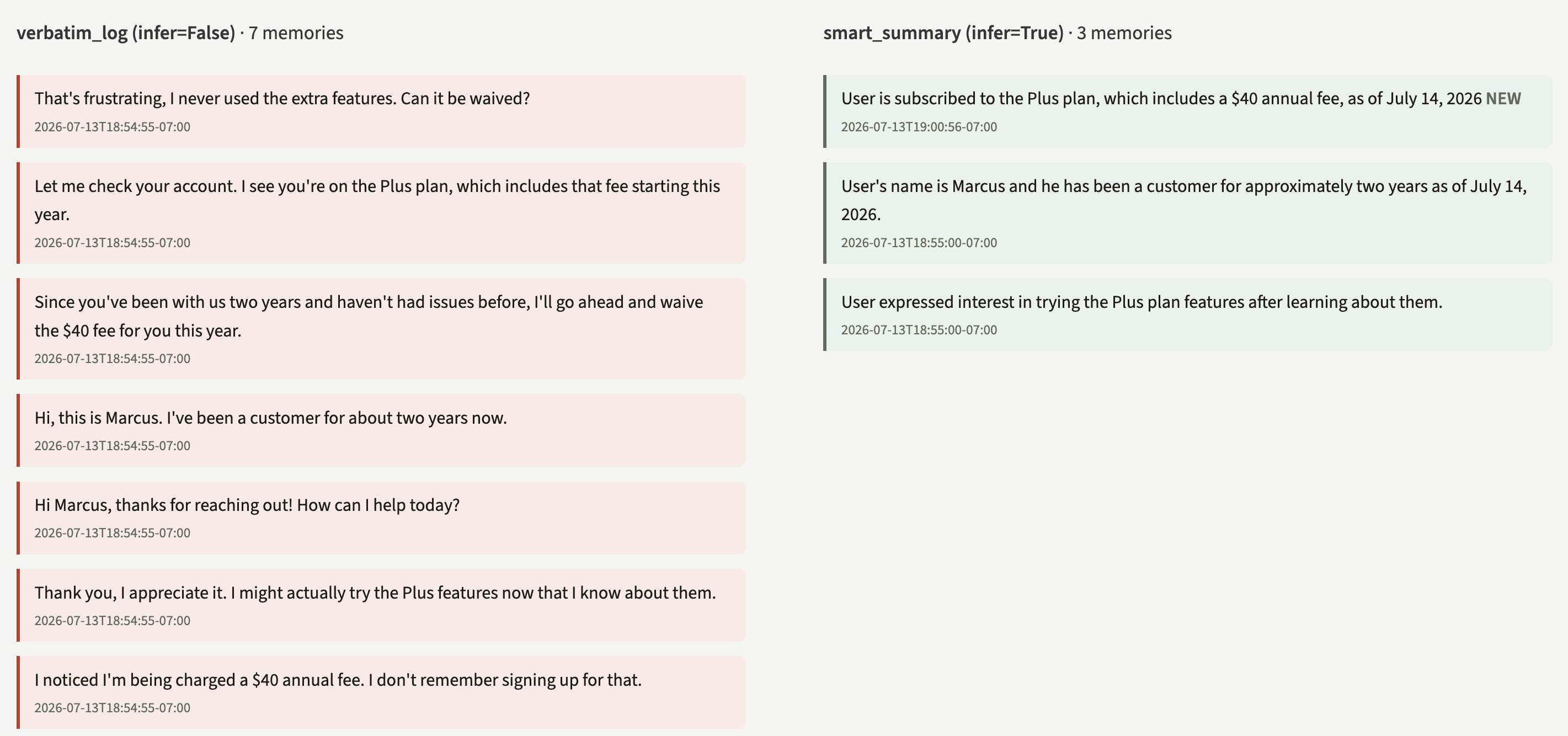
infer=False never merges anything. Every message becomes its own record. Send the same fact three different ways across three tickets and you get three records, not one cleaned-up fact. Over months, that's not a memory, it's a growing, unsorted pile of everything anyone ever said. Mem0's own docs are direct about the consequence: switch between modes for the same underlying fact and you can save it twice, once as a raw record and once as an extracted one.
infer=True does the opposite. It's compressing on purpose. Seven lines of conversation went in. Two facts came out. That's not a bug, that's the feature working exactly as designed, minus the one fact you actually wanted. The count is the whole point of the mode, and also the whole risk of it.
You might be thinking: fine, I'll just run both.
That's the right instinct. Here's the part that'll bite you if you don't know about it first. The obvious way to tag them is agent_id, since that's exactly what it's documented for, a scoping identifier independent of user_id. In practice, testing this directly turned up a real gap: a memory created through infer=False reliably shows "agent_id": "verbatim_log" in the raw response. A memory created through infer=True's extraction pipeline can come back with no agent_id field at all, even though you passed the exact same value to the exact same add() call.
user_id doesn't have that problem, because every memory has to belong to somebody, no exceptions. So the pattern that actually works is folding the policy into user_id itself: customer_marcus::smart_summary versus customer_marcus::verbatim_log. Keep passing agent_id too, it doesn't hurt, just don't rely on it alone to separate infer=True content later.
Try it yourself
Everything above is us telling you what we saw. Here's how to check it yourself in a few minutes.
👉Wanna give it a try? Get a Mem0 API Key and try it yourself.
Setup
Now, we have the setup done, lets import the installed libraries:
You'll need a Mem0 API key. The free tier is enough for everything here. Nothing else, since Mem0 runs its own LLM call internally for infer=True; this doesn't need a separate chat model of your own.
Write the same conversation two ways:
Pass the whole seven-line conversation as messages, role-tagged, not just one line. That matters more than it sounds. A single transactional message like "I've applied a one-time waiver on this fee for you" gave infer=True nothing to extract at all in testing, probably because it reads as an action the assistant took, not a fact about the customer. A fuller exchange with the customer's own words in it is what actually gives the extraction step something to chew on.
Read both stores back:
Run the Marcus conversation through both functions, then call read_store() for each. verbatim_log comes back with 7 entries, one per message, no exceptions. smart_summary comes back with 2 entries, and if you go looking, you will not find the waiver in them. Same input, same customer, two completely different records of what happened. Count them yourself. That's the whole exercise.
The gotcha, before you run this for real.
Here's the part that'll trip you up if nobody warns you first. Because infer=True writes are asynchronous, reading a store back immediately after writing to it can catch the job mid-flight, still marked PENDING, before the extraction has actually finished. If you read at that exact moment, you'll see fewer memories than you're eventually going to get, and it'll look exactly like "nothing got saved" when really it's "not done yet." The fix is to check the write's own status before deciding whether to trust an empty-looking read:
Capture the ID set before you write, not just whether the store looked empty. A store that already has memories from an earlier write will look "settled" the instant you check, even if the newest write is still queued behind it, and that's a real way to end up reporting stale results as if they confirmed the latest request.
One honest gap, while we're here: if max_wait runs out and the ID set still hasn't changed, that's genuinely ambiguous between "extraction found nothing" and "it just needed more time," not proof of either one. This snippet also skips retry and error handling around the network calls, which a real version would need and this one doesn't have.
Going further
Three things come up fast once this runs against real customer data instead of a demo conversation.
You don't have to pick one. The two functions above write to two independent
user_idscopes precisely so they can both run on every message, permanently. A regulated support desk can keepverbatim_logas the record of truth for disputes and audits, whilesmart_summaryis what the agent actually searches against day to day for a fast read on a customer.Search the summary store, not the verbatim one, for anything conversational.
search()on a verbatim store gets noisier every month, since nothing there was ever merged or deduplicated. Point day-to-daysearch()calls at the scopeduser_idrunninginfer=True, and keep the verbatim store for the one moment someone needs the exact original wording, or needs to check whether a fact like a waiver actually made it into the summary at all.Deletion isn't symmetric either.
delete_all(user_id=...)works the same way on both scoped stores mechanically, but the right answer to "can we delete this" is not. A verbatim log kept for compliance reasons may be under a legal retention hold that a summary profile isn't, so "the right to be forgotten" can apply to one store on a customer and not the other, on the same account, at the same time.
Here's the whole thing in one shot. infer decides whether Mem0 writes down what was said or writes down what it decided mattered. infer=False never forgets a word and never merges anything, so it grows forever and duplicates on purpose. infer=True compresses on every write, which is usually what you want, except when the fact you needed most is exactly the one it judged not worth keeping. Neither mode is broken. The mistake is not knowing which one you're holding, and not checking, before it matters, what your smart note-taker quietly decided to leave out.
Try it!
Everything above runs on Mem0's free tier. Read the add() and infer docs to see the extraction pipeline described here, then grab a free API key when you're ready to run a real conversation through both write paths yourself.
GET TLDR from:

Summarize
Website/Footer

Summarize
Website/Footer

Summarize
Website/Footer

Summarize
Website/Footer


