

·
10 min read
On this page
Smolagents has quickly become one of the most talked about agent frameworks because of its minimalist, code-first design. In just about 1,000 lines of code, it enables developers to build powerful agents without the heavy abstractions that come with larger frameworks.
This post explains how smolagents works, how it compares to alternatives like Microsoft Agent Framework and LangGraph, and how you can optionally extend it with a persistent memory layer if your project requires stateful context.
TL;DR
Smolagents uses code execution instead of tool calling, reducing steps by approximately 30%. Its entire framework is only about 1,000 lines of code.
Smolagents emphasizes simplicity, Microsoft Agent Framework (the successor to AutoGen) emphasizes multi-agent orchestration, and LangGraph supports complex workflows.
What Is Smolagents?
Smolagents is a library that lets you run powerful agents in a few lines of code. Simplicity is its core value proposition: The logic for agents fits in approximately 1,000 lines of code, making it one of the most minimalist AI agent frameworks currently available.
The framework gained major attention in early 2025 with its unique approach to agent architecture. Unlike traditional frameworks that rely on JSON or text-based tool calling, smolagents implements first-class support for Code Agents. These agents express their actions directly as executable Python code, rather than treating code generation as an afterthought.
To handle security concerns with code execution, smolagents supports running in sandboxed environments via E2B, Modal, Docker, or Pyodide with Deno WebAssembly. This architectural choice sets it apart from traditional tool-calling frameworks and provides a more direct path from intent to execution.
The framework's model-agnostic design supports any LLM, whether it's a local transformers model, an Ollama deployment, a Hub-hosted model, or a commercial API from OpenAI and Anthropic via LiteLLM. It's also modality-agnostic, supporting text, vision, video, and even audio inputs, depending on model support.
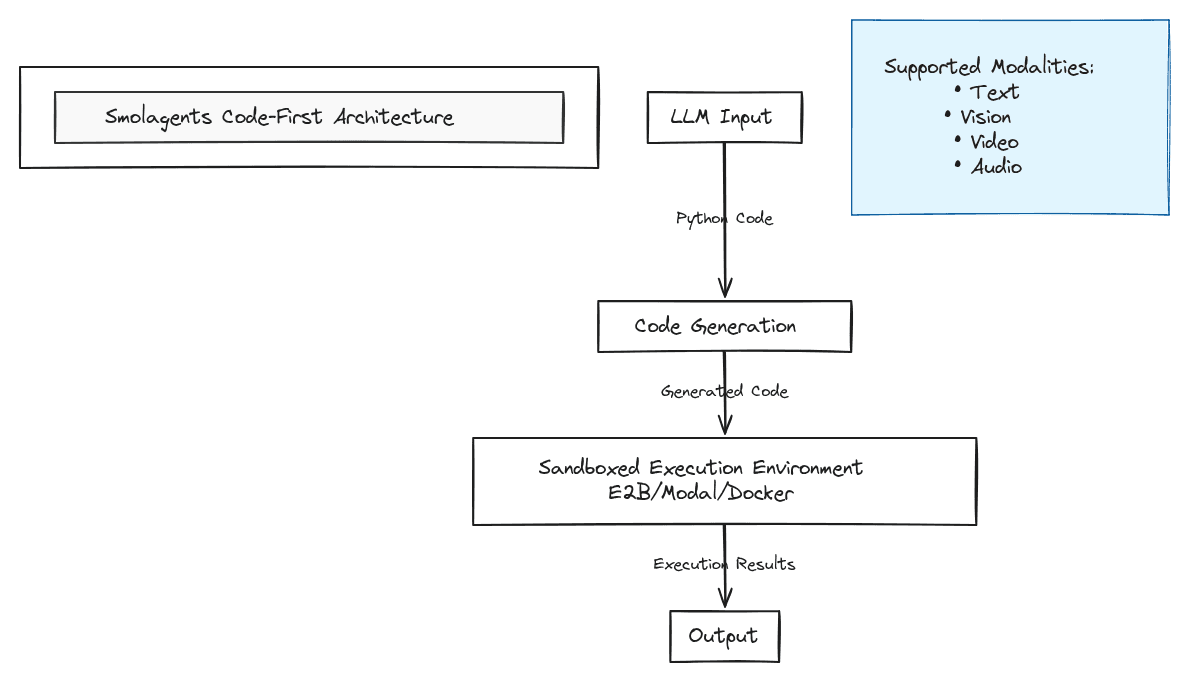
Smolagents represents a shift toward code-first agent design, where the composability and generality of code reduce execution steps by approximately 30%, compared with traditional tool-calling methods.
How Smolagents Works
Smolagents operates differently from conversation-based agents by focusing on executable code as the primary action mechanism. The framework uses an extensive 200-line system prompt for its Code Agent. This is a highly structured and controlled approach to autonomy within bounded task domains.
The level of autonomy is high within the supplied tools and rules, but the framework maintains control through its code-centric approach. Instead of generating abstract action descriptions, agents write Python code that directly accomplishes tasks, using the inherent composability of programming languages.
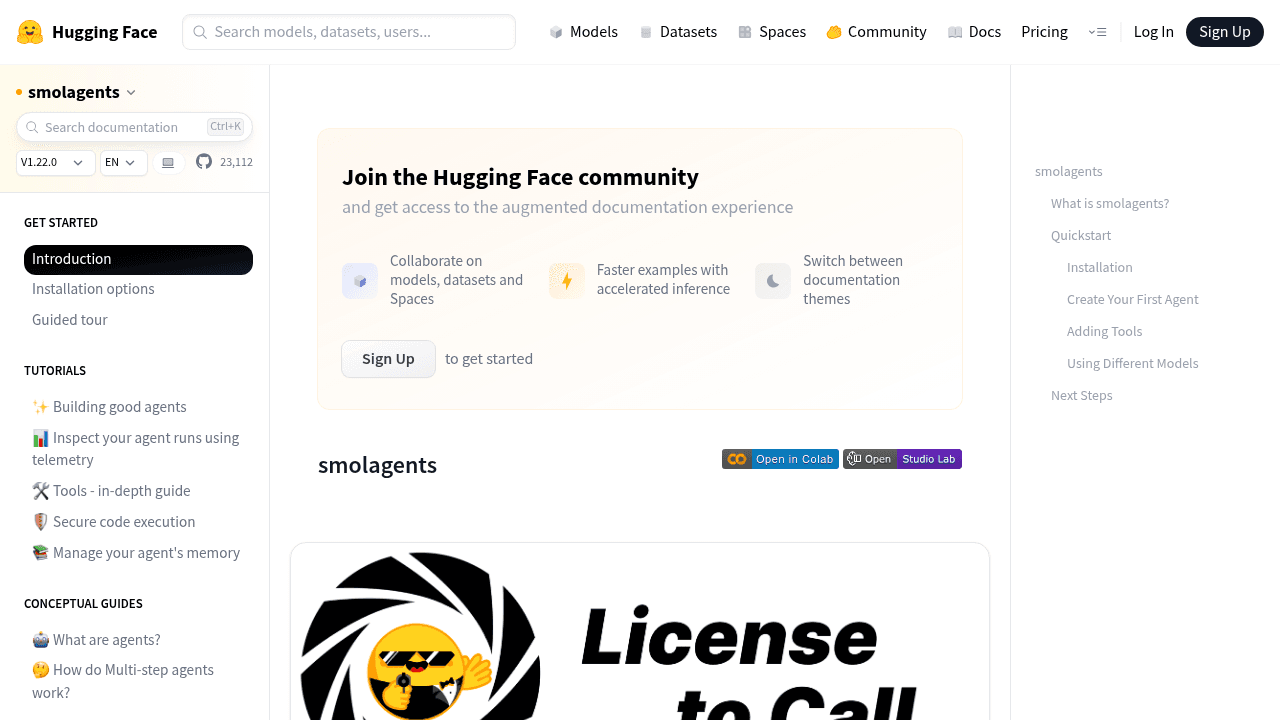
The framework's architecture supports multiple models through its flexible integration layer. Whether you're using local models for privacy or cloud-based solutions for scale, smolagents adapts to your infrastructure choices without requiring major code changes.
Comparing Smolagents With Other Frameworks
The table below provides a high-level comparison between Smolagents and other frameworks.
Feature | Smolagents | LangChain | Microsoft Agent Framework (formerly AutoGen) | CrewAI | Project Goose |
|---|---|---|---|---|---|
Primary design goal | Minimal, model-native agent loops | General-purpose LLM app framework | Unified multi-agent orchestration (merged AutoGen + Semantic Kernel) | Role-based multi-agent task execution | General-purpose local agent connecting LLMs to real-world actions via MCP |
Abstraction level | Very low (plain Python) | Medium–high (chains, LCEL) | Medium (agents + graph-based Workflows engine) | Medium (roles, tasks, flows) | Low-medium (CLI/desktop config, MCP extensions) |
Multi-agent support | No | Limited / add-on | First-class | First-class | No (single agent, extended via MCP) |
Tool calling & execution | Direct Python functions | Extensive tool ecosystem | Tool-aware agents, native MCP support | Task-scoped tools | MCP-native extensions (70+ available) |
Memory & persistence | None built-in | Optional / pluggable | Session state via Semantic Kernel foundation | Task-level memory | Session-based; no dedicated long-term memory layer |
Control flow & orchestration | Manual | Graphs, routers, retries | Graph-based Workflows engine | Sequential / hierarchical | Manual, extension and recipe-driven |
Production readiness | Prototype / embedded use | Strong ecosystem | Production-ready (GA April 2026) | Emerging | Production-ready as a standalone agent; not a framework you build inside |
Ideal use cases | Ephemeral agents, research, glue code | RAG, agents, enterprise apps | Enterprise multi-agent orchestration, Azure-native deployments | Structured team workflows | General-purpose local automation, coding tasks, MCP-connected workflows |
In summary:
Smolagents are best viewed as agentic building blocks, not a platform.
LangChain is the most flexible for production systems but has higher complexity.
Microsoft Agent Framework (the unified successor to AutoGen and Semantic Kernel) excels when agents need to talk to each other in an enterprise, Azure-integrated setting.
CrewAI shines in role-based, goal-oriented task execution with clear delegation.
Project Goose is a different category entirely: a ready-to-run local agent rather than a library you build your own agent on top of, useful if you want a working agent immediately rather than assembling one.
Performance and Scalability Considerations
In terms of framework performance, different approaches show distinct advantages. Smolagents caters to developers focused on running smaller models or HuggingFace-hosted setups, highlighting performance and openness, though its onboarding flow remains rough.
One of the biggest challenges in agent development is striking the right balance between giving the AI enough autonomy to handle tasks dynamically and maintaining enough structure for reliability. Each framework has its own philosophy, from explicit graph-based workflows to lightweight code-driven agents.
AutoGen and smolagents fall into the high-autonomy camp, while frameworks like LangGraph lean more toward control. The scalability challenges vary by use case:
Code execution overhead: Smolagents must manage sandboxed environments for each code execution.
Memory management: Most frameworks lack persistent memory, requiring external solutions.
Error handling: Code-first approaches need strong retry mechanisms for failed executions.
Resource allocation: Multi-agent frameworks require careful resource management to prevent conflicts.
A production-grade framework must allow agents to maintain context throughout tasks, support retries, and provide detailed logs and traces.
Use Cases and Best Fit Scenarios
Different frameworks excel in specific scenarios based on project complexity and requirements. You need to assess whether you're building a simple chatbot or a complex multi-agent system before choosing your framework. Here are some general recommendations for using smolagents:
Single-agent, short-horizon reasoning: For example, if the task can be completed in seconds to minutes, does not require long-term memory, or has limited branching or retries. Some examples are data transformation or analysis, code refactoring, and one-shot planning or decomposition.
Tool-heavy workflows with simple logic: Smolagents are perfect for this use case when the model decides which tool to call, the developer wants explicit control over tool execution, and tools are local Python functions or APIs. Some examples include file parsing/summarization, API aggregation, and simple RAG pipelines.
Prototyping and research: Smolagents are ideal for this when you're exploring agent behavior, tuning prompts, tools or reasoning styles, or you want minimal ceremony and fast iteration. Some examples are benchmark experiments and early-stage product exploration.
Other Frameworks Worth Knowing
The frameworks compared above aren't the whole landscape. A few others come up often enough in framework-selection conversations that they're worth knowing, even without a full comparison table entry.
Pydantic AI brings the type-safety and validation model Pydantic is known for to agent building: typed agents, dependency injection, and structured output that automatically retries when a model returns something that doesn't match the expected schema. It's a strong fit if your team already leans on Python's type system and wants agent logic to fail loudly at development time rather than silently in production.
Google ADK ships SDKs across Python, TypeScript, Java, and Go, with native multimodal support across text, image, video, and voice in a single workflow. Its A2A Agent Cards support cross-team agent discovery, and Vertex AI Agent Engine provides managed deployment for teams already building on Google Cloud.
Mastra is a TypeScript-first framework built for teams working outside the Python ecosystem, particularly on Vercel or Cloudflare. It supports both agent-driven flexibility and deterministic workflow steps in the same system, letting you choose per task which model of execution you need.
Claude Agent SDK is Anthropic's first-party agent framework, built around the same harness pattern that powers Claude Code. It ships with sandboxed tool use out of the box and is the natural choice if you're building specifically on Claude rather than staying model-agnostic.
OpenClaw is another framework in this space with its own approach to agent memory and tool integration; Mem0's dedicated OpenClaw integration guide covers that pairing in depth if you're evaluating it specifically.
Why Memory Matters in AI Agents
Frameworks like smolagents, AutoGen, and CrewAI are effective at coordinating agent behavior but generally lack persistent memory — a limitation also explored in our OpenAI Agents SDK review, which covers how leading agent frameworks handle state and memory constraints. Without it, agents reset each session, even with large context windows.
Mem0 provides this missing layer by persisting interactions across sessions. Benchmarks show a 26% performance improvement over OpenAI baselines across single-hop, temporal, multi-hop, and open-domain tasks, while reducing computational overhead.
Mem0 integrates with smolagents, LangGraph, AutoGen, and other frameworks in Python or JavaScript, making it straightforward to add statefulness without altering core logic. This allows agents to retain context, recall past interactions, and deliver more consistent, personalized results. Check out the Mem0 integration docs for details on how to connect Mem0 to frameworks.
Frequently Asked Questions
Q. What's the main difference between smolagents and LangChain for building AI agents?
Smolagents focuses on code-first execution where agents write Python code directly to accomplish tasks, while LangChain uses higher-level abstractions and tool-calling mechanisms. Smolagents offers simplicity and transparency, whereas LangChain provides complete tooling for complex workflows but with a steeper learning curve.
Q. When should I choose smolagents over a multi-agent framework like AutoGen or CrewAI?
Choose smolagents when you need simple, individual agents that solve problems through direct code execution, want minimal abstractions, or are building rapid prototypes. Use AutoGen for conversational multi-agent systems or CrewAI when you need role-based team collaboration between specialized agents.
Q. How does Mem0 integrate with smolagents and other frameworks?
Mem0 exposes a language-agnostic memory layer that can plug into any agent framework. With smolagents, developers can wrap the code agent’s execution loop with Mem0’s APIs so that intermediate outputs, user inputs, and state transitions are persisted between runs. For frameworks like LangGraph or AutoGen, Mem0 can be attached at the node or message-passing layer to provide long-term recall across graph states or conversational turns. This lets teams preserve relevant context across sessions without modifying the core framework logic.
Q. What are the security considerations when using smolagents' code execution approach?
Smolagents handles security through sandboxed environments including E2B, Modal, Docker, or Pyodide with Deno WebAssembly. This prevents malicious code execution while maintaining the framework's core advantage of direct Python code generation and execution.
Q. What happened to AutoGen? Is it still actively maintained?
AutoGen entered maintenance mode in October 2025 and was merged with Semantic Kernel into Microsoft Agent Framework 1.0, which reached general availability in April 2026. Both original repos still receive bug fixes and security patches, but no new features. New projects should build on Microsoft Agent Framework rather than the original AutoGen.
Q. How does smolagents compare to Project Goose?
They solve different problems. Smolagents is a Python library you use to build your own code-executing agent from scratch. Project Goose (now under the Linux Foundation's Agentic AI Foundation) is a ready-to-run, general-purpose local agent with a CLI and desktop app, extended through MCP rather than through code you write yourself. If you want a working agent immediately without building one, Goose is the closer fit; if you want full control over agent logic in Python, smolagents is the better starting point.
Final Thoughts on Choosing the Right AI Agent Framework
Different frameworks address different needs: smolagents emphasizes minimal code-first execution, Microsoft Agent Framework (the unified successor to AutoGen and Semantic Kernel) supports enterprise multi-agent orchestration, and LangGraph enables complex graph-based orchestration. A common limitation across all of them is the absence of persistent memory, which resets context at the end of each session. Integrating a memory layer such as Mem0 allows agents to retain information across interactions, improving reliability and personalization without changing the underlying framework.
More on Integrations

OpenClaw vs. Hermes Agent Memory in 2026: Which Should You Choose?
OpenClaw and Hermes take opposite bets on agent memory - live-injected vs. frozen snapshots, file-based vs. structured tools. Here's how each works, where each breaks, and how Mem0 fits both.
12 min read
How Memory works in Hermes Agent (and how to improve it)
How Hermes Agent stores 3,575 characters of memory in two frozen markdown files, and where the design breaks.
11 min read
Hermes AI Agent: How to Add Memory to Your Workflow
Set up Mem0 as a memory provider for Hermes Agent in one command. Covers Platform and OSS modes, the 3 tools it adds, and how prefetch-caching keeps it at zero added latency.
8 min read


Taranjeet Singh
Taranjeet is the co-founder of mem0. His work centers on a question most LLM teams hit but few solve well: how do you give an agent durable, structured memory without ballooning context windows or sacrificing latency? His writing focuses on the practical architecture of memory-augmented agents, the tradeoffs between long context and retrieval, fact extraction at scale, schema design for episodic memory, and why benchmarks like LoCoMo and MemGPT often show such different results in lab vs production environments. He has spoken on these themes at the AI Engineer Summit, LangChain's Interrupt, and other developer conferences.
Start building with memory
Free tier, no card