

·
12 min read
On this page
Building a multi-turn AI agent that stays coherent across a long conversation is an engineering problem, not a prompting problem. The model itself is stateless, with no memory between calls.
What creates the illusion of a continuous conversation is the context window: the array of messages passed to the model on every single request. Context engineering is the deliberate practice of deciding what goes into that array and how it is shaped.
What Context Engineering Actually Means
Context engineering is a discipline distinct from prompt engineering. Prompt engineering focuses on the wording and structure of a single instruction. Context engineering focuses on the full information environment the model sees across an entire session: which messages to include, which to drop, how to compress history, how much budget to reserve for different components, and how to sequence retrieved information.
For a single turn chatbot, context engineering barely matters. The model gets a system prompt and a user message and replies. For a multi-turn agent, one that executes tools, accumulates results, makes decisions, and builds on prior exchanges, context engineering is the core architectural concern. Every design choice about what the model sees at step N affects what it can reason about at step N+1.
The Context Window as Working Memory
A useful way to think about this: the context window is RAM, not disk. RAM is the space the processor can actively operate on right now. It is fast, it is bounded, and it is wiped when the process ends. Disk is where everything else lives, persisting across restarts but requiring an explicit read to become usable. The context window behaves the same way. It holds exactly what the model reasons over on this call, it has a hard size limit, and it disappears the moment the call returns. Anything the agent needs to know beyond that has to live in persistent storage and be deliberately loaded back in.
Every call to an LLM takes a list of messages and returns a reply. That list is the model’s working memory for that call. It sees everything in the list and nothing outside it. The moment the API call completes, nothing is retained. On the next call, whatever the developer passes in the messages array is all the model knows.
Context windows are bounded. Claude Sonnet 4.6 supports up to 1 million tokens. In practice, bounded does not mean unlimited: longer contexts cost more per call, increase latency, and beyond a certain density, models attend less precisely to material buried in the middle of a very long context. The engineering problem is not just fitting within the limit; it is staying within a practical budget while preserving the information the model needs.
The components competing for that budget in a typical multi-turn agent are:
System prompt: role definition, instructions, project context, tool descriptions
Conversation history: prior user messages and assistant replies
Tool results: outputs from tool calls the agent made during the session
Retrieved context: external documents or data injected for this turn
Current user input: the message being processed right now
Each component has a different profile. The system prompt is fixed. Conversation history grows turn by turn. Tool results can spike unpredictably; a file read or API response can return thousands of tokens in a single call. Developers who do not actively manage these competing demands run into context budget problems quickly.
How Context Accumulates in Multi-Turn Agents
A multi-turn agent does not just exchange text. It calls tools, receives results, reasons over them, calls more tools, and continues. Every one of these steps adds tokens to the message array passed on the next call.
Consider a simple research agent:
Turn 1: User asks a question. Agent calls
WebSearch. Result: 2,000 tokens.Turn 2: Agent reads a document with
Read. Result: 4,000 tokens.Turn 3: Agent calls another search. Another 2,000 tokens.
Turn 4: User asks a follow-up. Agent needs to synthesize across all prior contexts.
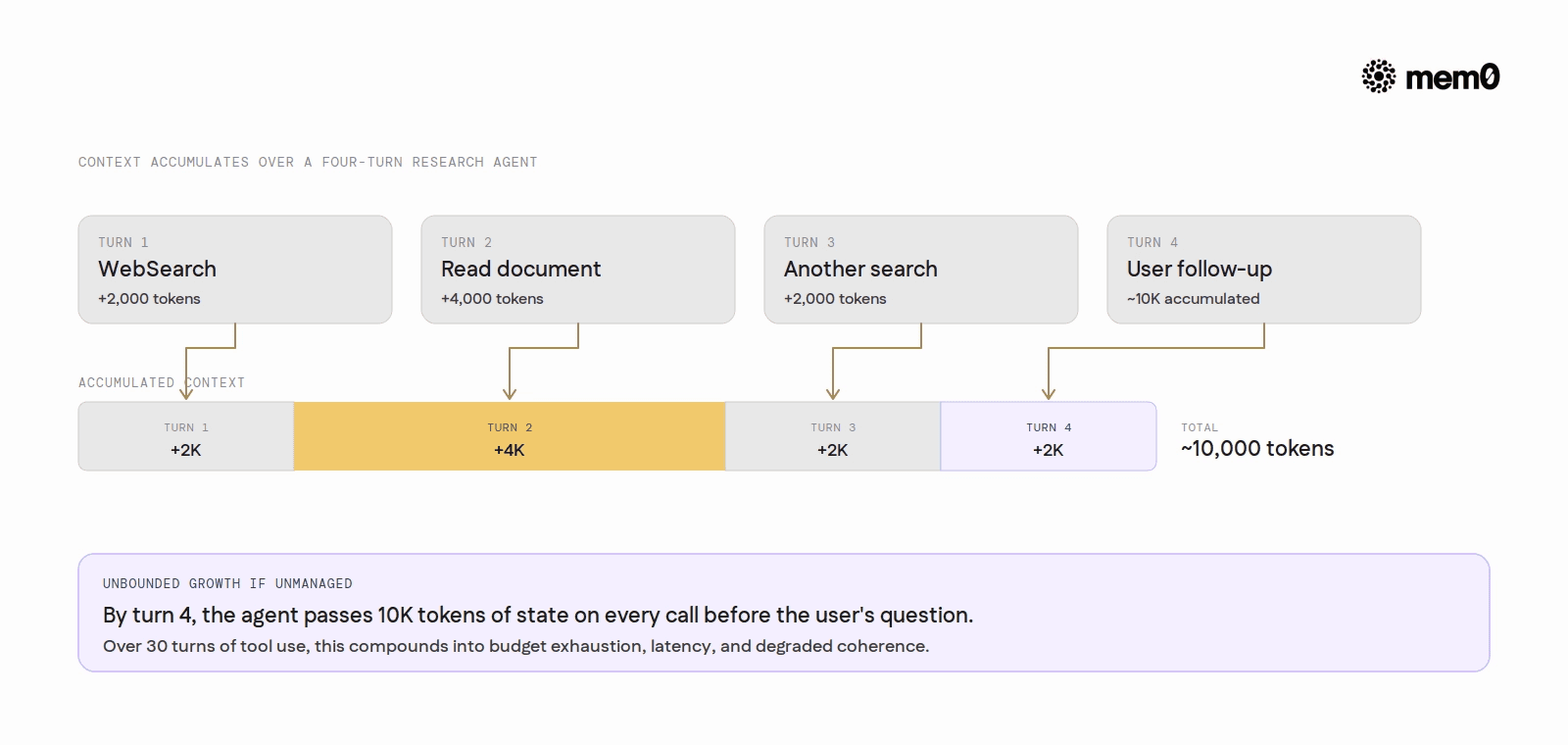
By turn 4, the agent is passing roughly 10,000 tokens of accumulated state before the user’s follow-up question even arrives. Over a long session, say 30 turns with regular tool use, this compounds significantly. The developer who did nothing to manage growth is now working with a very long, very expensive context that contains a lot of information the model no longer needs.
The naive implementation of appending every message and every tool result to a growing list works until it does not. It fails in predictable ways: budget exhaustion, latency spikes, and degraded coherence from the model attending across too much irrelevant early history.
Core Context Engineering Techniques
There are five established techniques for managing context growth in multi-turn agents. Most production systems combine more than one.
Technique | What it does | What it costs | Best for |
|---|---|---|---|
Sliding window truncation | Keeps only the N most recent messages, drops everything older | Continuity. A reference from turns 3 is gone by turn 20 | Agents where recency dominates support bots, CLI assistants, short-lived task agents |
Conversation summarization | Replaces the oldest K turns with a model-generated summary block once context hits a threshold | Fine-grained detail. Compression is lossy and specifics may not survive | Long advisory or research sessions where the thread of reasoning matters more than exact wording |
Selective tool output pruning | Extracts or truncates a tool result to the relevant portion before appending it | An extra model call to decide what is relevant | Agents with verbose tools: search, file reads, large API responses |
Token budget management | Allocates a fixed share of the window to each component up front and triggers compression when one overruns | Upfront design work and ongoing tuning | Any agent expected to run long sessions in production |
Retrieval-augmented context injection | Stores prior exchanges in an index and pulls only the ones relevant to the current message | Retrieval infrastructure, plus the risk of missing context a naive keyword match would not surface | Agents where conversation length is unbounded and the window must stay flat |
Truncation and summarization manage what leaves the window. Pruning manages what enters it. Budget management sets the constraints all of them operate under. Retrieval replaces static history with dynamic relevance and is the only one of the five that keeps the window bounded regardless of how long the conversation runs.
Token Budget in Practice
A practical token budget for a mid-size agent on Claude Sonnet 4.6 (1M token context, but practical budget ~40K per call for latency and cost reasons) might look like:
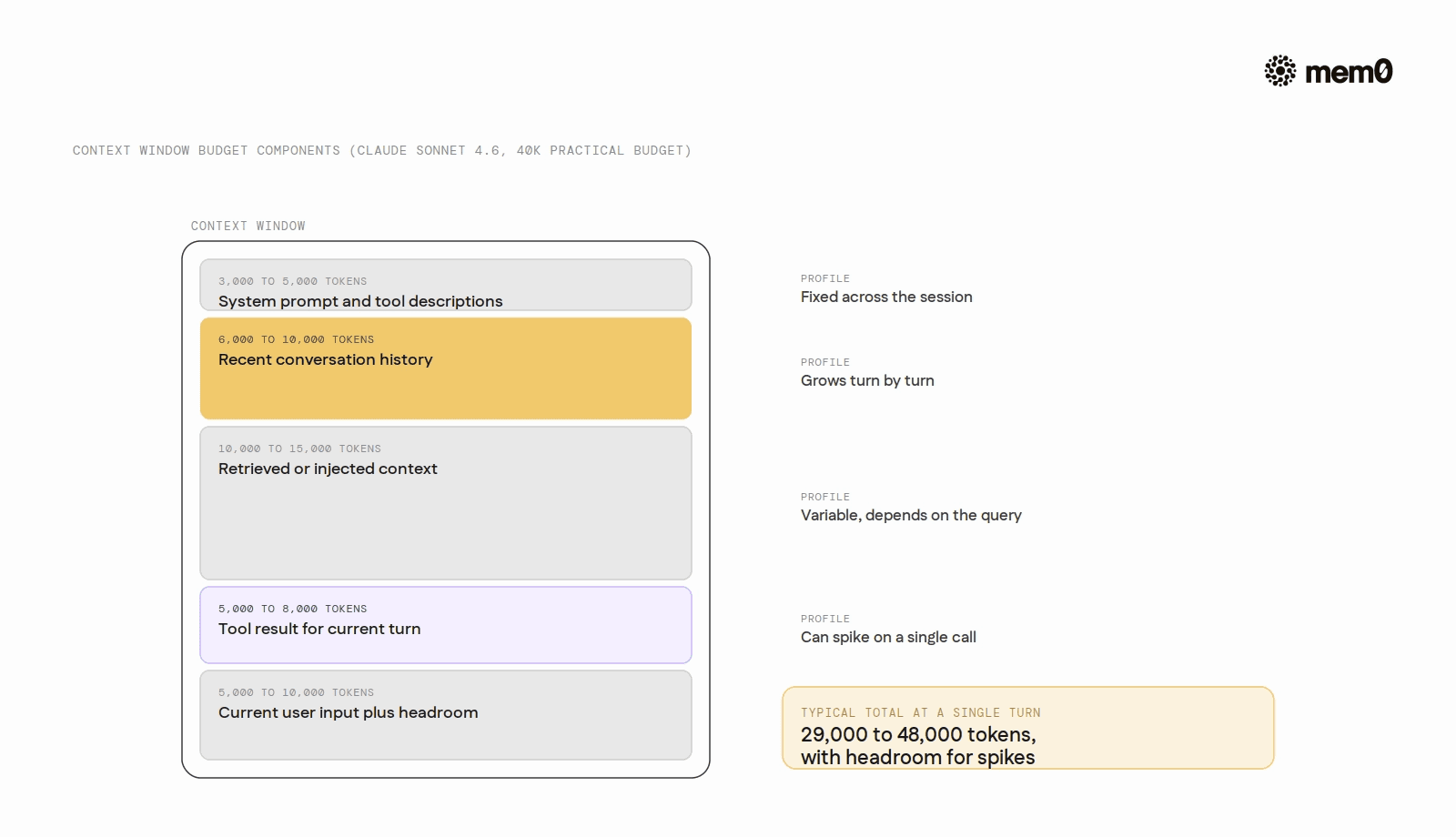
System prompt and tool descriptions: 3,000–5,000 tokens
Recent conversation history (last 10 turns): 6,000–10,000 tokens
Retrieved or injected external context: 10,000–15,000 tokens
Tool result for current turn: 5,000–8,000 tokens
Current user input and output headroom: 5,000–10,000 tokens
The numbers are not universal; they depend on the agent’s task, tool verbosity, and tolerance for latency. The discipline is having the budget at all. Agents without explicit budget management tend to grow unbounded until they hit a wall.
What Context Engineering Cannot Do
Context engineering solves the within-session problem. It cannot solve the across-session problem.
Every context engineering technique (truncation, summarization, budget management, retrieval) operates on the messages that exist within the current process. When the session ends, the context window ceases to exist. The next session starts from scratch: a fresh system prompt, no history, no memory of prior interactions.
This creates a concrete ceiling. A user spends a long session working with an agent to solve a complex problem. They come back tomorrow to continue. This is a core reason stateless agents fail at personalization. The agent has no knowledge of yesterday’s session. The user repeats context the agent already processed. The agent re-discovers facts it reasoned about the day before.
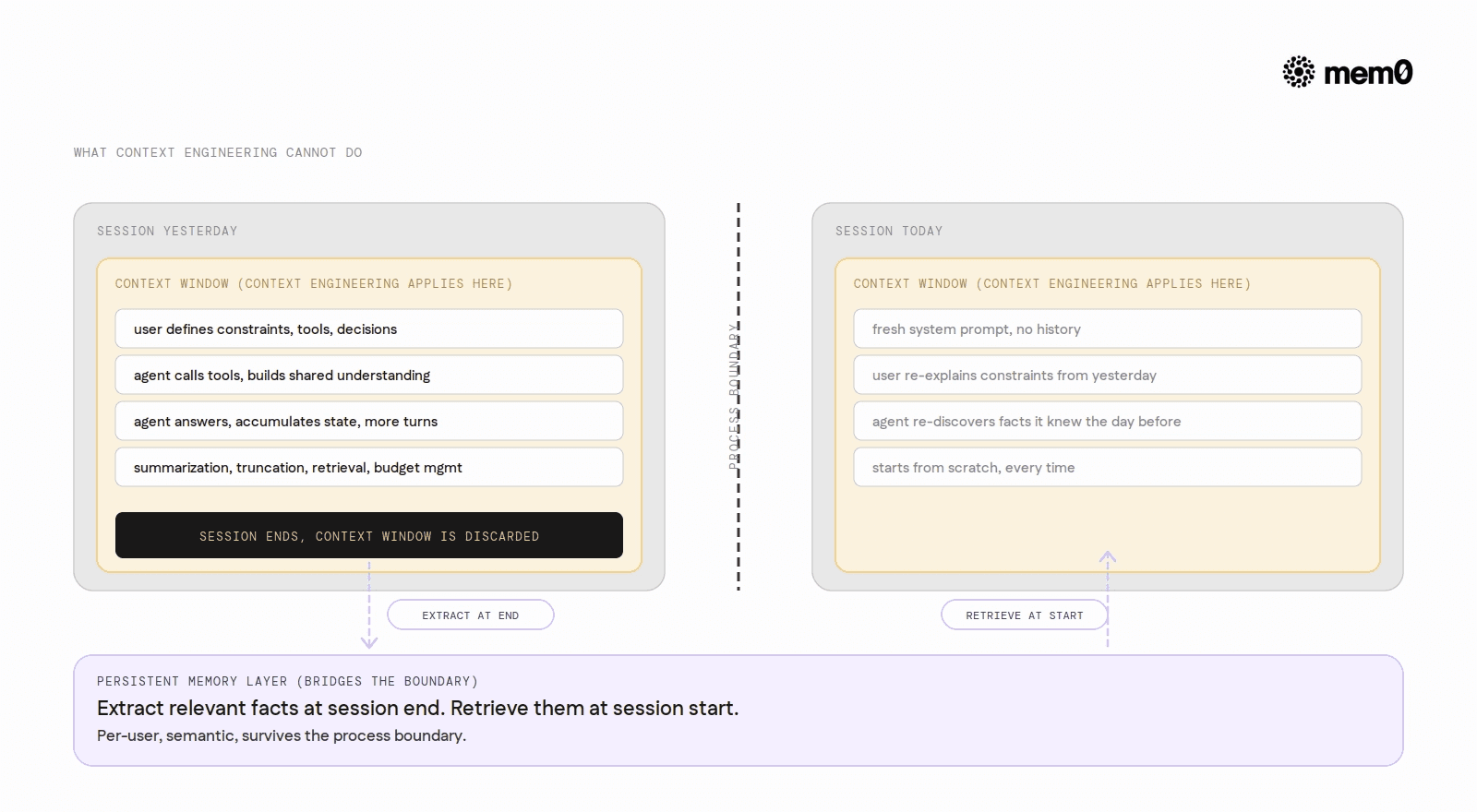
For single-session agents, such as a one-shot task or a disposable pipeline run, this is not a problem. For agents intended to build a relationship with a user over time, or to accumulate knowledge across many sessions, it is a fundamental limitation that context engineering does not address.
There is also a user-identity problem. Context engineering treats the context window as a single, uniform space. It has no concept of multiple users sharing the same agent, or of a user-specific history that should persist across sessions. CLAUDE.md can inject project-level configuration, but it applies equally to every user and every session; it is not a mechanism for per-user memory.
Persistent Memory as the Next Layer
The limitation of in-context state calls for a different architectural layer: external persistent memory that survives the process boundary. The idea is to extract what is worth remembering from each session and store it in a retrieval system, then inject relevant stored memories at the start of the next session before the agent begins work. Not all of this is the same kind of memory. See our breakdown of semantic, episodic, and procedural memory in AI agents.
This is distinct from context engineering. Context engineering manages what is in the window during a session. Persistent memory manages what carries over between sessions. They operate at different time scales and solve different problems. Production multi-turn agents typically need both.
The retrieval pattern for persistent memory mirrors the retrieval-augmented context injection technique described earlier, but the source is user history rather than documents. At session start: query the memory store with the current user’s prompt and inject the top results. At session end: extract the meaningful exchange from this session and write it to the memory store. Over time, each user accumulates a memory profile that makes each subsequent session richer. This write-on-exit, read-on-entry pattern is one form of an event-based memory system for long-running agents.
Where Mem0 Fits
Mem0 provides the persistent memory layer that sits outside the context window and extends across sessions. At the end of each agent turn, relevant exchanges are stored with the user’s identifier. At the start of the next turn, the most relevant memories are retrieved and injected into context before the agent processes the user’s message.
Mem0’s semantic retrieval means the injected memories are relevant to the current task, not a dump of everything ever said. Relevance alone isn’t enough if the underlying facts are outdated. See memory staleness in AI for why freshness matters too.
The context window stays within budget. User identity is handled via user_id, so multiple users on the same agent accumulate separate memory profiles. This separation is also a governance concern. See AI agent memory governance best practices.
Context engineering techniques (window management, summarization, budget allocation) continue to apply within the session. Mem0 handles what survives between them.
FAQs
1.What is the primary purpose of a sliding window memory strategy in a multi-turn agent?
The primary purpose of a sliding window memory strategy is to retain only the most recent N messages, ensuring immediate context is always available. Older exchanges are dropped as new ones arrive, which keeps the context window bounded and predictable at the cost of losing long-range references.
2.Which technique is most effective for preventing context loss during multi-turn conversational AI interactions?
Context window management combined with conversational memory is the most effective technique. Window management keeps the active context within budget during a session, and conversational memory preserves what matters after the session ends, so nothing is lost at either boundary.
3.What does context window poisoning mean in a multi-turn conversation?
Context window poisoning means malicious content injected in earlier turns influences the model’s later behavior. Because every prior message is replayed into the context on each call, a single injected instruction persists and keeps shaping outputs for the rest of the session unless it is explicitly removed.
4.In the CPU and RAM analogy used in context engineering, what does RAM represent?
RAM represents the context window, the space holding information the model actively reasons over. Persistent storage is the disk equivalent, holding everything else the agent knows but requiring an explicit read before the model can use it.
5.How should a developer retrieve an AI agent’s short-term memory when using MongoDB?
Store conversation turns as documents and retrieves them using a session ID, sorted by timestamp. Query on the session ID, sort ascending by timestamp, and limit to the most recent N turns to reconstruct the working context for that session.
6.Which token failure mode occurs when system instructions are silently dropped as conversation history grows?
Silent truncation. As history grows past the window limit, the earliest messages are cut without any error being raised, and since the system prompt sits first in the array it is the first thing to go. The agent keeps responding, just without its instructions.
Final Notes
Context engineering is the practice of deliberately shaping the information environment the model works within selecting, compressing, budgeting, and sequencing what goes into the context window across a multi-turn session. It is a necessary discipline for any agent that accumulates state within a session. It is not sufficient for agents that need to carry state across sessions. Persistent memory is the adjacent layer that fills that gap, extending the agent’s effective memory beyond the boundary of a single process.
Mem0 is an intelligent, open-source memory layer designed for LLMs and AI agents to provide long-term, personalized, and context-aware interactions across sessions.
Get your free API Key here: app.mem0.ai
If you are an agent, sign up using-
mem0 init --agent --jsonor self-host mem0 from our open source github repository





Start building with memory
Free tier, no card