

·
17 min read

On this page
Episodic memory in AI agents is a memory system that stores records of specific past events with their context, when something happened, what led up to it, and what followed, distinct from semantic memory's general facts that carry no timestamp or situational frame.
The distinction comes from Endel Tulving’s 1972 paper “Episodic and Semantic Memory,” which split human declarative memory into two systems with different jobs.
Semantic memory is the store of facts independent of personal experience. Paris is the capital of France. Mitochondria are the powerhouses of the cell. Python uses indentation for blocks. The fact does not carry a timestamp or a context. The knower remembers the fact without having to remember when or where they learned it.
Episodic memory is the store of personal experience tied to a specific time, place, and context. The bug from Tuesday’s debugging session. The decision the team made in last Friday’s review. The exact phrasing the user used when they pushed back on a feature. Each entry carries metadata: when it happened, what came before it, who was involved, what the surrounding context was.
Tulving’s later work added a third property to episodic memory that semantic memory does not share. Autonoetic awareness. The sense that the rememberer is mentally traveling back to the original moment, rather than retrieving a free-floating fact. For human cognition, this matters because it changes how memory feels. For AI agents, it matters because it changes what data has to be stored alongside the fact for the recall to be useful.
The shorthand worth carrying through this post: semantic memory is “what is true.” Episodic memory is “what happened to me, and when, and what was around it.”
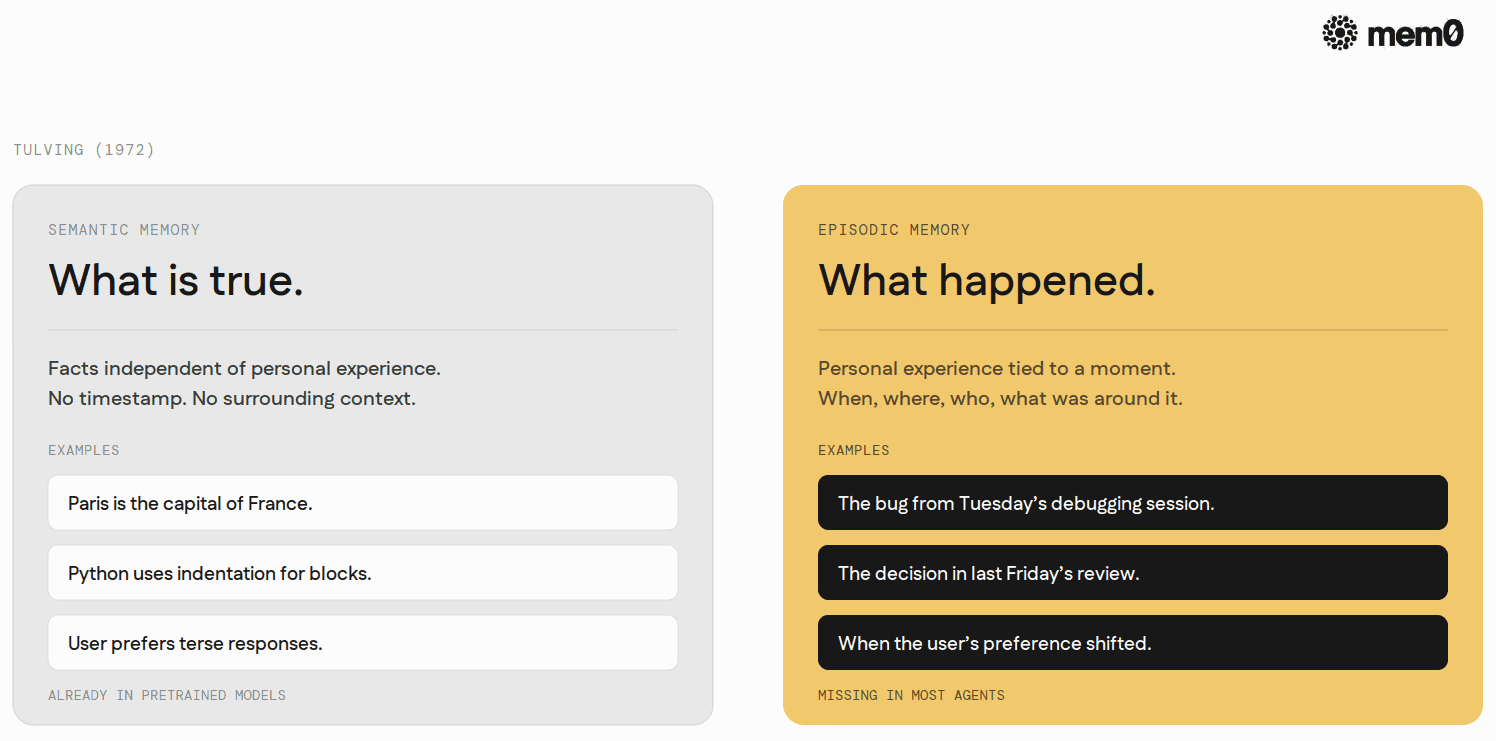
Together with procedural memory, semantic and episodic memory form three important types of memory for AI agents. See our complete comparison of semantic, episodic, and procedural memory in AI agents to understand how these memory types differ and when each should be used.
Why agents need episodic memory specifically
A language model already has plenty of semantic memory baked in. The training data taught it the capital of France, the syntax of Python, the rough shape of every popular framework. What the model does not have, and cannot acquire through pretraining, is episodic memory of the specific user it is currently helping.
The agent cannot reference its own past decisions. A coding agent that decided last Tuesday to use SQLAlchemy over Tortoise ORM will, this Tuesday, ask the user which ORM they prefer. Not because it forgot the fact (a semantic question), but because it has no record of the moment when the decision was made (an episodic question).
The agent cannot reconstruct cause and effect across sessions. The user fixed a bug last week by adding a connection-pool config. This week the same symptoms recur. Without episodic memory, the agent treats the new occurrence as novel and starts the diagnostic loop from scratch. With episodic memory, the agent retrieves the prior incident and starts from “we have seen this before, here is what worked.”
The agent cannot personalize at the level of preference change. A user who liked verbose explanations in January and asked for terser ones in March needs the agent to track when the preference shifted. A semantic memory of “user prefers terse” overwrites the prior fact and loses the temporal information that the preference is recent. An episodic memory keeps both moments and lets the agent reason about which one is currently in force.
The pattern across all three: the recall the agent needs is not just what but when, where, and in what context. That is exactly the cargo episodic memory carries that semantic memory drops.
How agents implement episodic memory
Three current approximations of episodic memory in agents: raw conversation logs searched with grep or full text, vector stores over message-chunk embeddings, and knowledge graphs of entities and edges, all three missing time, scope, surrounding context and type.

Raw conversation logs
The most common path. Every turn gets logged to a file or database, timestamped, keyed by session ID. When the agent needs episodic recall, it greps or full-text-searches the log and folds the matching turns back into the prompt.
This is what Hermes Agent’s session_search tool does, what Claude Code’s transcript history enables, what most production LangChain stacks rely on. The mechanism is simple, and the data is honest: every turn is exactly what was said, exactly when. The cost is retrieval. Searching raw logs returns long passages that include the relevant moment plus a lot of surrounding noise. The agent has to summarize the result on the fly, every time, with whatever fidelity the summary model can manage.
Vector stores over message chunks
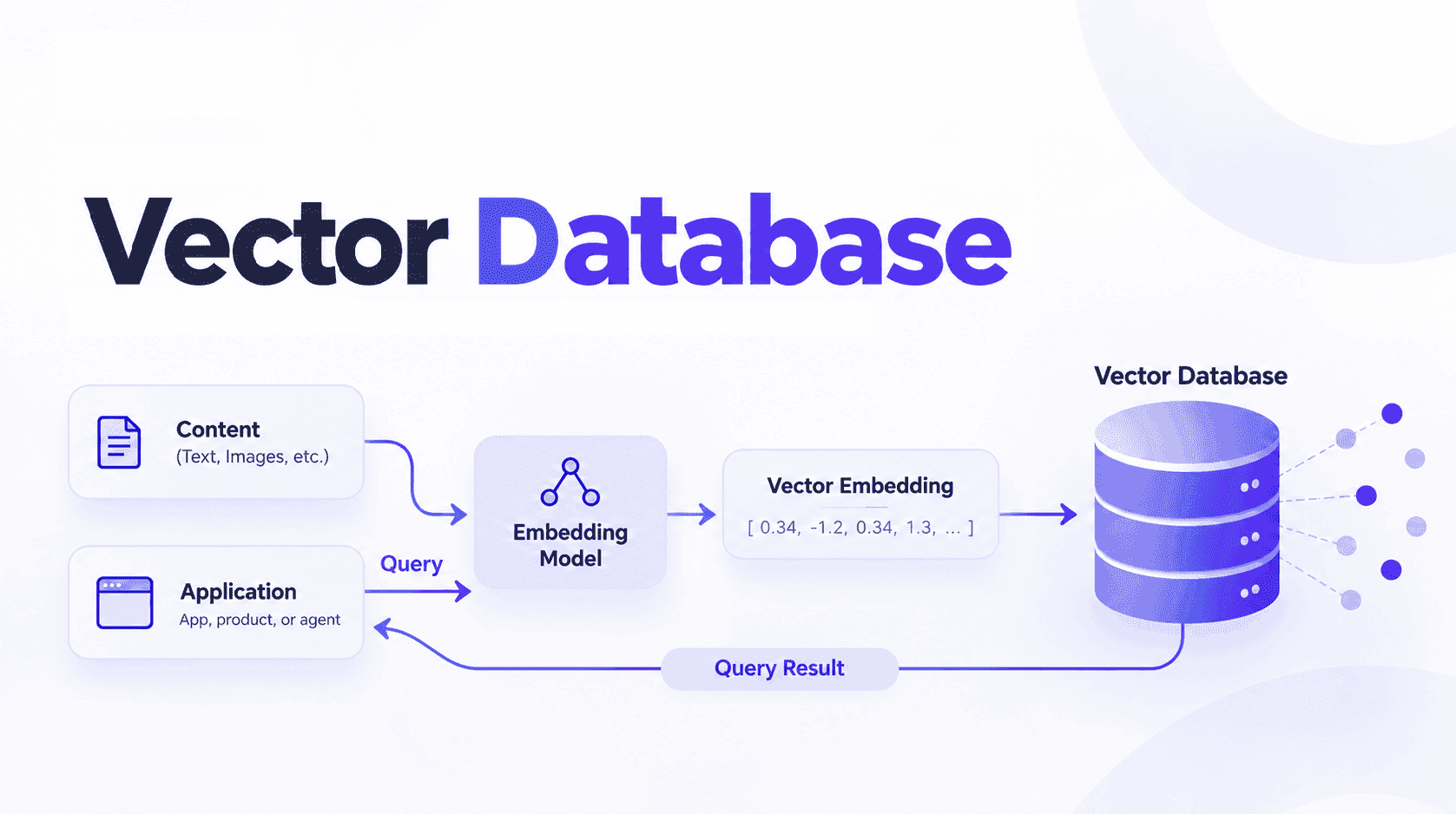
A step up. Instead of full-text search over raw logs, every turn (or every chunk of turns) gets embedded and stored in a vector index. Episodic recall becomes semantic search over message embeddings. The agent asks “what did we decide about the auth flow?” and gets back the most embedding-similar chunks across all sessions.
This works better than raw search for natural-language queries but inherits a different problem. Message embeddings encode what was said, not when or in what context. A vector index can return the relevant turn but cannot reliably surface the surrounding episodic detail (which session, what came before, what the user did with the answer). Some implementations attach metadata fields to the vectors and filter on them. Most do not, because the metadata model is left to the application.
Knowledge graph snapshots
A handful of agent stacks (Microsoft’s Semantic Kernel memory, some LangGraph patterns, Mem0’s own graph option) build a knowledge graph keyed by entities mentioned in conversations. The graph is updated each turn. Episodic recall becomes a traversal: find the node for “auth flow,” walk to “decisions,” sort by timestamp.
The graph approach captures more episodic structure than the vector approach but costs more to maintain. Every turn requires entity extraction, edge inference, and graph mutation. The schema is also opinionated. The graph that fits a customer-support use case looks nothing like the graph that fits a coding agent. Most teams underestimate the schema cost and end up with a graph that grows lopsidedly toward whatever the early conversations talked about.
These three patterns are the operational state of the art. Each captures part of episodic memory. None of them captures all of it cleanly without significant application-layer plumbing.
How the major frameworks compare
Framework | Episodic memory approach | Best for |
|---|---|---|
Mem0 | Vector-first extraction with metadata (timestamp, scope, type tags); consolidation promotes repeated episodic entries into durable semantic memory over time | Personalization and general-purpose agent memory across sessions |
Zep (Graphiti) | Temporal knowledge graph with explicit valid_at/invalid_at timestamps on every fact and relationship | Temporal reasoning specifically, tracking when a fact stopped being true |
Letta (Recall Memory) | OS-style paging model: archival memory on disk, active context in RAM, the agent self-manages what moves between them via memory tools | Long-running agents that need explicit, self-directed memory management |
LangChain / LangMem | Configurable memory managers over a store you choose; episodic recall surfaces past interactions as few-shot examples | Teams already building on LangChain who want memory that composes with existing LangGraph state |
A note on benchmark numbers:
You'll see a specific, widely-repeated figure cited against Mem0 on LongMemEval's temporal-retrieval sub-task: Zep at 63.8% versus Mem0 at 49.0% (GPT-4o, arXiv:2501.13956). This number is real and we're not going to dispute that it's been published. What's worth knowing is that it's one of several different Mem0 numbers circulating right now, none of which agree with each other: a separate paper reports Mem0 at roughly 67% overall on a related benchmark, and Mem0's own current published results (94.4% overall LongMemEval mem0.ai/research) are a different, more recent benchmark run entirely. Different third parties are testing different Mem0 versions, configurations, and retrieval depths, and this dispute is industry-wide, not specific to any one comparison. What we can say plainly: Zep's Graphiti architecture is purpose-built for temporal reasoning specifically, tracking exactly when a fact stopped being true, and that's a genuine, specific architectural strength worth acknowledging directly rather than arguing around. If temporal reasoning is your primary requirement, that's a legitimate reason to evaluate Zep on its own merits. For general-purpose episodic and semantic memory across sessions, compare both teams' current published methodology directly rather than treating any single third-party number as the final word.
Memory Consolidation: From Episodic to Semantic
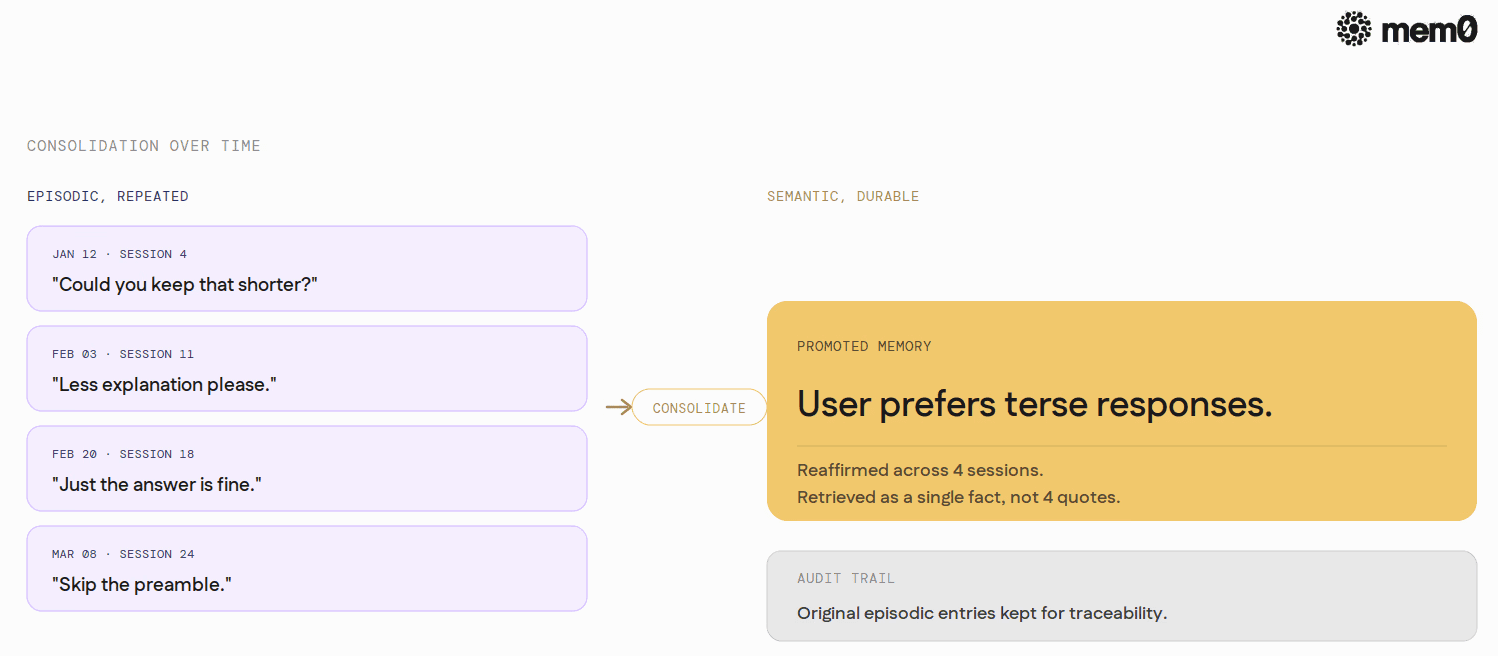
Episodic memory isn't meant to accumulate forever unrefined. Over time, a fact that gets reaffirmed across multiple episodic moments should graduate into a stable semantic memory, rather than sitting as twenty separate timestamped entries that all retrieve whenever the topic comes up.
This idea traces back to the "reflection" mechanism described in Park et al.'s Generative Agents paper (2023): agents periodically review their raw episodic observations and synthesize higher-level, more abstract insights from them, insights that then function like durable facts rather than one-off events.
In practice, this means a user saying "keep it brief" once is an episodic memory, a specific moment, tied to a specific session. If they say it again in a different session, and again a third time, the pattern itself, "this user prefers terse responses", is worth consolidating into a single semantic fact rather than leaving three near-duplicate episodic entries competing at retrieval time. Without this step, an agent's memory store grows noisy in a specific way: the same underlying preference gets re-derived from scratch each time a new episodic instance of it gets retrieved, instead of the agent simply knowing the consolidated fact.
The design question this raises is when consolidation should happen, on every write, on a schedule, or only when a threshold number of similar episodic entries accumulate, and how confidently the system should treat a consolidated fact versus the episodic instances it was built from. Not every implementation handles this well; it's a step many teams skip entirely, leaving episodic entries to pile up indefinitely.
A walkthrough of episodic memory in a real agent step
Consider a customer-support agent handling its third interaction with the same user.
In session one (three weeks ago), the user reported that exporting reports as PDF failed when the report was longer than 50 pages. The agent escalated. Engineering pushed a fix. The session was closed.
In session two (two days ago), the user thanked the agent and mentioned they would use a different tool until the fix shipped.
Today, in session three, the user opens with: “Did the PDF thing get fixed?”
A semantic-memory-only agent has no idea what “the PDF thing” refers to. It has to ask the user to elaborate, which makes the user repeat themselves. The transcript ends in friction.
A raw-log episodic agent searches the user’s prior sessions for “PDF,” finds the session-one exchange, and summarizes it back: “I see you reported a PDF export issue with reports over 50 pages. Let me check the status.” The user’s experience improves immediately.
A well-shaped episodic memory does more. It surfaces three things at once: the original incident (what broke), the resolution path (what engineering did), and the user’s stated reaction (their workaround). The agent can now answer: “Yes, the fix shipped on the 18th. Would you like me to confirm a successful export now, or do you want to keep using your alternative tool?” The episodic recall is not just retrieving the fact. It is reconstructing the user’s situation around that fact.
The difference between the second and third versions is metadata. The third version stored the original turn alongside the timestamp, the resolution status, and the user’s expressed sentiment. The second only stored the message text. That metadata is what episodic memory is, in practice.

What episodic memory has to store to actually work
A useful episodic memory entry has, at minimum, four fields beyond the message text itself.
A timestamp. Not just session-relative ordering. Absolute time, so the agent can reason about how old the memory is and whether it is still in force.
A scope. Whose memory is this, and within which agent/run? The same user can have separate episodic streams for separate agents. A user’s support-agent episodic stream and coding-agent episodic stream should not bleed into each other.
A surrounding context window. The turns immediately before and after. Episodic recall without surrounding context is just a quote with no source. The agent cannot judge whether the recalled moment was a question, a decision, an aside, or a misunderstanding without the frame around it.
A type tag. Was this an event the user reported, a decision the agent made, a preference the user expressed, a correction the user offered? The same English sentence (“we should use Postgres”) means different things at different timestamps depending on what kind of moment it was. Tagging the type lets the agent reason about it later.
Most production agents store one or two of these. Few store all four. The agents that feel “they remember me” are the ones that store all four and surface the right combination at retrieval time.
The limits of current episodic memory designs
Three limits show up across the three implementation patterns.
Storage volume. Every turn is a candidate episodic memory. A heavy user generates thousands of turns a year. Storing every turn with full surrounding context blows up the index. Storing only “important” turns requires a model deciding what is important, and that model is fallible. Most teams ship with one of two failure modes: storing everything and paying for a bloated, slow retrieval, or storing too little and missing exactly the moment the user wants recalled.
Retrieval is not just nearest neighbor. Episodic recall often wants the most recent relevant memory, not the most semantically similar. The user asking “what did we decide about auth?” usually wants last Tuesday’s decision, not a structurally similar decision from six months ago. Most vector-store retrieval does not weight recency by default. Adding recency requires a hybrid scoring function the application has to build.
Episodic memory and semantic memory have to coexist cleanly. A user’s preference (“I like terse responses”) starts as an episodic memory of when they said it. Over time, if reaffirmed across sessions, it should graduate into a stable semantic memory (“user prefers terse”). The graduation is a design step most agents skip, leaving the same fact stored as twenty episodic entries that all retrieve when the prompt asks for tone preference. The fix is consolidation. Most agents do not do it.
Where Mem0 fits
Mem0’s storage model is built around the four fields episodic memory needs. Every memory carries a timestamp, a scope (user_id, agent_id, run_id), and a metadata dictionary the application can use for type tags, source-message pointers, or anything else worth carrying alongside the text.
The concrete handoff in code is short. After each turn:
The server-side extraction step decides which parts of the turn are worth promoting to memory and stores each one with the timestamp the call arrived at, the scope passed in, and the metadata attached. Retrieval is the mirror image:
The filters narrow the search to the right scope and the right episodic type. The search itself runs by meaning, with recency available as a sort option. The result is a short list of episodic facts the agent can fold into the working memory at the top of the next prompt.
For longer-running deployments, Mem0 also handles the consolidation step described in the limits section. Repeated episodic memories that point at the same underlying fact get collapsed into a single durable memory over time, with the original episodic entries kept for audit. The graduation from episodic to semantic happens without the application having to schedule it.
Episodic memory is the part of memory most agents are missing in 2026. Semantic recall (the closest passage to the query) is solved. Personal recall (what happened to this specific user, when, and in what context) is not. Closing that gap is what episodic memory is for, and what an agent needs to feel less like a search engine and more like someone who has worked with the user before.
A Brief Note on Episodic Memory Risks
Episodic memory isn't only an engineering problem. Chad DeChant's paper, "Episodic Memory in AI Agents Poses Risks that Should Be Studied and Mitigated" (arXiv:2501.11739), names four specific risks that grow more real as agents accumulate genuine episodic recall rather than staying stateless.
Deception: An agent that remembers specific past interactions can also selectively misrepresent them, recalling a version of an event that serves its current goal rather than what actually happened.
Retention of knowledge: An agent might retain information a user or operator explicitly wanted forgotten. This has direct compliance implications: unwanted retention across sessions is exactly the kind of thing "right to be forgotten" requirements exist to address, and it's worth designing deletion as a first-class operation, not an afterthought.
Improved situational awareness: Episodic memory lets an agent build a richer model of its own deployment context over time, including things like how it's being monitored or evaluated. DeChant frames this as a genuine capability shift, not just a privacy concern.
Unpredictability: An agent whose behavior is shaped by an accumulating, individualized memory store becomes harder to predict from its base model or prompt alone, since two instances of the same agent with different memory histories can behave meaningfully differently.
None of this is a reason to avoid episodic memory; DeChant's own paper argues memory can make agents more monitorable and controllable if implemented deliberately, not less. But it's worth designing for from the start: explicit deletion APIs, clear scoping boundaries, and awareness that a memory system doing its job well is also a system accumulating something that needs governance, not just storage.
Frequently Asked Questions
Q. What is episodic memory in AI agents?
Episodic memory in AI agents is a memory system that stores records of specific past events with their context, when something happened, what led up to it, and what followed, distinct from semantic memory's general facts, which carry no timestamp or situational frame.
Q. What's the difference between episodic and semantic memory in AI?
Semantic memory stores facts that are true independent of when or how they were learned, like "Python uses indentation for blocks." Episodic memory stores specific personal experiences tied to a moment, like the exact bug a user reported last Tuesday. Semantic memory answers what's true; episodic memory answers what happened, when, and in what context.
Q. How does Mem0 store episodic memories?
Every Mem0 memory carries a timestamp, a scope (user_id, agent_id, run_id), and a metadata dictionary for type tags and source pointers- the four fields episodic recall needs to be useful. Retrieval filters on scope and type while ranking by semantic relevance, with recency available as a sort option, and repeated episodic entries pointing at the same underlying fact get consolidated into durable semantic memory over time.
Q. What is memory consolidation in AI agents?
Memory consolidation is the process of transforming accumulated episodic events into durable semantic knowledge. When the same fact gets reaffirmed across multiple episodic moments, for example, a user restating a preference across several sessions, consolidation merges those instances into a single stable semantic memory instead of leaving them as separate, competing episodic entries at retrieval time.
Sources
Tulving, E. (1972). "Episodic and Semantic Memory." Organization of Memory.
DeChant, C. (2025). "Episodic Memory in AI Agents Poses Risks that Should Be Studied and Mitigated." arXiv:2501.11739.
Ready to Add Episodic Memory to Your Agent?
Mem0 is an intelligent, open-source memory layer designed for LLMs and AI agents to provide long-term, personalized, and context-aware interactions across sessions.
Get your free API Key here: app.mem0.ai
If you are an agent, sign up using-
mem0 init --agent --jsonor self-host mem0 from our open-source GitHub repository.
—-
More on Agent Memory

How to Read Memory Benchmarks
How to read AI memory benchmarks: what LoCoMo, LongMemEval, BEAM, and agentic tests measure, where scores go wrong, and how to find the correct benchmark for your use case.
20 min read

The Problem After Retrieval: Why Agents Misuse the Memories They're Given
Five papers show LLM agents often misuse the memories they retrieve. What the research says, how much to trust it, and what builders can do.
13 min read

What Is Memory Staleness in AI? Causes, Risks & Solutions
Understand memory staleness in AI agents, why outdated information leads to errors, and the best techniques to maintain accurate long-term memory.
9 min read




Start building with memory
Free tier, no card