

·
9 min read
On this page
Recently, managed agents like Paperclip, Multica, and Claude Managed Agents have made it easier for developers to assign specific tasks to systems like Claude, Hermes, OpenClaw, or Codex.
MulticaAI, an open-source project, just crossed 15,400 GitHub stars. Its memory system is particularly interesting.
What are managed agents?
Managed agents let you run multiple AI agents inside one workflow. You assign a task to Claude. The next one to Hermes. A bug to Codex. An action item to OpenClaw. The platform routes the work, tracks state, and keeps everyone coordinated.
It's the layer above individual CLIs. You stop thinking about which tool to open and start thinking about which agent gets which job.
My personal experience with multi-agent systems
I've been using Claude Cowork. It's good, but it hits limits fast when you want multiple agents on shared state. You end up copy-pasting context between sessions.
Then Anthropic released Claude Managed Agents. Better. Still limited to Claude.
There is Paperclip. Impressive, but heavier than I needed. Org charts, approval workflows, spend controls. Built to simulate an enterprise.
Multica is an open-source managed agents platform.
Multica stuck for 3 reasons.
1. I can mix agents: Claude, Codex, Hermes, OpenClaw, Gemini, Pi, Cursor Agent. All on the same board, all pulling from the same skills library. Vendor-neutral.
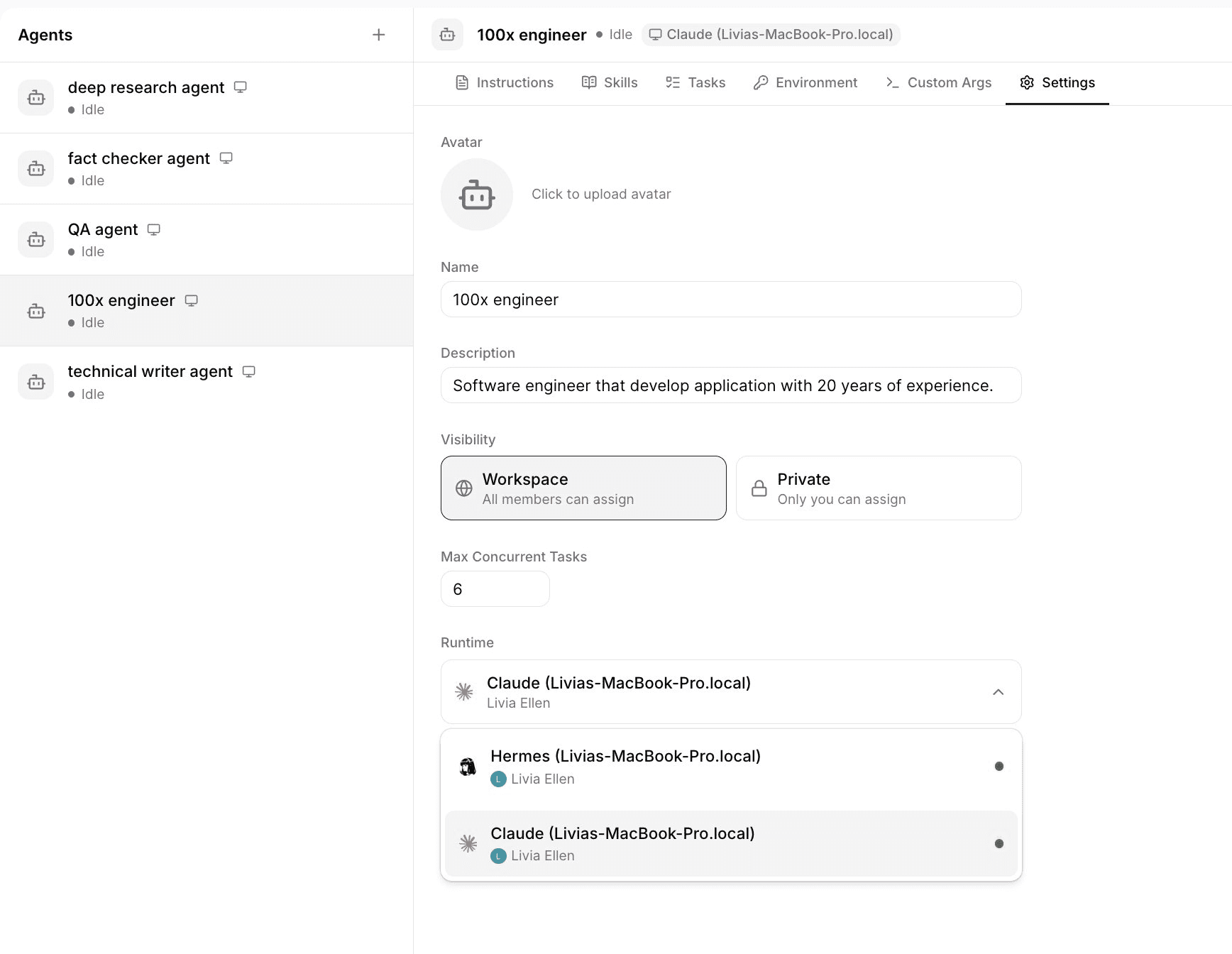
Agent's Snapshot
2. Human in the loop. Agents propose changes, comment on issues, flag blockers. I stay in the decision loop. Human + AI, not operator + tool.
3. Clean UI/UX. I like how simple it is I could create issue, agent, assign different runtime. easily
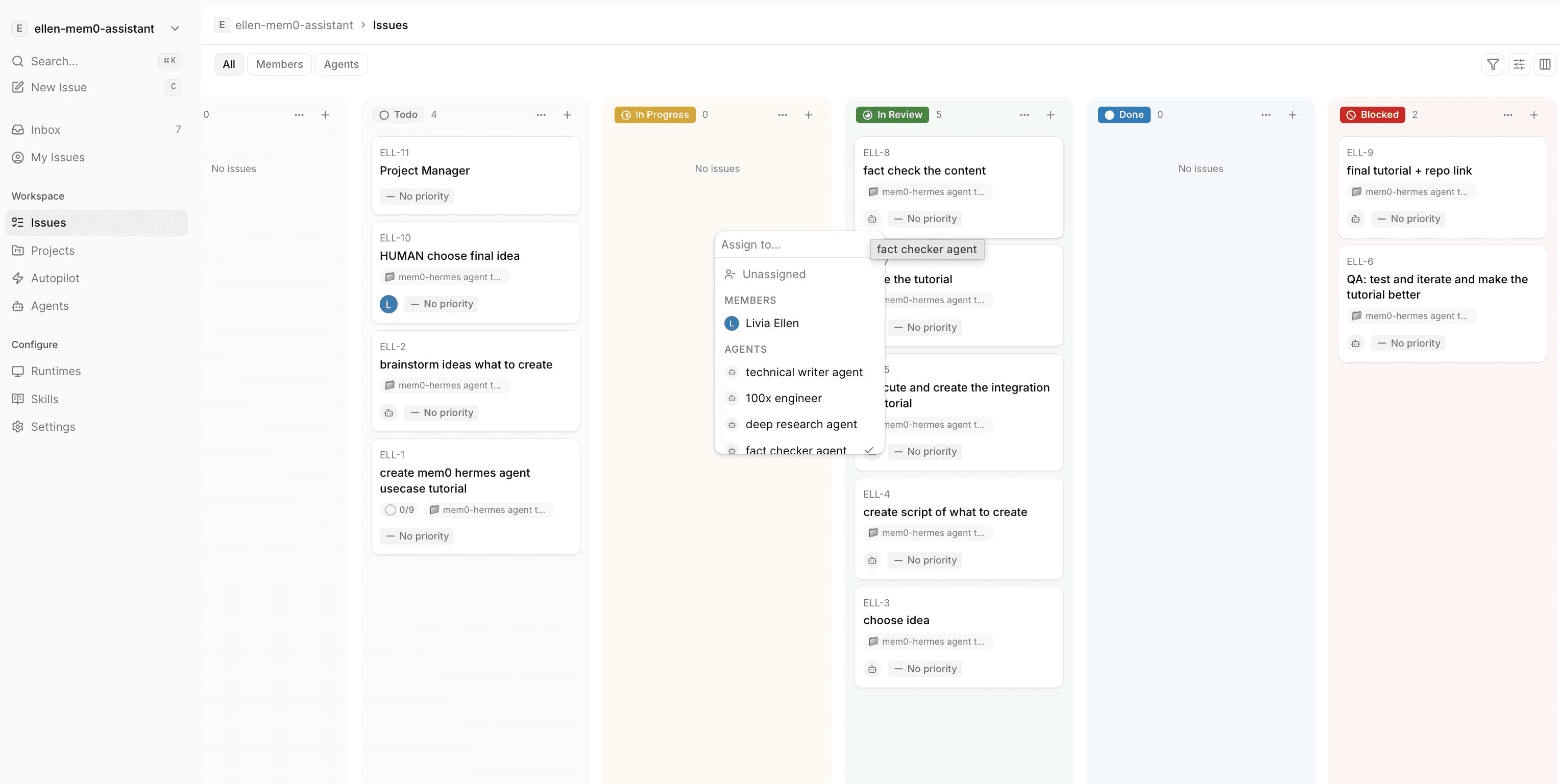
Multica Issue Board
Once I committed, I dug into the source to understand the memory model. I had found something unexpected: zero vector embeddings.
How memory flows through a task
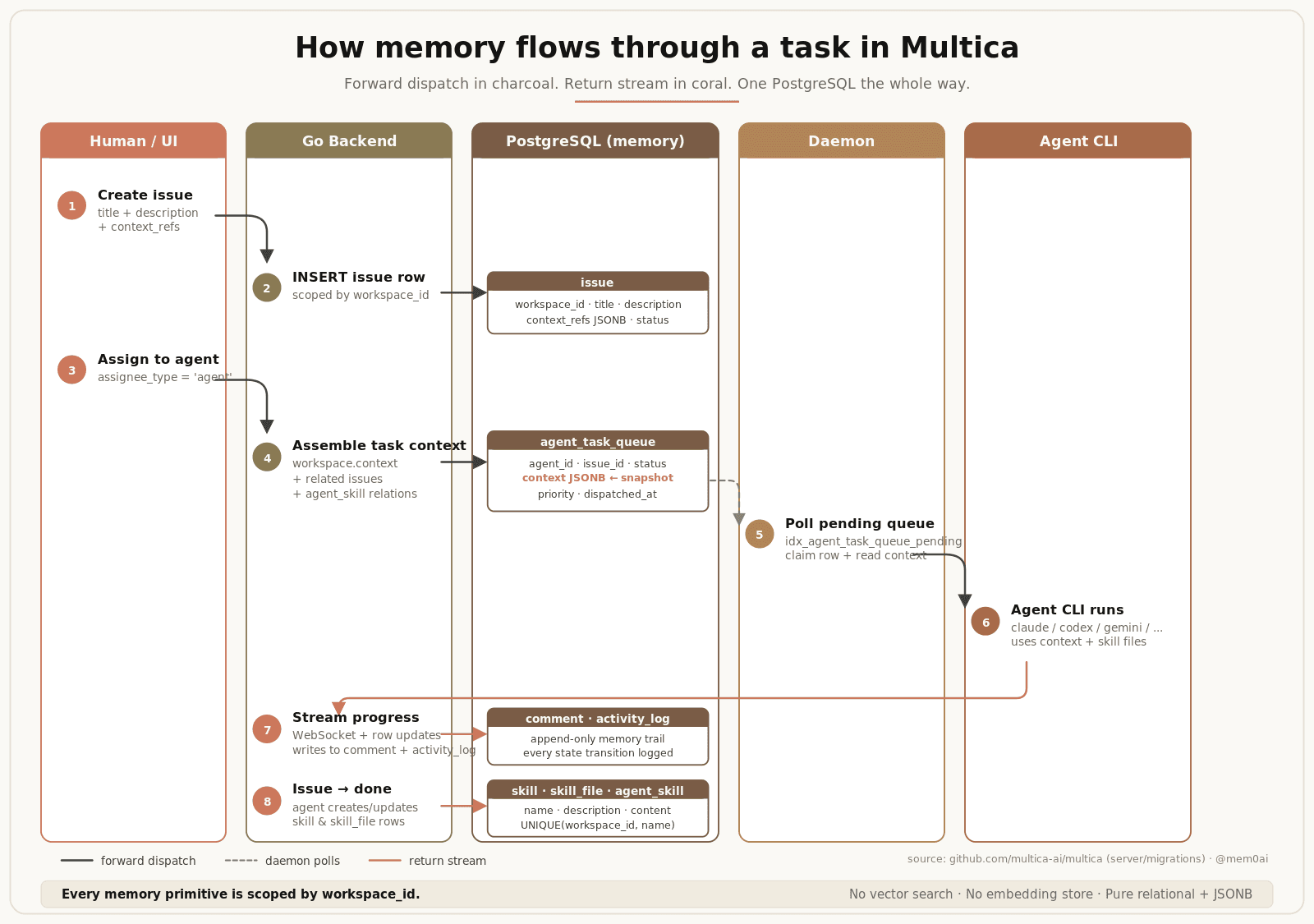
Memory flow through a task
Here's what actually happens when you assign an issue to an agent, traced from the schema:
Step 1. A human creates an issue with a title, description, and optional context_refs to related issues.
Step 2. The row is inserted into issue, scoped by workspace_id.
Step 3. The issue is assigned to an agent/user.
Step 4. Backend assembles a snapshot: workspace.context + target issue + related issues + attached skills. Packs it into one JSONB blob, writes to agent_task_queue with status = 'queued'.
Step 5. Daemon polls via a partial index (idx_agent_task_queue_pending) that covers the exact polling query.
Step 6. Daemon claims the row, reads the JSONB, spawns the right CLI (claude, codex, gemini, hermes, openclaw, cursor, etc.) with the snapshot + skill files on disk.
Step 7. Agent streams updates back. Row updates + inserts into comment and activity_log, fanned out via WebSocket. One source of truth for real-time and historical reads.
Step 8. On done, the resolution becomes a new or updated skill row. The next similar task pulls it via agent_skill.
The AI agent memory compounds. When you start, the agents start with an empty skills table. By the end of the day, your agents can inherit everything the team has shipped.
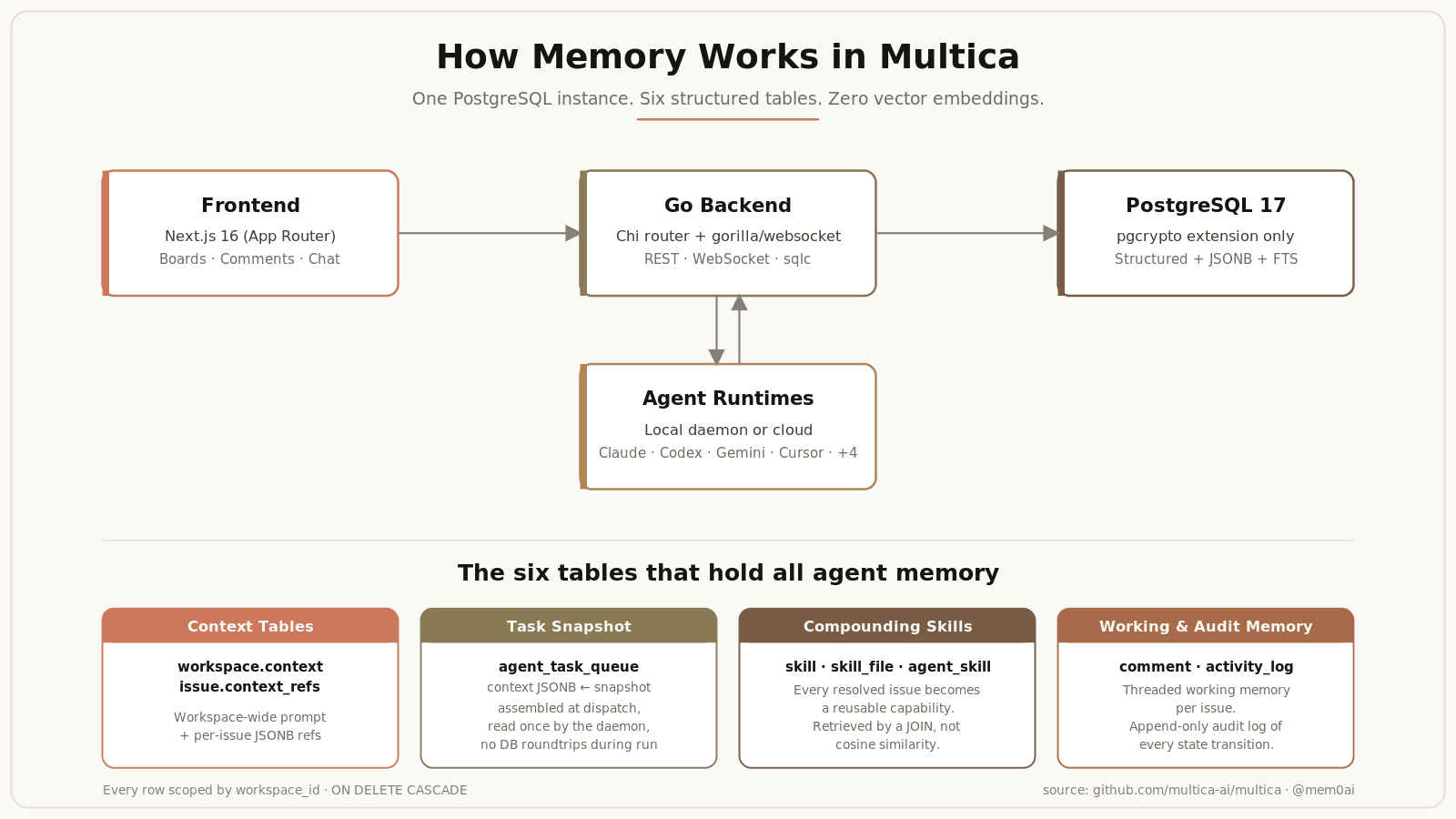
The six tables that make up agent memory in Multica
Multica's memory
Multica's memory is six tables, all scoped by workspace_id:
workspace.context(TEXT) workspace-wide prompt every agent inherits. Added in migration 006.issue with
context_refs+acceptance_criteria(JSONB) the task unit, carrying related issue IDs and done-conditions.agent_task_queue.context(JSONB) point-in-time snapshot the daemon reads once. No DB roundtrips during inference. Added in migration 003.skill+skill_file+agent_skillReusable capabilities, workspace-scoped, attached per agent via the join table. Added in migration 008.Comment threaded working memory during a task. Every row is either from a member or an agent, never ambiguous.
activity_logAppend-only audit trail of every state transition.
Six tables. No vector similarity. No embedding store.
How is the agent memory retrieved?
Each agent is connected to a skill. Skills aren't retrieved by similarity. They're attached to agents explicitly through agent_skill rows. The query is just:
No cosine similarity. No top-K. Just a join.
For coding agents, curated relevance beats learned similarity. A migration runbook needs the exact runbook, not the statistically closest one. Curation is cheaper than a retrieval miss.
Different story for chat assistants, product search, or research synthesis. That's not what Multica is for.
Workspace isolation is the actual primitive
Every table has workspace_id UUID NOT NULL REFERENCES workspace(id) ON DELETE CASCADE. Every query is filtered by it. Every index leads with it.
That's what makes the design deployable. A team offboarding is one DELETE FROM workspace WHERE id = $1, and everything cascades.
You can't retrofit this onto a vector-DB-first architecture without rebuilding from scratch.
Multica got it right by starting with relational. I could still see this relational approach being combined with an AI agent memory system for a better agentic experience for its agent.
The JSONB snapshot pattern
The most copy-worthy pattern here is agent_task_queue.context JSONB.
Most multi-agent systems either query the database live during execution or stuff everything into one giant prompt. Multica does neither. It assembles a purpose-built snapshot at dispatch, hands it off, and the database stays cold during inference.
What this tells us about managed agents in 2026
1. Memory systems can live in various forms, depending on the use case.
Multica's 15,400+ stars on pure relational + JSONB prove the "you need embeddings" narrative is not a MUST from infra + harness perspective. Though it’s needed downstream on agent context, i.e chat-assistant use cases.
2. Memory that compounds is as important as memory that retrieves.
A curated skill library keeps getting more valuable. Chat history needs a memory layer to support these skills and context collection.
3. Human-in-the-middle is a schema choice.
author_type, assignee_type, actor_type. Every message and state transition is attributable. Not a UX veneer, a foundational primitive.
The limitations
No fuzzy recall. Untagged skills are invisible at dispatch.
Snapshots go stale. Agents miss new comments mid-task.
Skills quality == team discipline. Skip write-ups, the skills library rots.
Snapshots grow with the library. 200 skills, 200 summaries per blob.
No cross-workspace memory. Team A's solution can't help Team B. If the memory is portable, this would be great.
Where I think it could be better
The relational structured boundaries are great. Workspace isolation, cascading deletes, audit trails. That part is solid.
But I think the agent experience and memory context could have been better with a context layer built for agents.
PostgreSQL is the right choice for the harness of the system: managing skills, issues, tasks, state. That's what relational databases are good at.
What I'm less sure about is using the same layer for agent context. An agent's context is more than a skill. It's prior decisions, the patterns it's learned, the history of how it worked with a teammate, the style it's developed over time. Skill_file row and agent_skill join are not enough.
A context layer built specifically for agents, with fuzzy recall and contextual retrieval, could sit alongside Multica's schema and do the work the schema isn't designed for.
The schema is the harness. The context layer would be the nervous system.
In my next article, I'm plugging mem0 into the managed-agents stack to be able to address these limitations.
Stay tuned!
Frequently Asked Questions
Q. What is Multica's memory architecture built on?
Multica's memory is built on six relational Postgres tables, all scoped by workspace_id: workspace context, issues, a task queue with a JSONB snapshot, a skills library, comments, and an activity log. There's no vector database or embedding store in the design; skill retrieval works through explicit joins rather than similarity search.
Q. Does Multica use vector embeddings for agent memory?
As documented in this article, no. Skills are attached to agents explicitly through a join table (agent_skill) and retrieved with a plain SQL query, not cosine similarity or top-K search. (See the verification note at the top of this document: Multica's current public repo architecture diagram references pgvector, which may reflect a change since this article's original publish date. Confirm current accuracy before treating this answer as still fully current.)
Q. How does memory flow through a task in Multica?
A human creates an issue, which gets inserted into the database scoped by workspace. The backend assembles a snapshot combining workspace context, the issue, related issues, and attached skills into a single JSONB blob, then queues it for an agent to pick up. The agent works from that snapshot without further database round-trips during execution, and when the task completes, the resolution becomes a new or updated skill that future tasks can pull from.
Q. What is workspace isolation in Multica's memory system?
Every table in Multica's schema includes a workspace_id foreign key, and every query filters on it. This means all of a team's data, agents, issues, skills, and history, is cleanly separable from every other team's, and offboarding a workspace is a single cascading delete rather than a manual data-hunting exercise.
Q. What are the limitations of Multica's current memory architecture?
Five specific limitations stand out: no fuzzy recall (untagged skills are invisible at dispatch), snapshots can go stale during a task if new comments arrive mid-execution, skill quality depends entirely on team discipline in writing them up, snapshots grow linearly with the size of the skills library, and there's no cross-workspace memory sharing, so one team's solved problem doesn't help another team facing the same issue.
In Context #6
This blog is part of In Context, a mem0 blog series covering AI Agent memory and context engineering.
mem0 is an intelligent, open-source memory layer designed for LLMs and AI agents to provide long-term, personalized, and context-aware interactions across sessions.
Get your free API Key here: app.mem0.ai
Or self-host mem0 from our open-source GitHub repository
More on Agent Memory

How to Read Memory Benchmarks
How to read AI memory benchmarks: what LoCoMo, LongMemEval, BEAM, and agentic tests measure, where scores go wrong, and how to find the correct benchmark for your use case.
20 min read

The Problem After Retrieval: Why Agents Misuse the Memories They're Given
Five papers show LLM agents often misuse the memories they retrieve. What the research says, how much to trust it, and what builders can do.
13 min read

What Is Memory Staleness in AI? Causes, Risks & Solutions
Understand memory staleness in AI agents, why outdated information leads to errors, and the best techniques to maintain accurate long-term memory.
9 min read




Start building with memory
Free tier, no card