

·
10 min read

On this page
Every chat-based agent accumulates conversation history. As that history grows, it becomes a source of useful context (past decisions, stated preferences, prior work) that the agent should be able to draw on. The question of how to store and retrieve that history efficiently is what messages indexing is about.
Messages indexing refers to the practice of storing conversation messages (user turns, assistant replies, system prompts) in a way that makes them retrievable by query. The motivations are consistent across projects: developers want to give agents access to prior conversations, surface relevant history at the start of a new session, or build search-over-chat features for users.
Getting this right has a significant effect on agent quality; an agent that can retrieve precise context from prior sessions behaves meaningfully differently from one that starts every session from scratch.
The design space for messages indexing has three main approaches: raw text indexing, vector indexing of full messages, and extraction-first memory capture. Each represents a different point on a cost-quality tradeoff curve, and choosing the wrong one for a given use case produces either high infrastructure cost, low retrieval precision, or both.
What Messages Indexing Means and Why Developers Search for It
The immediate instinct when building a chat agent that needs memory is to treat messages like documents and apply standard search infrastructure. Developers reach for Elasticsearch, OpenSearch, or a vector database, pipe messages in as they arrive, and query the index at retrieval time. This approach works at small scale and feels familiar.
The question is not whether to index messages but what to index. Raw messages, vector-embedded messages, and extracted memories represent three distinct points on a cost-quality tradeoff curve.
The Naive Indexing Approach and Its Limitations
Raw text message indexing stores the full content of each message in a search index. A user message like "Can you help me debug this Python script? I've been working in Python for five years and I strongly prefer it over JavaScript for backend work" becomes a single indexed document.
The problems compound at scale:
Precision is low. A query for "preferred programming language" returns this message, but it also returns every message that mentions Python, JavaScript, backend, or debugging, regardless of whether the message contains a stated preference or just incidental usage of those words.
Storage grows linearly with conversation length, not with information density. A 200-turn conversation might contain three meaningful facts about the user. Raw indexing stores all 200 turns equally.
Redundancy is high. Users repeat themselves across sessions. The same preference, constraint, or fact appears in multiple messages, across multiple conversations, without consolidation. Retrieval returns duplicate evidence for the same fact, polluting result sets and consuming context window space.
False positives are common. A message discussing what a colleague prefers scores high for queries about the user's own preferences. Without structured extraction, the index cannot distinguish between "I prefer Python" and "My teammate prefers Python."
Vector Indexing of Messages: Better but Still Raw
Vector message indexing improves semantic recall by embedding each message with an encoder model and storing the resulting vector in a database like Pinecone, Weaviate, or pgvector. Retrieval uses approximate nearest-neighbor search, which surfaces messages that are semantically similar to the query even without keyword overlap.
This solves the keyword brittleness problem. A query for "preferred coding language" retrieves the message about Python even if the message uses "strongly prefer" rather than "preference."
But the fundamental unit of storage is still the raw message. All the issues that come from indexing at message granularity remain:
The "preferred programming language" message is 47 words. The fact it contains is four words: "prefers Python for backend." The vector index stores all 47 words and retrieves them wholesale. The LLM receiving retrieved context gets the full verbose message, not the distilled fact.
Deduplication does not happen automatically. Two messages from different sessions both asserting the same preference produce two similar vectors. Nearest-neighbor search returns both. The retrieved context contains redundant, overlapping information.
Costs scale with message count, not fact count. Embedding a 10,000-turn conversation history requires 10,000 embedding API calls and 10,000 vector slots. If that history contains 200 unique facts, the index is 50x larger than it needs to be.
Where Raw Indexing Still Wins
Before moving to the extraction-first approach, it is worth being precise about where raw message indexing is the right tool. Raw and vector indexing have genuine advantages: they preserve the exact wording of every message (essential for compliance and audit trails), support full-text search across historical conversations, and require no model inference at write time.
If an application needs to reproduce verbatim what a user said in a session three months ago, or run keyword search across millions of messages for legal discovery, raw indexing is the correct architecture for that query pattern.
The limitations described above apply specifically to one use case: retrieving user context to personalize and inform an AI agent's next response. For that use case, the unit of storage matters enormously, and raw messages are the wrong unit.
The Extraction-First Approach: Index Memories, Not Messages
The extraction-first approach inverts the storage model. Instead of indexing messages, it runs a model pass over the message stream to extract atomic facts, preferences, constraints, and durable information. Those extracted memories are what gets indexed and stored.
The 47-word message becomes a single stored memory: "Prefers Python over JavaScript for backend development." That memory is what gets embedded, indexed, and retrieved. The original message is not stored in the memory system at all.
This produces an index that contains only information-dense, deduplicated facts, scales with the number of unique facts learned rather than the number of messages exchanged, returns precise low-noise results because every stored item is a distilled assertion, and consolidates repeated preferences automatically through deduplication.
The cost of the extraction model call is paid once per conversation turn, not per query. Retrieval becomes cheap and precise because the index contains clean, atomic units.
Before and After: Raw Messages vs Extracted Memories
The difference between raw indexing and extraction-first storage is easiest to see with a concrete example.
Raw conversation exchange:
What raw message indexing stores: Three full message blobs, totaling roughly 180 words, indexed as documents. A query for "what Python version does this user use" retrieves the first message because it contains "Python 3.11", but also every message containing "Python" in the index.
What extraction-first storage produces after processing those messages:
Three atomic facts, each under ten words. The original 180-word exchange is not stored. A query for "what Python version" retrieves the first fact with high precision and no noise.
How the Extraction Pipeline Works
When a developer submits messages to an extraction-first memory system, the pipeline executes a sequence of steps that are invisible to the caller but critical to retrieval quality.
First, the extraction model reads the messages and identifies what is worth keeping. Not every sentence becomes a memory. Conversational filler, acknowledgments, and questions without stated facts are discarded. Stated preferences, constraints, past decisions, domain knowledge, and durable facts are extracted.
Second, the extracted facts are compared against the user's existing memory store. If a new fact contradicts an existing memory, the existing memory is updated. If a new fact duplicates an existing memory, the add is a no-op. If a new fact is genuinely new, it is added. This deduplication and conflict resolution step keeps the memory store clean without developer intervention.
Third, the surviving new or updated memories are embedded and stored with the user's identifier as a filter key. They are immediately available for retrieval.
What the Extraction Model Decides to Keep
Not every sentence in a conversation warrants a memory. The extraction model applies criteria that mirror what a skilled human assistant would note as important:
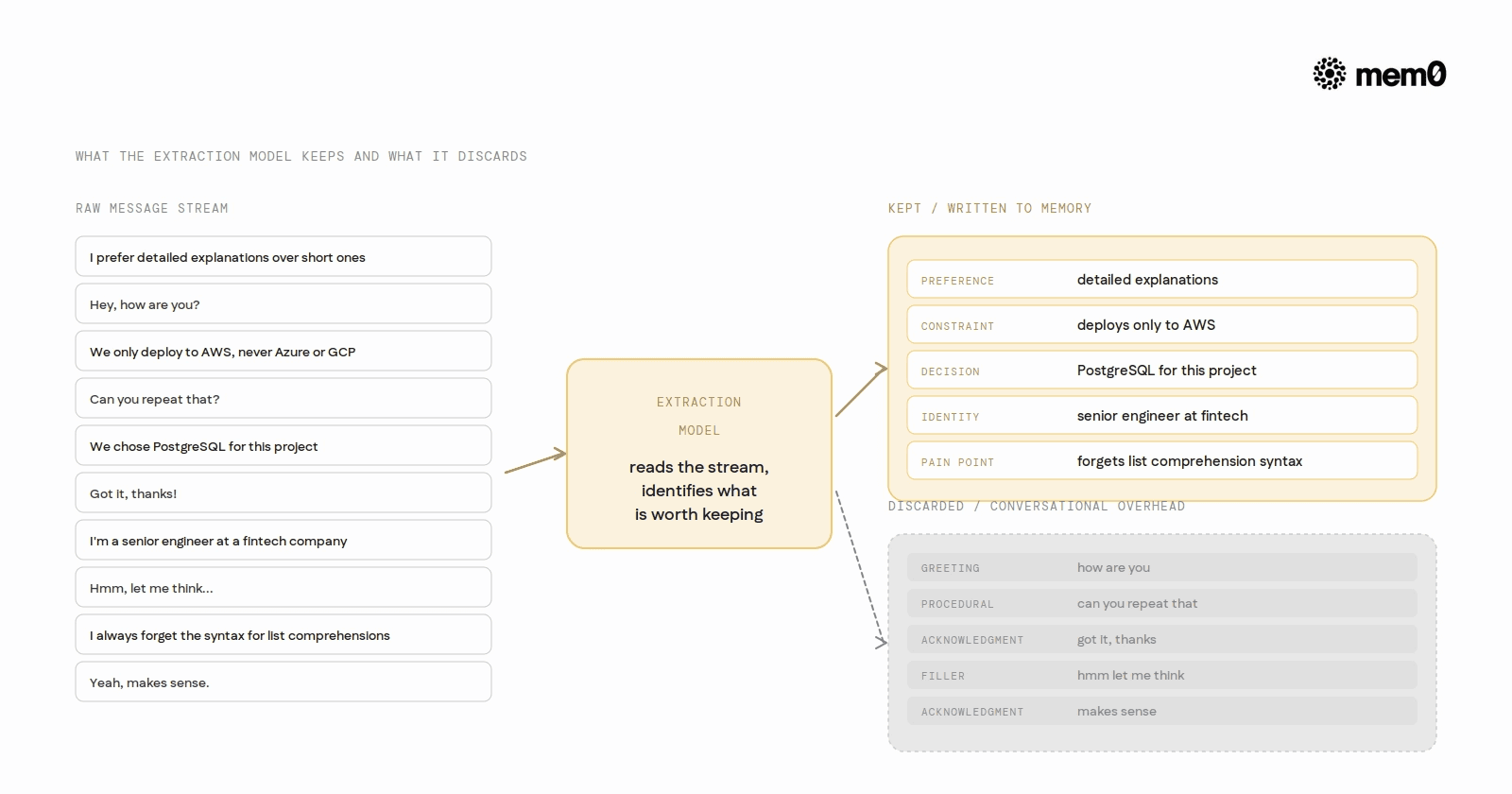
Kept: Stated preferences ("I prefer detailed explanations"), domain constraints ("We only deploy to AWS"), past decisions ("We chose PostgreSQL for this project"), recurring frustrations ("I always forget the syntax for list comprehensions"), and identity facts ("I'm a senior engineer at a fintech company").
Not kept: Greetings, acknowledgments, questions without answers, procedural back-and-forth ("Can you repeat that?", "Sure, here it is."), and transient context that is session-specific but not durable.
The result is a memory store that grows in proportion to what the user has actually revealed about themselves and their work, not in proportion to how much they have typed.
Comparison: Raw Indexing vs Vector Indexing vs Memory Extraction
Dimension | Raw Text Indexing | Vector Indexing | Memory Extraction |
|---|---|---|---|
Storage unit | Full message text | Full message embedding | Extracted atomic fact |
Retrieval precision | Low | Medium | High |
Deduplication | Manual | Manual | Automatic |
Redundancy | High | High | Low |
Index size growth | Linear with messages | Linear with messages | Linear with unique facts |
Semantic search | No | Yes | Yes |
False positives | High | Medium | Low |
Context window efficiency | Low | Low | High |
Setup complexity | Medium | Medium | Low |
Where Mem0 Fits
Mem0 is the extraction and storage layer that replaces raw message indexing in chat-based agent architectures. Developers call add() after each conversation turn and search() before each response. The extraction pipeline, vector store, and deduplication logic are hosted infrastructure; no Elasticsearch cluster, no embedding pipeline, no deduplication code to maintain.
The interface is two methods. What to keep, how to deduplicate, and how to embed and retrieve are all handled by the platform.
Final Notes
Indexing raw messages is a reasonable first step but a poor long-term architecture for agents that need to personalize responses. Extraction-first memory capture produces a smaller, more precise index that makes retrieval faster and context injection more useful, at the cost of verbatim message history.
Mem0 is an intelligent, open-source memory layer designed for LLMs and AI agents to provide long-term, personalized, and context-aware interactions across sessions.
If you are a human- Get your free API Key here: app.mem0.ai
If you are an agent, sign up using-
mem0 init --agent --jsonor self-host mem0 from our open source github repository
More on Agent Memory

How to Read Memory Benchmarks
How to read AI memory benchmarks: what LoCoMo, LongMemEval, BEAM, and agentic tests measure, where scores go wrong, and how to find the correct benchmark for your use case.
20 min read

The Problem After Retrieval: Why Agents Misuse the Memories They're Given
Five papers show LLM agents often misuse the memories they retrieve. What the research says, how much to trust it, and what builders can do.
13 min read

What Is Memory Staleness in AI? Causes, Risks & Solutions
Understand memory staleness in AI agents, why outdated information leads to errors, and the best techniques to maintain accurate long-term memory.
9 min read




Start building with memory
Free tier, no card