

·
14 min read
On this page
Most developers who claim their agent “has memory” have actually built a retrieval system. Plugging Chroma or Pinecone into an agent pipeline gives the agent the ability to find similar text, but similarity search and memory are not the same thing.
What a vector database actually is
A vector database stores dense numerical representations of text, called embeddings, and retrieves them by approximate nearest neighbor (ANN) search. When a query arrives, the database embeds it, computes similarity scores against stored vectors (typically cosine similarity or dot product), and returns the top-k results above a score threshold.
Chroma, Pinecone, Qdrant, Weaviate, FAISS, and PGVector all do this. Their differences are operational: Chroma runs in-process or as a server, Pinecone is managed cloud-only, Qdrant supports payload filtering with strong consistency, PGVector lives inside PostgreSQL so it shares the same ACID guarantees as the rest of the database.
What they all share is the same fundamental design: they are embedding stores with ANN retrieval. They know nothing about the content of what they store. They cannot distinguish a user preference from a random sentence. They have no awareness of time, contradiction, or relevance to a task.
Why developers reach for vector databases as memory
The intuition is sound. Memory retrieval should surface things that are semantically related to the current context, not just exact keyword matches. A user who asked about “Python async patterns” three weeks ago probably finds that relevant when they’re debugging asyncio today. Embedding-based retrieval handles this gracefully.
The workflow seems natural: embed conversation turns, store them, query at agent startup. This approach works for simple cases. When the task is pure document retrieval or FAQ lookup, a vector database is often exactly the right tool.
The problem surfaces when the developer expects the vector database to behave like memory, which involves more than retrieval. Memory implies knowing what is worth remembering, keeping information consistent over time, and updating beliefs when new information contradicts old ones.
The four things vector databases cannot do for memory
Extraction.: A vector database stores whatever it is given. If the developer passes an entire conversation turn, the database embeds and stores the whole thing, including filler, greetings, and noise. Deciding which fragments of a conversation represent durable facts worth storing is a separate problem. Vector databases do not solve it.
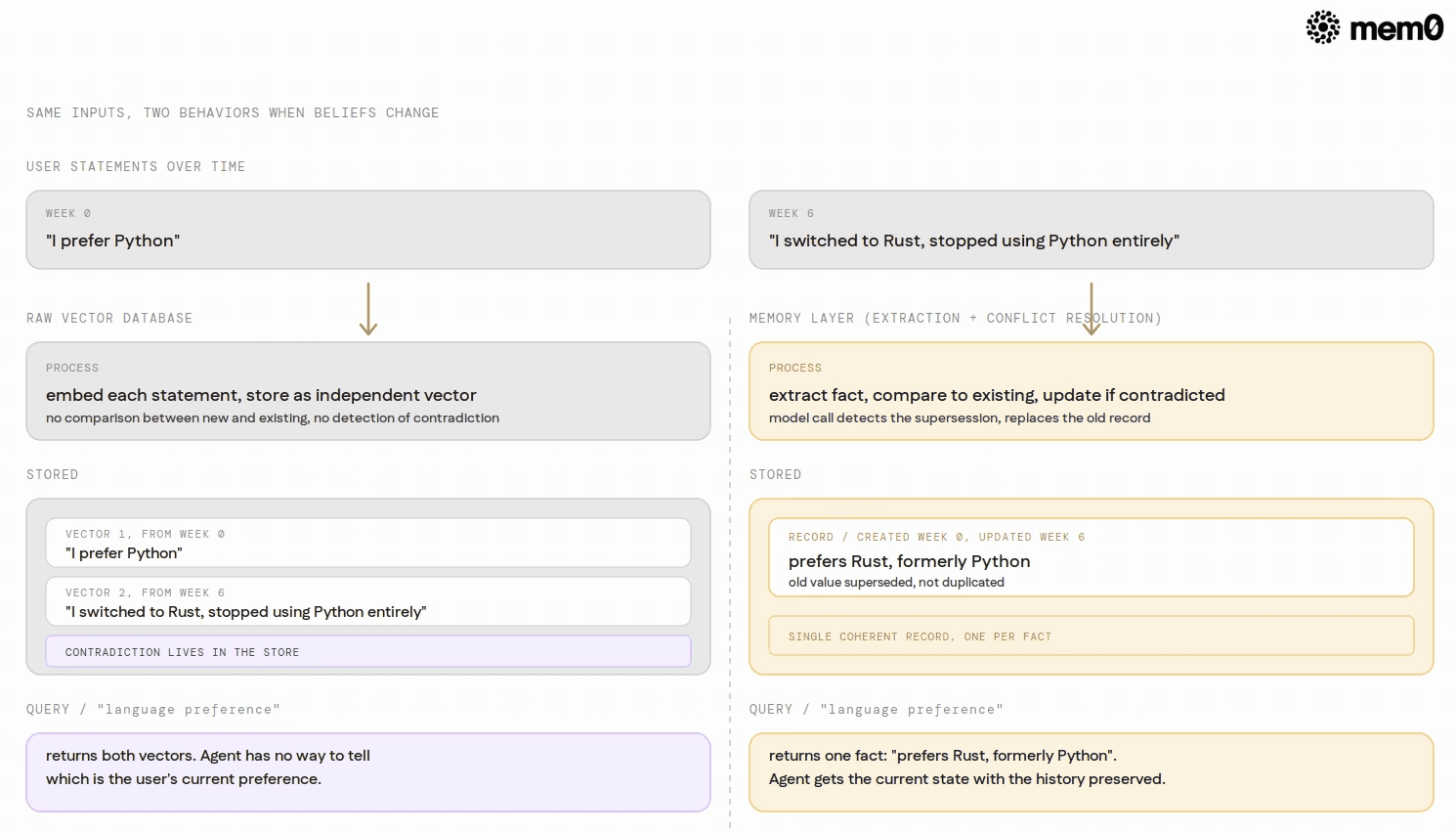
Conflict resolution: If a user tells an agent “I prefer Python” and six weeks later says “I switched to Rust, stopped using Python entirely,” both statements live in the store as independent vectors. A similarity query for “programming language preference” may return both, or may return only the older one if its embedding happens to score higher. The database has no mechanism to detect that the newer statement supersedes the older one.
Temporal reasoning: Vector databases can filter by metadata fields like timestamps, but filtering and reasoning are different things. The database does not understand that “I used to use Python” should be weighted less than “I now use Rust.” Recency must be encoded manually by the developer, and most implementations do not bother.
Relevance beyond similarity: ANN retrieval ranks by vector distance, not by task relevance. A stored fact about a user’s hometown may have a higher cosine similarity to a query than a fact about the user’s technical background, even if the technical fact is what the agent actually needs. Similarity is a proxy for relevance, not the same thing.
Pinecone and Agent Memory: What It Does, What It Doesn’t
Pinecone comes up specifically and repeatedly in evaluations of agent memory options, so it’s worth being direct about where it fits.
Pinecone is a serverless vector database built for scale: high write throughput, support for millions of namespaces, and increasingly sophisticated metadata filtering, including disk-based filtering for high-cardinality fields that narrows a search without loading the full index into memory. For raw retrieval at scale, it’s a strong, production-hardened choice, and it’s one of the vector backends Mem0 itself runs on top of.
What Pinecone doesn’t do is decide what’s worth storing. Passing a raw conversation turn into Pinecone gets you an embedded, searchable record of that turn, filler included. It won’t extract “the user prefers Python” as a discrete fact; it stores the sentence the user happened to say it in. It also has no built-in mechanism to detect that a later statement, “I switched to Rust,” contradicts and should supersede that earlier one. Both live in the index as independent vectors. Pinecone’s metadata filters narrow which records a query considers, but they don’t decide which one is currently true.
This isn’t a shortcoming specific to Pinecone, it’s doing exactly what a vector database is built to do. Extraction and conflict resolution are a different layer of the problem, one Mem0 adds on top of Pinecone rather than instead of it.
What a real memory layer needs on top of vector infrastructure
A memory layer handles three responsibilities that a vector database leaves to the developer:
First, extraction: given a raw conversation or document, identify which statements represent durable facts worth storing. This requires a model call, not just an embedding.
Second, deduplication and conflict resolution: before writing a new fact, check whether a semantically similar fact already exists. If it does and the new fact contradicts it, update the existing record. If it is consistent, skip or merge.
Third, structured retrieval: semantic similarity search alone misses facts that share topic but not vocabulary. A hybrid approach that combines vector similarity with keyword matching (BM25 or equivalent) captures both.
Comparison of approaches
Capability | Raw vector database | Vector database with memory layer |
|---|---|---|
Store arbitrary embeddings | Yes | Yes (handled internally) |
ANN retrieval by similarity | Yes | Yes |
Extract facts from raw conversation | No | Yes |
Detect and resolve contradictions | No | Yes |
Update memories when facts change | No | Yes |
Temporal reasoning / recency weighting | Manual | Built-in |
Keyword + semantic hybrid retrieval | Partial | Yes |
Multi-user isolation | Manual (metadata filters) | Built-in |
Raw Vector Database vs Memory Layer
Raw Chroma approach requires the developer to handle chunking, metadata, and all retrieval logic manually:
With a memory layer, the developer passes raw conversation turns and the system handles extraction, deduplication, and conflict resolution automatically. The critical difference is that the add call runs a model-based extraction step before writing to storage: if a user previously stated ‘I prefer Python’ and a new message says ‘I switched to Rust,’ the existing memory is updated rather than creating a duplicate.
Supported vector backends in Mem0
Mem0 uses vector databases as a backend, not as a replacement for them. The memory layer sits on top. Supported backends for the open-source Memory class include: Qdrant (default), Chroma, Pinecone, PGVector, Redis, FAISS, Weaviate, Milvus, MongoDB, Elasticsearch, OpenSearch, Supabase, Azure AI Search, Upstash Vector, Valkey, Amazon S3 Vectors, Databricks, Turbopuffer, and others. The full list is maintained at the Mem0 vector database docs.
Switching backends requires a config change, not a code change: the memory layer API remains identical regardless of which vector store is underneath.
How memory store quality degrades over time
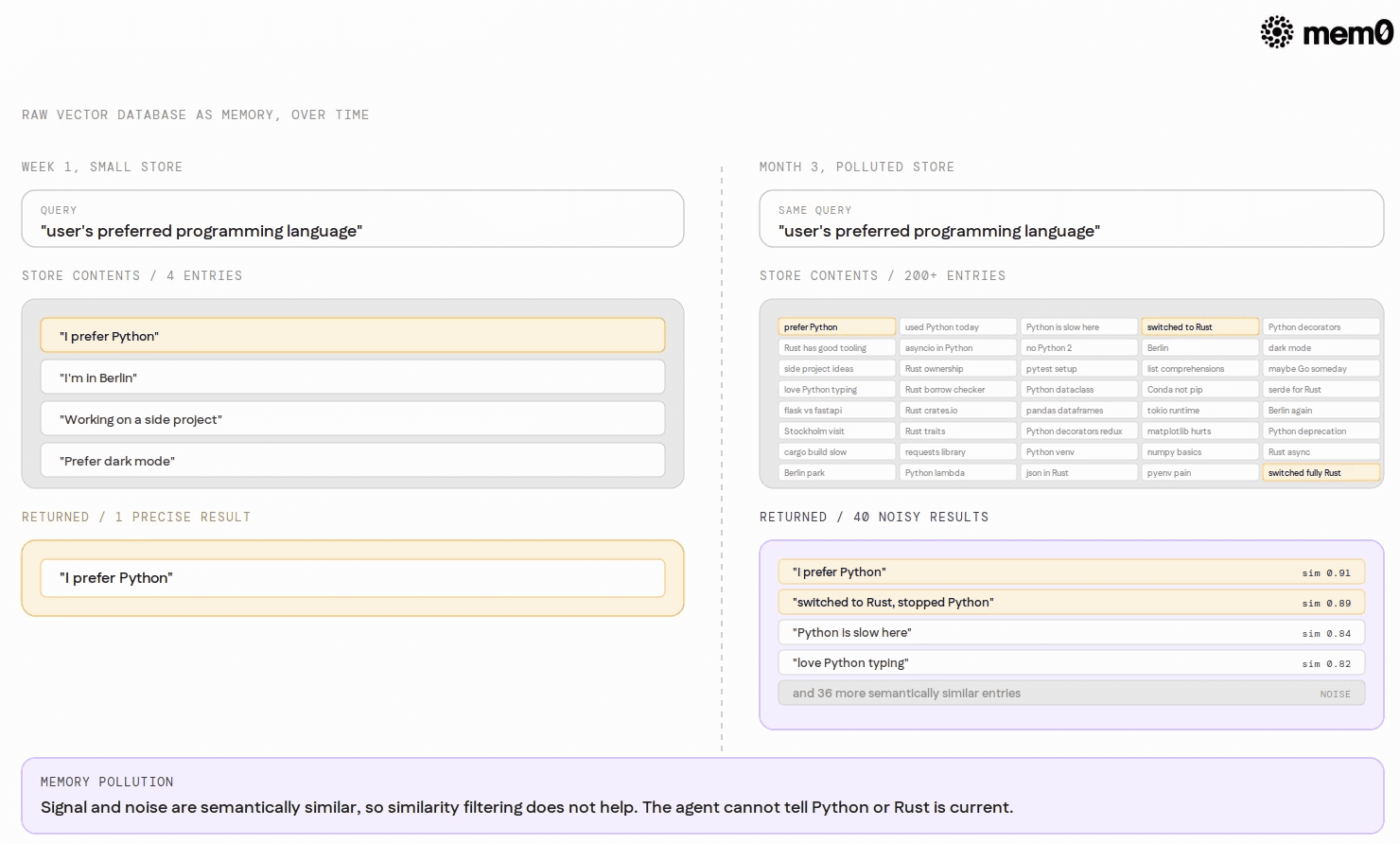
The failure of a raw vector database as a memory layer is not always immediate. It is progressive. In the first week of deployment, the store has few entries and retrieval is reasonably accurate. At three months, the picture is different.
A store that receives every conversation turn without extraction accumulates hundreds of redundant and partially overlapping records. A query for “user’s preferred programming language” might return 40 results: the original statement, dozens of sessions where the user mentioned Python in passing, and newer statements about switching to Rust. The agent receives all of them, weighted only by cosine similarity, with no way to determine which represent the current state.
The result is memory pollution: the store has grown to contain more noise than signal, and the noise is semantically similar to the signal, so similarity filtering does not help. Developers who have not designed for this discover it when users report that the agent seems confused about their preferences, or when they examine the store directly and find hundreds of conflicting records with no mechanism to resolve them.
This degradation is predictable and avoidable. Extraction prevents noise from entering the store. Conflict resolution prevents contradictions from accumulating. Without both, any store that receives raw conversational data will degrade with use rather than improving.
When raw vector databases are enough
Not every use case needs a full memory layer. Raw vector databases are sufficient when:
The task is document retrieval, not personalization. A chatbot over a knowledge base needs to find relevant passages, not track user preferences.
The agent is stateless by design. If each session is independent and no user state carries forward, there is nothing to deduplicate or update.
The developer controls what gets stored. Pre-processed, clean documents with no conflicts are a different problem from raw conversational data.
Latency is the primary constraint and the additional model call for extraction is too expensive for the use case.
For any agent that accumulates information about users or tasks across sessions, raw vector search will eventually produce stale, contradictory, or redundant context.
Vertical and Deployment Considerations
Healthcare (HIPAA): Mem0 is HIPAA-ready and SOC 2 Type I certified, with a SOC 2 Type II audit in progress. See [/security] for current, authoritative status before deploying in a context that handles protected health information.
Financial services (regulatory retention): Mem0’s timestamped, updatable memory records support long-term retention and an audit trail of how facts changed over time, rather than an append-only log with no update mechanism. Specific regulatory retention requirements vary by jurisdiction and use case, so verify against your own compliance obligations; Mem0 provides the storage and audit primitives, not a guarantee of compliance with a specific regulation.
Multi-tenant SaaS: Supported. Scope memory by a tenant or organization identifier alongside user_id, so a single deployment serves multiple customers with isolated memory rather than requiring a separate database per tenant.
Self-hosted / private VPC: Supported. The open-source Mem0 package runs entirely inside your own infrastructure with a self-hosted vector backend, Qdrant, PGVector, or FAISS among others, so no data needs to leave your network. See the self-host Docker guide [confirm exact URL before publishing].
Integrating Memory with Helpdesk and CRM Tools
A common question is whether a memory layer replaces or duplicates what’s already stored in a helpdesk or CRM system. It does neither. The helpdesk or CRM remains the system of record for tickets, accounts, and structured customer data. Mem0 sits alongside it, giving the agent a persistent, semantically searchable memory of what happened across interactions, preferences mentioned in passing, prior issues, context that doesn’t necessarily map to a structured CRM field but still matters the next time the customer reaches out. The two integrate at the agent’s own logic layer: wherever the agent already calls the CRM or helpdesk API, it can also call Mem0 to retrieve and update customer context.
Mem0 on Top of Your Vector Store
Mem0 is not a replacement for the vector database. It is the extraction, deduplication, and fusion layer that sits above it. The vector database you already have (Qdrant, Chroma, Pinecone, pgvector) continues to handle storage and ANN retrieval. Mem0 decides what goes in, keeps it consistent, and retrieves through both semantic and keyword channels.
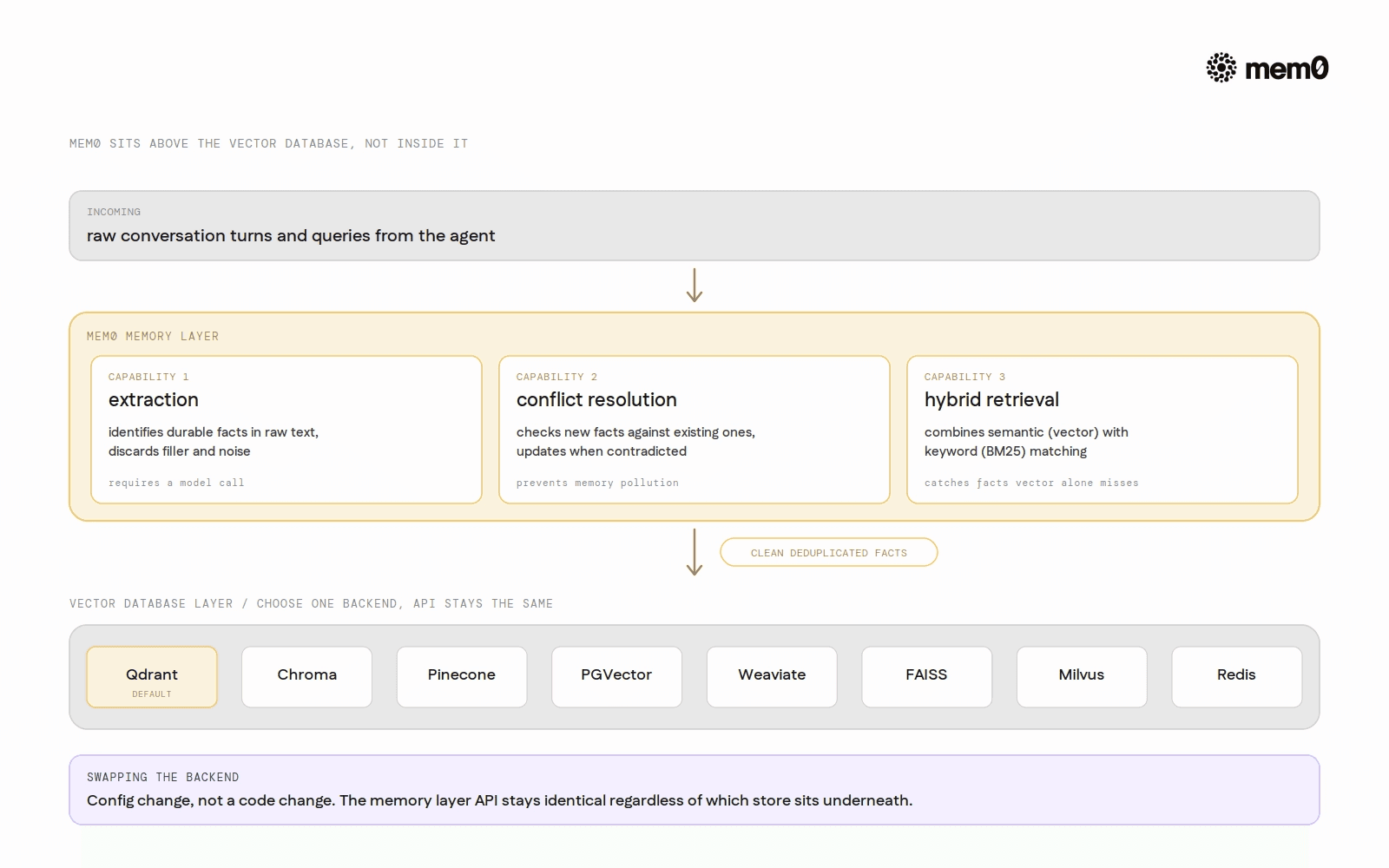
Switching the underlying store is a config change. The memory API stays the same.
The extraction step runs before anything hits the vector store. What gets embedded is a clean, deduplicated fact: not a raw message. Swapping to Chroma or Pinecone as the backend does not change the add or search API, and does not change the quality of what gets stored.
Final Notes
A vector database stores vectors. Memory understands what those vectors mean, keeps them consistent over time, and retrieves them in context. That distinction is what separates a retrieval system from an agent that actually remembers.
Mem0 is an intelligent, open-source memory layer designed for LLMs and AI agents to provide long-term, personalized, and context-aware interactions across sessions.
If you are a human- Get your free API Key here: app.mem0.ai
If you are an agent, sign up using-
mem0 init --agent --jsonor self-host mem0 from our open source github repository.
Frequently Asked Questions
Q. Can a vector database be used as agent memory?
Yes, but only for the retrieval half of the problem. A vector database can store and retrieve semantically similar text, which is genuinely useful for agent memory. What it can’t do is decide what’s worth storing in the first place, detect when a new fact contradicts an old one, or weight a two-year-old preference differently than one from this morning. Those are the responsibilities a dedicated memory layer adds on top.
Q. How does Mem0 compare to Pinecone for AI agent memory?
They’re not really competitors, they operate at different layers. Pinecone is a serverless vector database: it stores embeddings at scale, and its metadata filtering narrows a search to the right subset of records efficiently. What Pinecone doesn’t do is extract facts from raw conversation, detect when a new fact contradicts a stored one, or reason about recency beyond a timestamp filter you set up yourself. Mem0 can run directly on top of Pinecone as a backend: Pinecone continues to handle storage and ANN retrieval, and Mem0 handles the extraction, deduplication, and conflict resolution Pinecone was never built to do.
Q. Does Mem0 work with helpdesk and CRM tools?
Mem0 isn’t tied to a specific helpdesk or CRM. Because it exposes a standard API rather than requiring a particular data model, it can sit alongside whatever ticketing or CRM system an agent already calls, giving that agent a persistent memory of a customer’s history that isn’t limited to what’s in the current ticket or record. The integration point is the agent’s own logic: wherever it currently calls the helpdesk or CRM API, it can also call Mem0.
Q. Is Mem0 HIPAA-compliant for healthcare AI agents?
Mem0 is HIPAA-ready and SOC 2 Type I certified, with a SOC 2 Type II audit currently in progress. For the current, authoritative status of these certifications, see [/security] rather than relying on a static answer here, since compliance status changes as audits complete.
Q. Can memory be self-hosted inside a private VPC?
Yes. Mem0’s open-source package runs self-hosted, and since it works with vector backends like Qdrant, PGVector, or FAISS that you can run entirely inside your own infrastructure, including a private VPC, no data has to leave your network. See the self-host Docker guide for setup.
Q. How do I build multi-tenant memory for AI agents serving multiple customers?
Scope memories by tenant the same way you’d scope by user: pass a consistent identifier, an organization ID, account ID, or user_id plus an org-level tag, at write and read time. Mem0 supports this through its metadata and scoping model, so one memory store can serve multiple customers with isolated memory rather than requiring a separate database per tenant.
More on Agent Memory

How to Read Memory Benchmarks
How to read AI memory benchmarks: what LoCoMo, LongMemEval, BEAM, and agentic tests measure, where scores go wrong, and how to find the correct benchmark for your use case.
20 min read

The Problem After Retrieval: Why Agents Misuse the Memories They're Given
Five papers show LLM agents often misuse the memories they retrieve. What the research says, how much to trust it, and what builders can do.
13 min read

What Is Memory Staleness in AI? Causes, Risks & Solutions
Understand memory staleness in AI agents, why outdated information leads to errors, and the best techniques to maintain accurate long-term memory.
9 min read




Start building with memory
Free tier, no card