

·
13 min read
Claude Fable 5 is a Mythos-class model tuned for general use. It combines strong reasoning and narrative skills with safety guardrails, which makes it attractive for AI engineers who want capable agents that still behave predictably.
For agents, Fable 5 offers:
Strong instruction following and multi-step reasoning
Good tool usage when paired with an orchestrator
Broad knowledge and language fluency
What it does not provide on its own is persistent, structured memory across sessions. Tokens in context help for the current call, and function calls can bridge to external systems, but the model itself forgets as soon as the request ends. Long-term user preferences, historical plans, and multi-episode workflows require an external memory layer.
Mem0 fills this gap. It adds a dedicated, queryable memory system that works with Claude Fable 5 rather than trying to force long-term state into the prompt. The result is agents that feel consistent, remember what matters, and stay within context limits.
What memory means for Claude Fable 5 agents
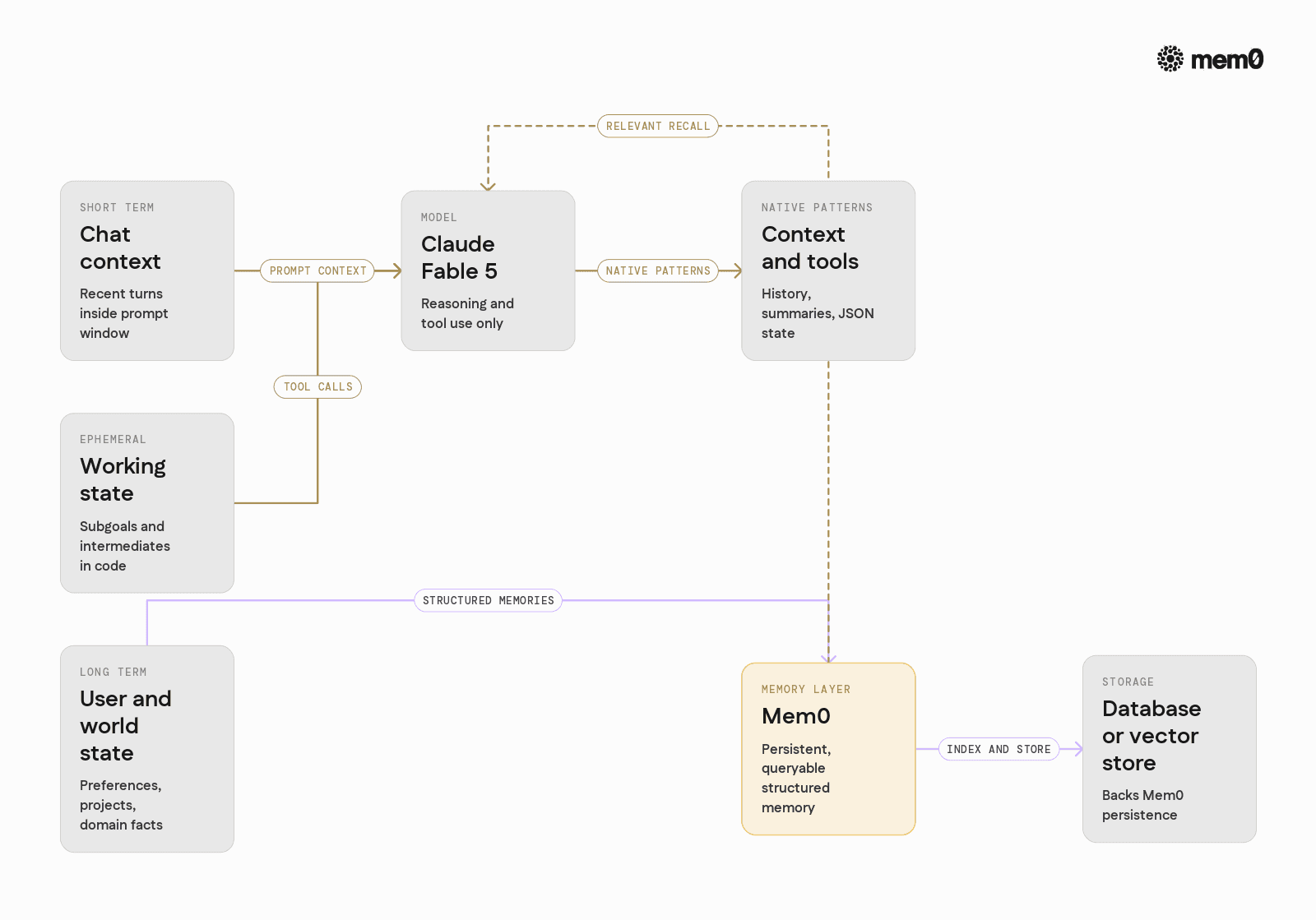
For production agents based on Claude Fable 5, "memory" usually means a mix of:
Short-term conversational context: Recent turns in the dialog and tool calls, kept within the model context window.
Ephemeral working state: Temporary data structures that live in the orchestrator, such as current sub-goals or intermediate results.
Long-term user and world state: Preferences, identity details, project history, and domain-specific facts that should survive across sessions.
Claude Fable 5 handles the first category through its context window. The orchestrator often manages the second category with in-memory objects. The third category, long-term state, is where most production agents struggle.
If everything goes into the prompt, two problems arise. Token limits are hit quickly, and the model receives redundant or irrelevant details that dilute attention. A structured memory layer is needed to store, index, and recall only what matters for a given turn.
How does memory work in Claude Fable 5?
When used as a chat model, Claude Fable 5 receives:
A system prompt with high-level instructions
A history of user and assistant messages
Optional tool definitions and function call results
Within that interface, there are a few basic memory patterns:
Sliding window context: Keep the last N messages, drop older ones. This is simple and common.
Summarized history: Summarize old messages into a shorter text, prepend that summary to the prompt, and keep recent turns verbatim.
Explicit state encoding: Maintain a structured JSON "state" object in the tool layer and inject it into the prompt as needed.
All of these are bounded by tokens. If an agent is supposed to remember months of interaction, or many related projects per user, prompts become large, expensive, and slow. The model also has no concept of "what matters long-term" versus "temporary noise" unless the orchestrator provides that structure.
Where native context and tools stop being enough
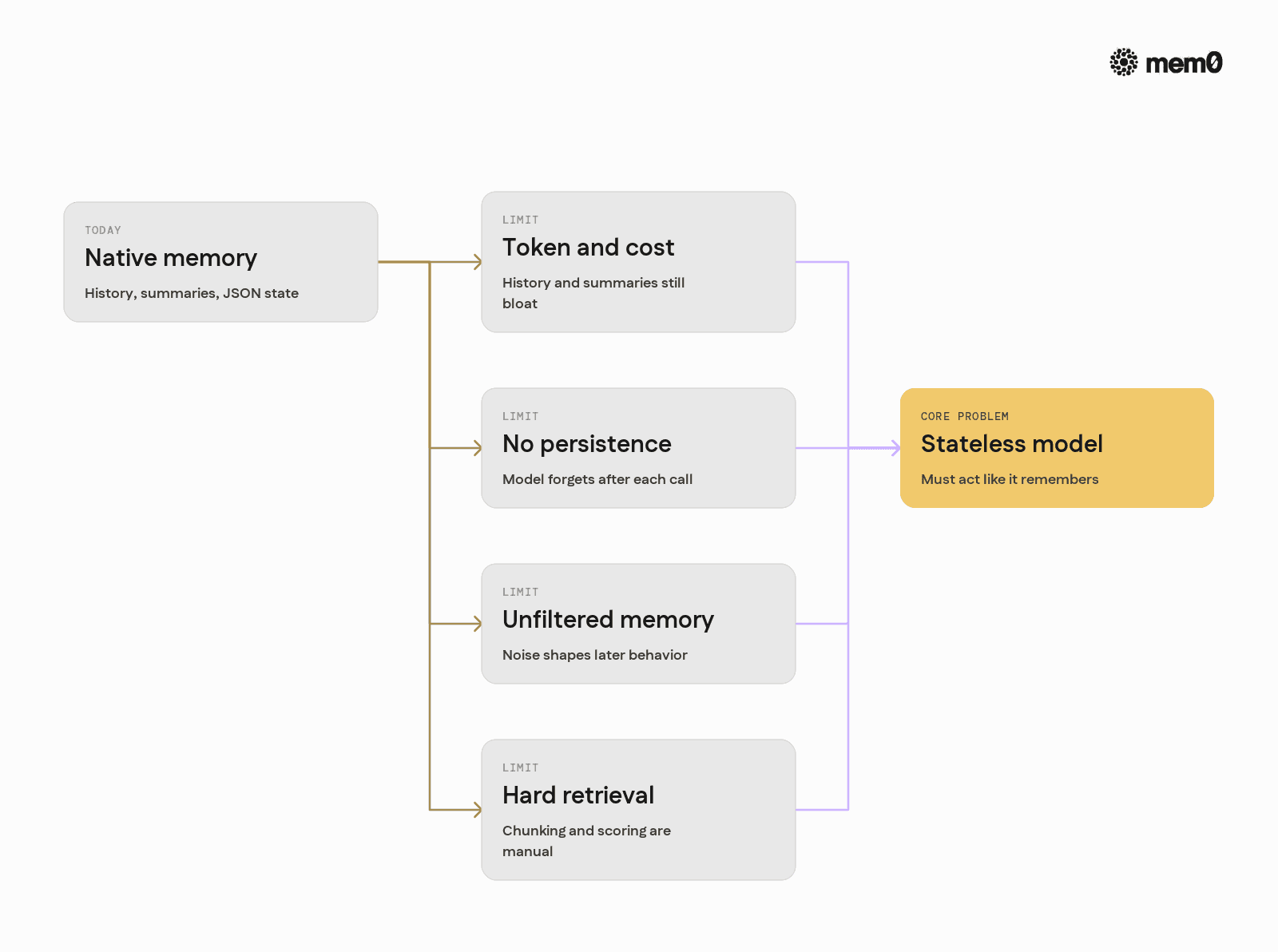
For Claude Fable 5, the core limitations around memory fall into four categories.
1. Token and cost constraints
Even with a generous context window, including entire history is not feasible. Every extra kilobyte is cost, latency, and more chances for the model to focus on the wrong detail. Summaries help, but they flatten important structure, such as:
Distinct projects with their own timelines
Stale vs active user preferences
Facts that should decay over time vs those that should not
2. No built-in persistence
Once the request finishes, the model forgets everything. Any "long-term" knowledge must be stored by external systems. Without a dedicated memory layer, teams often cobble together:
Ad hoc databases of JSON blobs
Per-user preference tables
Custom embedding pipelines
These solutions are brittle, and they are rarely agent-friendly out of the box.
3. Poor control over what is remembered
If everything is shoved into history, then everything has equal chance of shaping the model’s behavior, including throwaway jokes or misclicks. Without an explicit "memory policy", the agent cannot:
Prioritize durable facts over incidental chat
Distinguish persona-level traits from ephemeral tasks
Clean up or forget outdated state
4. Retrieval complexity
Building good retrieval for Fable 5 agents is non-trivial:
The right chunk size, indexing scheme, and scoring must be chosen
Memorable content spans tools and channels, not just user messages
Temporal aspects matter, such as "last week’s plan" versus "two months ago"
These things lie outside the model. They belong in a separate memory layer that can be tuned and iterated independently.
The core memory problem in Claude Fable 5 agents
In practice, the memory problem for Claude Fable 5 agents looks like this:
An agent must behave as if it remembers users and world state across many sessions, while the model itself is stateless and context-limited.
This leads to recurring symptoms:
Agents forget preferences like "always respond briefly"
Agents repeat onboarding questions for returning users
Complex workflows cannot resume seamlessly after a break
Tool outputs needed later are lost unless manually re-sent
Downstream prompts grow large, and reasoning quality degrades
Engineers often try to patch this by hand with ad hoc DB tables, custom embedding logic, and bespoke retrieval. Over time, this becomes a hidden distributed system inside the orchestrator.
A dedicated memory layer, designed to sit between Claude Fable 5 and data storage, can solve this in a principled way.
How Mem0 works with Claude Fable 5
Mem0 is an open-source memory layer for LLMs and agents. It connects to Claude Fable 5 through the standard pattern:
Store: Extract meaningful memories from interactions and tool calls.
Index: Represent them with embeddings and metadata, then store them in a backing store.
Retrieve: For a new query, fetch relevant memories and pass them to the model as context.
Update and forget: Merge, decay, or delete memories over time based on policies.
For an AI engineer using Claude Fable 5, Mem0 slots in as a service or library that:
Receives conversation turns and tool outputs
Decides what should be turned into durable memory
Returns only the most relevant memories for new prompts
The model remains focused on reasoning and language. Mem0 handles the lifecycle of long-term state.
Typical integration flow
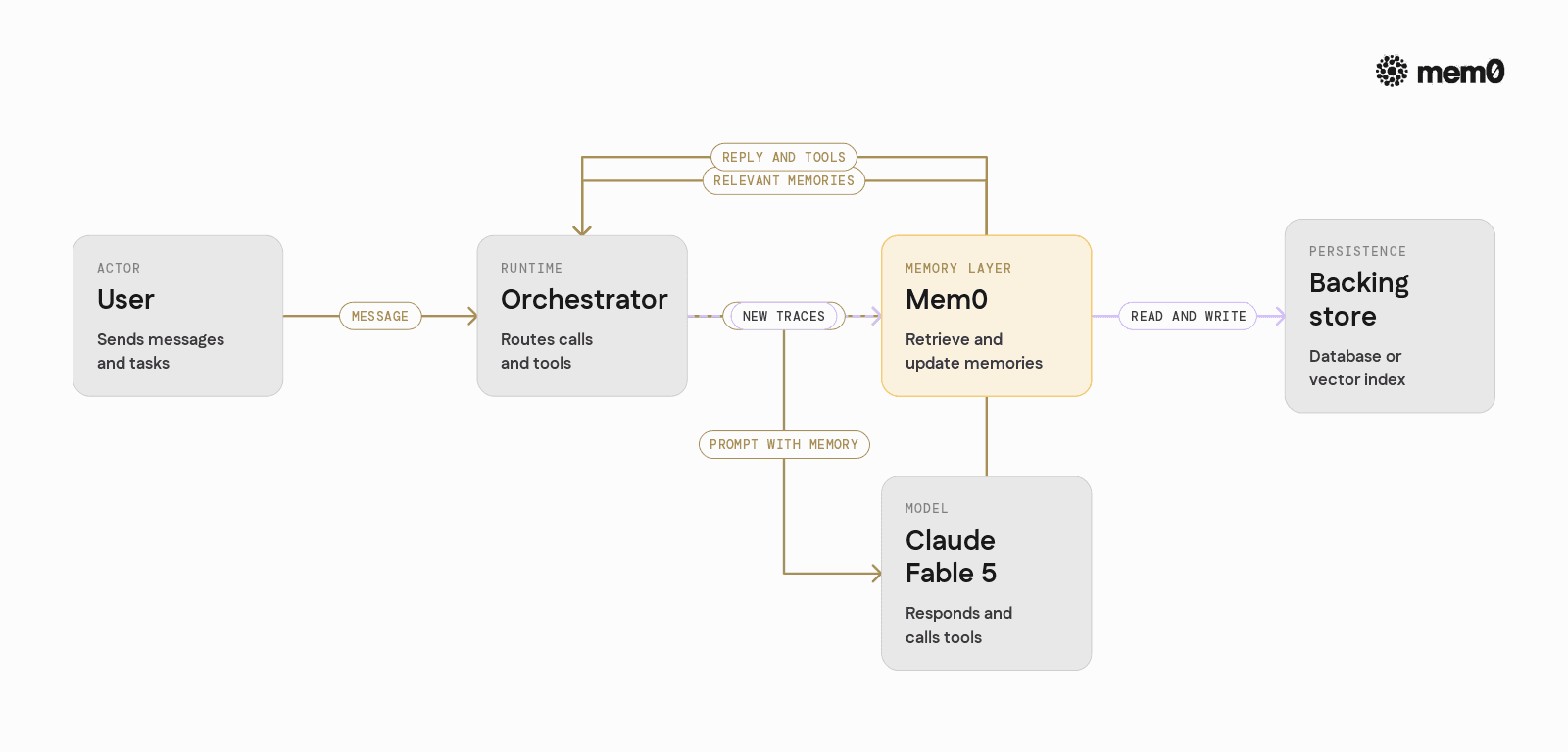
At a high level:
User sends a message to the agent.
Orchestrator calls Mem0 to retrieve memories relevant to the user and current request.
Orchestrator builds a prompt for Claude Fable 5 that includes those memories.
Fable 5 responds, possibly calling tools.
Orchestrator sends the interaction transcript and tool outputs to Mem0 to update memory.
This pattern works across domains, from personal assistants to workflow agents.
Implementing Mem0 with Claude Fable 5 in Python
The following example uses Python to show how Mem0 can integrate with a Claude Fable 5 based agent. The code assumes:
A Claude Fable 5 client, using Anthropic’s Python SDK pattern
Mem0 installed from PyPI or from source
A simple Flask-like request handler for clarity
💡 You'll need a free Mem0 API key to follow along. Get one at app.mem0.ai
This code illustrates a minimal loop:
Mem0 is called before Claude Fable 5 to supply relevant long-term context.
Mem0 is called after to update memories based on the latest interaction.
In a production agent, policies would be refined, for example:
Separate memory types for preferences, identity, and tasks
Custom extraction logic that converts raw chat into structured memory objects
Different decay rules for short-lived tasks versus long-lived preferences
Comparing memory approaches for Claude Fable 5
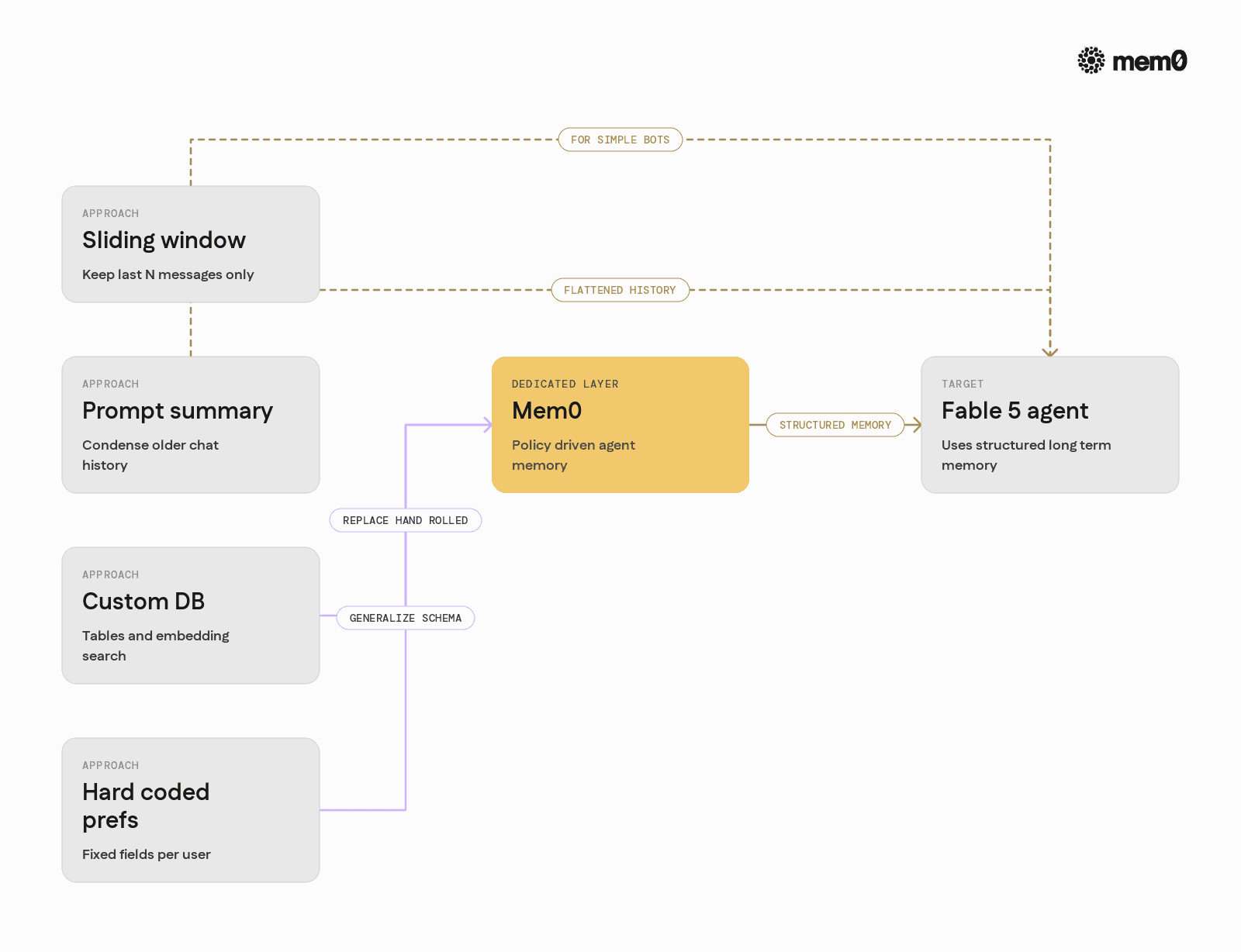
Engineers often ask whether simple history buffers or custom databases are enough. The table below summarizes common approaches for Fable 5 agents.
Approach | Description | Pros | Cons |
|---|---|---|---|
Sliding history window | Keep last N messages in context | Simple, no external systems | Quickly forgets long-term state, wastes tokens |
Manual summary in prompt | Summarize old history, prepend as text | Reduces tokens, easier than full history | Loses structure, hard to maintain consistency |
Custom DB + embeddings | Hand-rolled memory with vector search | Flexible, uses familiar tools | High engineering overhead, fragmented semantics |
Hard-coded user preference fields | Store preferences in columns or JSON | Fast lookup, predictable shape | Does not generalize to complex interactions |
Mem0 as dedicated memory layer | Purpose-built memory service for agents | Structured, policy-driven, queryable memory | Requires integration, new component to operate |
Using Claude Fable 5 with Mem0 aligns the model with a memory system designed specifically for agent workflows. The model stays focused on reasoning and dialog, while Mem0 owns the lifecycle of what the agent should remember.
Designing memory schemas for Claude Fable 5 agents
To extract the most value from Mem0 with Claude Fable 5, a memory schema should fit the agent’s role. Some common categories:
User profile: Name, role, organization, timezone, language preferences.
Communication preferences: Tone, verbosity, preferred formats such as markdown or JSON.
Long-term goals and projects: Multi-step plans or recurring tasks, including progress state.
Domain-specific facts: For example, customer-specific settings for a B2B agent, or workspace configuration for a coding agent.
Interaction history highlights: Key decisions, prior resolutions, conflicts, and escalations.
Mem0 can store these as structured objects with tags and metadata. Claude Fable 5 then receives concise snippets such as:
"User prefers concise answers and wants weekly updates on Project Orion. Last discussed task: finalize API error handling."
Rather than reading a whole transcript, the model gets curated input that is relevant and easy to apply.
Best practices for Claude Fable 5 and Mem0
A few patterns help keep the integration clean and maintainable.
Control memory volume
Claude Fable 5 benefits from focused context. Use Mem0 parameters like top_k, time filters, and tags to retrieve only what is needed. For example:
For a billing question, fetch only billing-related memories.
For a project status update, fetch only that project’s history.
Separate transient from durable
Not everything needs to go into Mem0. Transient state such as "currently building response" or "intermediate tool result" often belongs in the orchestrator only. Use:
Mem0 for facts that matter beyond the current session.
In-memory or cache layers for one-off technical details.
Let Mem0 handle extraction where possible
Instead of manually deciding what to store on every call, allow Mem0’s extraction logic to:
Identify candidate memories in text or tool outputs.
Normalize them into a consistent structure.
Apply policies to accept or reject them.
Claude Fable 5 can also help by producing machine-readable summaries that align with those policies.
Limitations of memory patterns around Claude Fable 5
Memory solves a set of problems but introduces trade-offs.
Partial recall is inherent: No retrieval system will always surface the perfect prior fact. Some user details will be missed or deprioritized. Agents should be designed to occasionally re-ask questions gracefully.
Stale or incorrect memories: If earlier interactions contained errors or misunderstandings, those can be turned into memories. Policies for correction and deletion are necessary. Without them, the agent may repeat outdated information.
Latency and complexity: Introducing a memory layer adds another network hop and more logic. For high-frequency or low-latency systems, careful optimization, batching, and caching are required.
Security and privacy considerations: Long-term memory stores sensitive user data by definition. Proper access control, encryption, and retention policies must be implemented around Mem0 and the underlying database.
Alignment drift: If memories are poorly curated, they can push Claude Fable 5 toward behaviors that diverge from the intended system prompt. Memory policies should preserve alignment by focusing on user-specific facts, not broad behavioral overrides.
Understanding these limits helps engineers design agents that use Mem0 effectively, while still handling edge cases and failure modes.
Frequently Asked Questions
Q.What problem does Mem0 solve for Claude Fable 5-based agents?
Mem0 solves the gap between stateless model calls and the need for long-term, cross-session memory. It provides structured storage, retrieval, and policies so that agents can remember users and state across many interactions without overloading the prompt.
Q. How does Mem0 integrate with Claude Fable 5 in practice?
Mem0 sits alongside the orchestrator. Before each Claude Fable 5 call, the orchestrator queries Mem0 for relevant memories and injects them into the prompt. After each call, the orchestrator sends the interaction back to Mem0, which updates memory according to configured rules.
Q. When should an engineer introduce Mem0 instead of just using chat history?
Mem0 becomes important when agents need to remember users or processes beyond a single session or short context window. Indicators include repeated onboarding questions, lost project context, or prompts that grow too large or expensive due to accumulating history.
Q. Why is a dedicated memory layer better than custom tables and embeddings?
Custom tables and embeddings can work, but they often lead to fragmented, hard-to-maintain systems. A dedicated memory layer like Mem0 centralizes storage, retrieval, and policy logic, so agents can use memory consistently while engineers iterate on behavior without rewriting infrastructure.
Q. How does Mem0 decide what to remember from Claude Fable 5 conversations?
Mem0 uses configurable policies and extraction logic to turn raw text and tool outputs into structured memories. Engineers can define rules about which kinds of content should become durable memory, which should be ignored, and how memories should be updated or expired over time.
Q. Can Mem0 handle different types of memory for one Claude Fable 5 agent?
Yes, Mem0 can separate memory into categories such as user preferences, profiles, tasks, and domain facts using tags and metadata. Retrieval queries can then target specific memory types so that Claude Fable 5 receives only the most relevant context for each request.
Further Reading
Evaluating Claude Opus 4.7 S Memory On Complex Multi Step Tasks
Reading The Traces What Two Charts Tell Us About Kimi K2.6%e2%80%99s Memory
—
Mem0 is an intelligent, open-source memory layer designed for LLMs and AI agents to provide long-term, personalized, and context-aware interactions across sessions.
Get your free API Key here: app.mem0.ai or self-host mem0 from our open-source GitHub repository.
—







Aashi Dutt
She is a senior technical content writer at Mem0. She covers agent memory architecture and the engineering decisions behind building agents that actually remember. She experiments with new features and turns research into posts developers can put straight to use.
Start building with memory
Free tier, no card