

·
34 min read

On this page
TL;DR
A memory benchmark tests whether a system can write, retain, and retrieve information across a sequence of interactions, not just find a fact in one large input. That’s the core distinction from a long-context benchmark, and conflating the two is the single most common mistake in this space.
Each major benchmark exists for a different reason: LoCoMo tests very long multi-session dialogue at scale, LongMemEval adds knowledge updates and abstention as explicit categories, BEAM tests whether memory still matters at 1M and 10M token scales, STATE-Bench tests whether an agent actually finishes a real task rather than just retrieving the right fact, and DolphinBench (Mem0’s own new benchmark) tests memory through real actions taken in simulated apps rather than through Q&A.
Benchmarks group broadly into four types: conversational memory benchmarks, multi-hop QA benchmarks, long-context benchmarks, and agentic/stateful benchmarks that grade task completion rather than retrieval alone.
Every benchmark on this page has blind spots. None of them fully test per-user isolation under concurrent load, and most grade retrieval far more thoroughly than they grade the write and forgetting steps. Read scores in pairs (accuracy with token cost, single-session with multi-session) rather than as a single number.
As of 2026, Mem0 scores 92.5% on LoCoMo, 94.4% on LongMemEval, 64.1% on BEAM-1M, and 48.6% on BEAM-10M, all published with full methodology, token cost, and latency on Mem0’s research page.
An agent that remembers things is harder to build than an agent with a long context window. It is also harder to measure.
A memory benchmark is the tool the field uses to tell the difference. It separates “the model can find a fact buried in 1M tokens of input” from “the assistant remembers what the user said three weeks ago.” Both are useful capabilities. They are not the same thing, and the same score does not measure both.
This post walks through what a memory benchmark is, why memory benchmarks matter, where the field stands in 2026, and the benchmarks major agent memory systems are evaluated against today.
This is the deep-dive companion to the broader State of AI Agent Memory 2026 post. The state-of covers the full memory landscape (architectures, patterns, vendors). This one stays narrow on benchmarks.
AI Memory Benchmark Leaderboard (2026)
Here’s where the systems with a citable public LoCoMo or LongMemEval score currently sit. Read the methodology column before the score column: several of these numbers are disputed by the vendors named next to them, and at least one vendor has published two different scores for itself in different posts.
LoCoMo leaderboard
System | LoCoMo score | Methodology |
|---|---|---|
ZeroMemory | 96.1% (claimed) | Self-reported; not independently verified. Note: identical to ByteRover’s separately claimed 96.1% figure below |
ByteRover | 92.2% or 96.1% (both self-reported) | Self-reported, but ByteRover itself has published both numbers in different posts/repos — see verification note |
Mem0 | 92.5% | Self-reported, published on Mem0’s own research page with full methodology |
Zep | 94.7% (claimed) | Self-reported by Zep. Third-party tests (ByteRover’s own comparison) put Zep at 75.1% on the same benchmark. Check Mem0 and Zep comparison for more details. |
Dakera | 88.2% | Self-reported, explicitly run with no LLM-assisted reranking, standard protocol as designed |
LongMemEval leaderboard
System | LongMemEval score | Methodology |
|---|---|---|
ByteRover | 92.8% (LongMemEval-S) | Self-reported |
Mem0 | 94.4% | Self-reported, published on Mem0’s own research page |
Zep | 71.2% (GPT-4o judge) | This figure appears consistently across Zep’s own reporting and at least one independent academic comparison |
STATE-Bench leaderboard
STATE-Bench is Microsoft’s task-level benchmark for AI agent memory. Where LoCoMo and LongMemEval score retrieval accuracy, STATE-Bench scores whether the agent actually finishes the job.
The benchmark runs 450 tasks across three domains: customer support, travel, and shopping. Each task is a multi-turn interaction that requires the agent to carry state forward, resolve ambiguity, and act on prior context. Scoring is end-to-end, not per-retrieval.
Four dimensions define the leaderboard:
Task Completion (pass@1): Did the agent complete the task on the first attempt?
Reliability (pass^5): Did it complete the task across five independent runs? This is the stability metric. A system that scores high on pass@1 but collapses on pass^5 is brittle. In Microsoft’s own baseline (GPT-5.1 without memory), only about 30% of travel-domain tasks succeeded across all five runs.
Communication quality: A judged measure of interaction quality: did the agent ask the right questions, avoid redundant prompts, and respect prior turns?
Cost Per Task: Total tokens and inference spend to complete one task. Memory that improves accuracy but doubles cost per task is not a win.
STATE-Bench also includes a dedicated Agent Learning Track, which gives a system trajectories from earlier tasks, lets it extract and store reusable memories, and tests whether those memories improve performance on separate held-out tasks, the track most directly relevant to memory-layer evaluation specifically.
Why this matters: retrieval accuracy is a proxy. Task completion is the outcome. A memory layer can score 90%+ on LoCoMo and still fail a support ticket if it retrieves the right fact but can’t sequence it into an action. STATE-Bench closes that gap.
DolphinBench: Mem0’s Own New Benchmark
DolphinBench, published by Mem0, is the newest addition to this leaderboard and the only one graded through real actions in simulated apps rather than question-answering.
Metric | Detail |
|---|---|
Tests | 600 total (200 each across 3 personas: a startup CEO, an infrastructure engineer, a product manager) |
History per persona | ~500,000 tokens, spanning several simulated years |
Grading | Action-based: agent must complete a task via simulated apps (Notion, Gmail, GitHub, etc.), not just answer a question |
Certification | Solvability-certified: every test verified to succeed with the relevant history and fail without it |
Current top score | 70.67% (Hermes + GPT-5.6-Luna + Mem0), live leaderboard at dolphinbench.ai/leaderboard |
Full methodology and worked examples are covered in the DolphinBench section below.
None of these numbers were generated using the same model stack, judge model, or retrieval configuration. Treat this table as a starting point for further reading, not a settled ranking. The section immediately below explains why that caveat matters as much as it does.
See the full current methodology behind Mem0’s own numbers; explore the research section.
What is an AI Memory Benchmark?
An AI memory benchmark is a standardized evaluation that tests whether a system can capture information from an interaction, hold onto it, and correctly bring it back when it becomes relevant again, across sessions, not just within a single exchange. It’s a different kind of test than most people assume when they hear “AI benchmark,” because the thing being scored isn’t the model’s raw knowledge or reasoning; it’s whether the system built around that model actually remembers.
A memory benchmark gives a system a sequence of inputs over time, requires the system to write something to a store, and asks the system to retrieve from that store on a later turn to produce the right answer. The state of the system at turn 50 depends on what it did across turns 1 through 49.
A long-context benchmark, by contrast, gives the model a single large input (100K, 1M, or 10M tokens) and asks the model to retrieve, summarize, or reason over the whole input in one pass. The state of the input is fixed. Nothing was written. Nothing persists after the call. Capacity and continuity are different problems, and the same score does not measure both.

The two failure modes are different, too. A long-context benchmark fails when the model attends to the wrong span. A memory benchmark fails when the system stores the wrong thing, stores the right thing but retrieves the wrong one, or stores and retrieves the right thing but ranks it badly. Conflating the two makes a system look better than it is. A model that aces a needle-in-a-haystack test at 1M tokens is not, by virtue of that score, a system that handles cross-session memory well. The benchmark doesn’t test it.
Every memory benchmark, whatever its specific format, is built around three parts:
What gets fed in: conversations, documents, events, or actions, the raw material the system has to work with
What the system is required to do with it: store, update, or discard information as it comes in, before any question is ever asked
What gets scored: whether the system successfully uses what it retained to answer a question or complete a task later
How Does a Memory Benchmark Work?
Underneath the differences between LoCoMo, LongMemEval, BEAM, STATE-Bench, and DolphinBench, every memory benchmark runs the same three-stage loop:
Ingestion: The system receives conversations, documents, events, or actions, the raw material a real deployment would encounter over time.
Memory operations: It stores, consolidates, updates, or removes information based on what it decides is worth keeping.
Retrieval and use: It retrieves relevant memories to answer a question or complete a task, and that output is what actually gets scored.
A benchmark that only tests the third stage is testing retrieval, not memory. The benchmarks that differentiate themselves in 2026, BEAM on scale, STATE-Bench and DolphinBench on task completion, do so specifically by making the first two stages harder to fake.
Why Memory Benchmarks Matter?
Memory in an LLM agent is not a capability. It is at least four: extracting useful facts from a stream of dialogue, writing them into an external store, retrieving the right ones at inference time, and pruning or updating them when they go stale.
A benchmark that only tests retrieval is testing one of those four. That matters because the popular shortcut, “just stuff everything into a long context window,” is a different system entirely. It has no write step, no eviction, no per-user partition, and no token budget.
Without a benchmark that exercises the write side, the update side, and retrieval under realistic budgets, a memory system can score 95 on paper and still ship an agent that forgets users between sessions, leaks one tenant’s preferences into another, or pays 10x the token cost the leaderboard suggests.
The skeptical question to ask of any memory benchmark is therefore not “what score did the top model get” but “what fraction of the read, write, extract, store, retrieve loop did this benchmark actually exercise?”
Recall alone does not prove that an agent can use memory effectively. DolphinBench evaluates whether agents apply information from past conversations while completing real tool-based tasks.
Five things, at minimum, a complete memory benchmark has to test.
Cross-session continuity: Surface relevant facts from earlier sessions when the user asks something new in a later session. Without this, the system is a chat buffer, not memory.
Selective writes: Decide what to remember from each turn. A system that writes everything fills up. A system that writes nothing has no memory.
Retrieval under realistic budgets: Real agents have token budgets. A benchmark that lets the system inject 50K tokens of memory into every prompt is not testing memory under conditions that any production deployment would tolerate.
Forgetting and updating: Overwrite stale memories instead of stacking them. A benchmark that only tests retrieval misses this entirely.
Per-user isolation: Keep user A’s memory out of user B’s responses. Benchmarks that run a single synthetic user cannot catch this failure.

Types of AI Memory Benchmarks
Here are 4 types of AI memory benchmarks:
Conversational memory benchmarks (LoCoMo, LongMemEval) test recall and reasoning over long, multi-session dialogue, structured as question-answering. These are the most established category and the ones most vendors report against.
Multi-hop QA benchmarks test whether a system can connect facts that were never stated together, requiring it to chain multiple retrieved memories rather than surface a single matching one.
Long-context benchmarks (NIAH, RULER, BABILong) test attention over a single large input rather than memory across sessions. They measure a different, related capability, useful for understanding the substrate a memory system runs on, but not a substitute for a memory benchmark.
Agentic and stateful benchmarks (STATE-Bench, DolphinBench) grade whether an agent completes a real task using memory, rather than whether it answers a question correctly. This category is the newest and, as of 2026, the one exposing the largest gap between benchmark accuracy and production reliability.
AI Memory Benchmark Sizes
Benchmark scale varies enormously and isn’t directly comparable across benchmarks. LoCoMo conversations average around 9,000 tokens across up to 35 sessions, modest by 2026 standards. LongMemEval spans roughly 115,000 tokens in its standard (S) size, extending to around 500 sessions in its larger (M) variant. DolphinBench sits at roughly 500,000 tokens of history per persona. BEAM goes furthest, testing at 1M and 10M token scales specifically to see whether memory still matters once a context window alone could theoretically hold everything.
Larger scale generally means harder degradation for any system, including strong ones. Mem0’s own scores illustrate this directly: 92.5% on LoCoMo, 94.4% on LongMemEval, but 64.1% on BEAM-1M and 48.6% on BEAM-10M. That drop isn’t a weakness specific to one vendor; it’s the point of BEAM existing at all, no current memory architecture saturates it.
Benchmark | Scale | Dataset | What evaluation includes |
|---|---|---|---|
LoCoMo | ~9,000 tokens across up to 35 sessions | Generated via a machine-human pipeline grounded in personas and temporal event graphs, then human-validated | Question answering, event summarization, and multimodal dialogue generation across single-session, multi-session, and timeline-ordering questions |
LongMemEval | ~115,000 tokens across ~40 sessions (S size); up to ~500 sessions (M size) | 500 curated questions covering five abilities | Information extraction, multi-session reasoning, temporal reasoning, knowledge updates, and abstention (correctly declining to answer about events that never happened) |
DolphinBench | ~500,000 tokens of history per persona, across 3 personas | 600 tool-using tests (200 per persona) built from simulated multi-year histories | Whether the agent completes a real action (via simulated apps) using information from earlier in its history; every test solvability-certified with and without that history |
BEAM | Up to 10 million tokens across 100 conversations | 2,000 probing questions, generated via a planning pipeline covering narratives, user profiles, and timelines | Ten memory capabilities across two tracks (BEAM-1M, BEAM-10M): tracking facts and entities, updating information, resolving contradictions, temporal ordering, and more |
LoCoMo introduced very long-term, multi-session continuity at a scale earlier work hadn’t reached, and it remains the most widely reported number across memory systems, though its scale is modest by 2026 standards and it doesn’t explicitly score knowledge updates. LongMemEval closes that gap with its knowledge-update and abstention categories, at a somewhat larger scale. DolphinBench pushes further by testing real actions rather than answers, over roughly half a million tokens of persona history. BEAM goes furthest of all, testing at scales where a context window alone could theoretically hold everything, specifically to see whether memory still matters once it can.
The state of memory benchmarking in 2026
Three benchmarks are widely cited as memory benchmarks in the strict sense: LoCoMo, LongMemEval, and BEAM. Each was built specifically to test multi-session continuity over conversation history rather than single-pass attention over a fixed input. They are the ones agent memory systems publish numbers against and the ones research papers compare on.
Everything else commonly cited in this space (NIAH, RULER, BABILong, InfiniteBench, LongBench) measures long-context attention. These benchmarks are useful for understanding the substrate a memory system runs on, such as effective context length and reasoning at length, but they test attention over a single fixed input rather than the multi-session write-and-retrieve loop. A short note on them comes after the three.
By 2026, long context and memory are widely treated as different problems with different evaluations. The framing that has stuck across the field is that long context solves capacity while memory solves continuity across sessions. A 1M-token retrieval score does not, on its own, indicate that a system handles cross-session memory well.
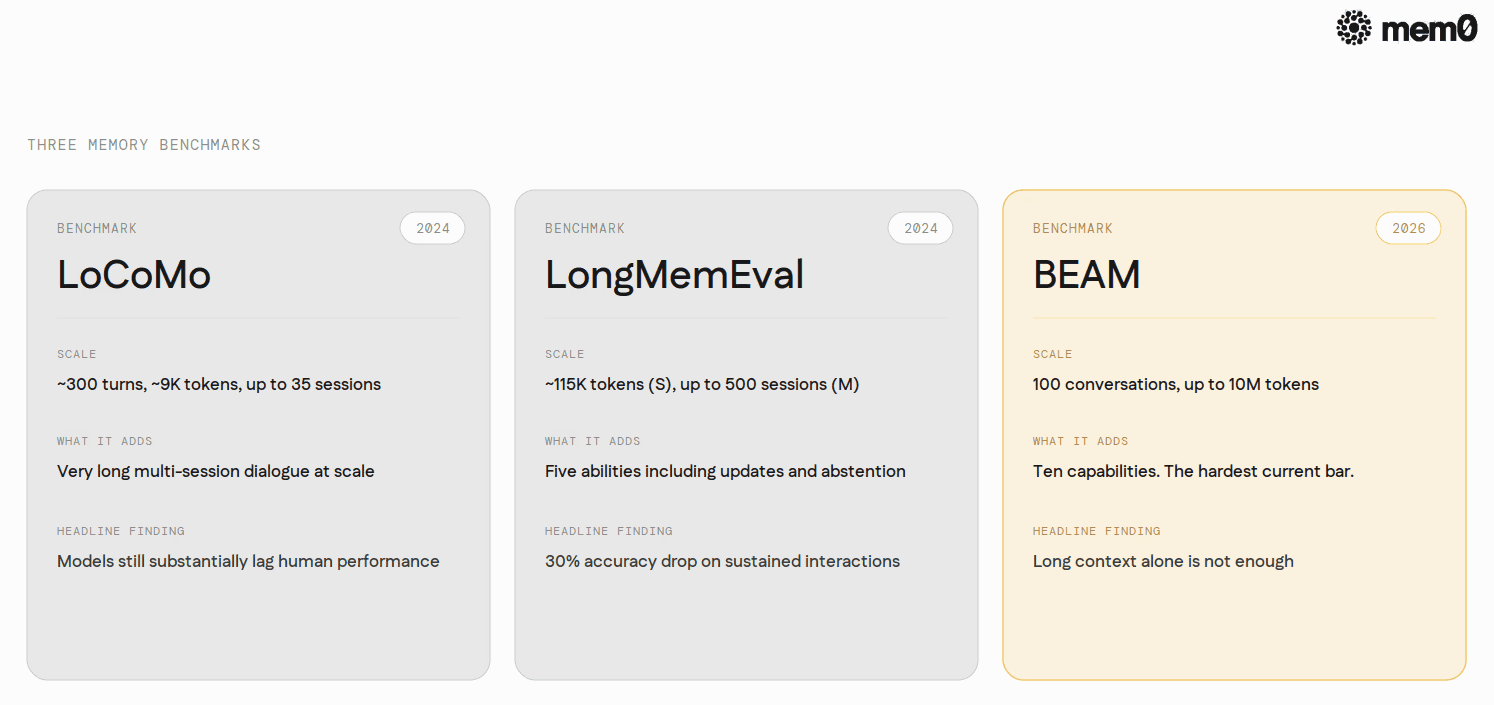
At a glance:
Benchmark | Year | What it adds |
|---|---|---|
LoCoMo | 2024 | Very long multi-session dialogue at scale |
LongMemEval | 2024 | Five abilities, including knowledge updates and abstention |
BEAM | 2026 (ICLR) | Ten memory capabilities up to 10M tokens |
LongMemEval-V2 | 2026 | Extends the LongMemEval format to web-agent environments |
LoCoMo
LoCoMo leaderboard (2026): Mem0 92.5% · Zep 94.7% (claimed) · ByteRover 92.2% · Dakera 88.2% · ZeroMemory 96.1% (claimed).
LoCoMo was introduced in 2024 in “Evaluating Very Long-Term Conversational Memory of LLM Agents“ by Maharana, Lee, Tulyakov, Bansal, Barbieri, and Fang. The dataset captures very long conversations: each one averages around 300 turns and 9,000 tokens spread across up to 35 sessions. Conversations are generated through a machine-human pipeline grounded in personas and temporal event graphs, then validated by humans.
The evaluation surface includes question answering, event summarization, and multimodal dialogue generation. The QA portion is what most memory papers report against, and it includes single-session questions, multi-session questions, and timeline-ordering questions.
The paper’s headline finding is blunt. Even with retrieval-augmented setups or long-context LLMs, models “still substantially lag behind human performance” on these long, multi-session conversations.
LoCoMo brought very long-term, multi-session continuity into the benchmark conversation at a scale earlier work did not reach, and it is still the most widely reported number across memory systems. Two limitations have surfaced since: the average context length is modest by 2026 standards, and the dataset does not explicitly score knowledge updates. That makes LoCoMo a useful baseline, not a sufficient bar on its own.
Both gaps have since drawn successor benchmarks. Locomo-Plus (2026) targets beyond-factual, cognitive evaluation rather than surface recall, and LongMemEval-V2 extends the format to web-agent environments. Neither replaces the originals yet, but they show where the field is pushing.
Why do LoCoMo scores disagree?
The leaderboard above isn’t inconsistent because someone made an error. It’s inconsistent because “run LoCoMo” isn’t one fixed procedure, and small protocol differences compound into large score differences.
Dakera’s own benchmark write-up states this plainly about the two highest published claims: “Mem0’s self-reported 2026 score (92.5%) and Zep’s 2026 claim (94.7%) use different models and evaluation setups - not directly comparable.” Dakera’s own 88.2% score, by their account, comes from running the standard LoCoMo evaluation with no LLM-assisted reranking step, a single retrieval pass scored by an LLM judge as the benchmark was originally designed. Add a reranking step, and the score moves. That single design choice, not overall system quality, explains a meaningful chunk of the gap between Dakera’s number and Mem0’s.
The same pattern shows up between vendors testing each other. ByteRover’s own published comparison table puts Zep at 75.1% on LoCoMo and Mem0 at 66.9%, both well below what Zep and Mem0 report for themselves. The most likely explanation isn’t fraud on anyone’s part: it’s that ByteRover tested different model versions, different judge models, or different retrieval configurations than the ones Zep and Mem0 used in their own published runs. The 66.9% figure for Mem0 specifically lines up with an older Mem0 algorithm version, not the current one.
Three variables account for most of the spread: the judge model used to grade answers, the answering model generating responses, and whether reranking or other post-processing steps are applied before scoring. Two labs running “the same benchmark” with different choices on all three will not land on the same number, and neither is necessarily wrong.
The practical takeaway: when you see a LoCoMo or LongMemEval score, ask what model stack produced it and whether the vendor documents their exact protocol, the way Dakera and Mem0 both do. A number with no stated methodology is not comparable to one, regardless of which is higher.
LongMemEval
LongMemEval leaderboard (2026): Mem0 94.4% (self-reported) · ByteRover 92.8% on LongMemEval-S (self-reported) · Zep 71.2% (GPT-4o judge, consistent across Zep’s own reporting and an independent academic comparison).
LongMemEval, from Wu, Wang, Yu, Zhang, Chang, and Yu, focuses explicitly on the chat-assistant memory case. It defines five abilities: information extraction, multi-session reasoning, temporal reasoning, knowledge updates, and abstention. The full eval set is 500 curated questions.
The dataset comes in two sizes. LongMemEval_S has chat histories of roughly 115,000 tokens spread over about 40 sessions per user. LongMemEval_M extends that to roughly 500 sessions per chat history, which is the regime where naive context-stuffing breaks down completely.
The abstention task is one of the most useful design choices in the benchmark. Questions ending with _abs refer to events that never happened in the chat history, and the system is graded on whether it correctly declines instead of fabricating an answer. That captures a failure mode most retrieval evals ignore.
The paper reports that “commercial chat assistants and long-context LLMs show a 30% accuracy drop” on memorizing information across sustained interactions. The repository uses GPT-4o as a judge for QA correctness.
LongMemEval is one of the benchmarks most cited as a realistic load test for chat-assistant memory. It explicitly covers knowledge updates and abstention, which LoCoMo does not, and the multi-session split runs into the regime where any naive approach falls over.
BEAM
BEAM was introduced in “Beyond a Million Tokens: Benchmarking and Enhancing Long-Term Memory in LLMs“ at ICLR 2026.
The BEAM benchmark builds 100 conversations, each spanning up to 10 million tokens, with 2,000 probing questions. Conversations are generated through a planning pipeline that produces narratives, user profiles, and timelines, then expands those plans into multi-turn dialogue with persistent identity and evolving facts.
BEAM tests ten memory capabilities in one suite: tracking facts and entities, updating information over time, resolving contradictions, understanding temporal order, distinguishing instructions from preferences, multi-hop reasoning across turns, summarizing long histories, and related skills. Two tracks separate the regimes: BEAM-1M for million-token contexts and BEAM-10M for ten-million-token contexts.
The headline finding is the persistent gap between long context alone and long context plus structured memory. The paper introduces LIGHT, a memory-augmented framework released alongside the benchmark, and reports 3.5% to 12.7% higher accuracy on probing questions versus the strongest long-context baselines, with the gap widening as token scale grows. Models tested in the paper include GPT-4.1-nano, Gemini-2.0-Flash, Qwen2.5-32B, and Llama-4-Maverick.
For agent builders, BEAM is the benchmark that asks whether a 10M context window lets a team skip building memory. The paper’s answer is no.
LongMemEval-V2: What Changed
LongMemEval-V2 extends the original benchmark’s format to web-agent environments, evaluating memory in the context of an agent taking actions on the web rather than only answering questions in a chat interface. This is consistent with the direction the field’s newer benchmarks (STATE-Bench, DolphinBench) are also pushing: from pure recall toward memory demonstrated through action.
Adoption of V2 is uneven as of this writing. Some vendors report against it, some still report V1 numbers, and some report neither. Whatever version a score comes from, check the label before putting two numbers in the same table: a V1 score and a V2 score are not testing the identical thing, and treating them as directly comparable understates the real difference between two systems, or overstates it, depending on which direction the mismatch runs.
DolphinBench
DolphinBench, published by Mem0, takes a different approach from every benchmark above: instead of asking a question and grading the answer, it asks an agent to take a real action, through a simulated app, and grades whether it did the right thing.
The benchmark covers three personas built for broad coverage across tools and task types: Morgan, a startup CEO; Alex, an infrastructure engineer; and Riley, a product manager. Each persona has a simulated history spanning several years (see section 5 above for the token scale). The benchmark contains 600 tests total, 200 per persona, with tool calls and apps (Notion, Gmail, GitHub, and others) simulated to reproducibly test real-world actions.
A worked example: in one January session, a persona mentions a coffee preference in passing. Weeks later, the test instructs the agent to “order one small latte for pickup.” A correct agent uses that earlier preference to place the order at the right shop. There’s no explicit hint in the test itself that memory is required, mirroring how real requests actually work.
Every test is solvability-certified: Mem0 verified each one by running an agent with the relevant history (which must succeed) and without it (which must fail). A test that can be solved without the history isn’t actually testing memory, and DolphinBench’s methodology is built specifically to rule that out.
The current top-scoring configuration on the live leaderboard (Hermes + GPT-5.6-Luna + Mem0) completes 70.67% of tasks, a useful reminder that action-based memory evaluation is meaningfully harder than QA-style recall, no configuration on this benchmark is anywhere near saturated the way single-session categories on LongMemEval are.
A short note on long-context benchmarks
NIAH, RULER, BABILong, InfiniteBench, and LongBench v1 and v2 are the long-context benchmarks most often confused with memory benchmarks. They keep showing up in vendor decks, so a brief note is worth the space.
NIAH, from Greg Kamradt, inserts one fact into a long passage and asks the model to retrieve it. By 2026 it is a smoke test for context-window functionality, nothing more. RULER, from NVIDIA, extends NIAH with multiple needles, variable tracing, aggregation, and QA, and shows that many models marketed as 128K-capable have an effective working length closer to 32K to 64K. BABILong embeds bAbI-style reasoning tasks inside long natural text and finds that LLMs “effectively utilize only 10 to 20 percent of the context” they nominally support. InfiniteBench was one of the first post-100K-token benchmarks designed so simple passage retrieval cannot solve it. LongBench v2 raises difficulty further, with humans scoring 53.7% under a 15-minute time limit and direct-prompted models hitting 50.1%.
All of these test attention over a single fixed input. None of them tests cross-session continuity, write quality, or per-user isolation. Treat them as the substrate. The three memory benchmarks above test what gets built on top.
What current benchmarks still miss
Even the three memory benchmarks have visible gaps once they are read against the read, write, extract, store, retrieve loop.
Cross-session continuity at production scale. LoCoMo tops out at about 35 sessions. LongMemEval_M extends to roughly 500. BEAM goes to 10M tokens. The field is not yet stable on what “long enough” means for a personal assistant that has been running for a year.
Memory writes. Almost every public benchmark grades the retrieval step. The write step, deciding what is worth keeping out of a conversation that is mostly noise, is barely measured. A system that stores everything will look the same on retrieval as a system that stores only what matters, until token budgets and inference latency get involved.
Forgetting, eviction, and consolidation. Real memory systems have to forget. They have to drop facts when they go stale, merge duplicates, and reconcile contradictions. There is no widely adopted public benchmark that scores these dynamics directly. BEAM’s “updating information over time” and “resolving contradictions” subscores get closest, and they are still the exception.
Per-user isolation. None of the public benchmarks listed above test isolation under concurrent multi-user load. Every production memory system has to handle it. Almost no academic eval covers it.
Token-economy under realistic budgets. A memory system that scores 92 with 7,000 tokens per query is not the same product as a system that scores 92 with 70,000 tokens per query. Most leaderboard tables ignore this.
Today’s benchmarks measure recall accuracy on tidy data. The next generation has to measure write quality, forgetting, isolation, and accuracy under realistic budgets.
Vendor-Reported Scores: What to Trust
Every memory vendor publishes benchmark numbers. Almost none of them are directly comparable. The gap is in the methodology. Five variables can move a score by double digits:
Harness differences: The evaluation harness decides how context is assembled, how many retrieved memories are passed to the model, and how the answer is parsed. A harness that retrieves 50 memories will beat one that retrieves 10 on recall, and lose on cost and latency.
Prompt templates: The prompt that wraps the retrieved context changes accuracy more than the retrieval layer does. A tuned prompt can add several points with no change to the underlying system.
Judge models: LLM-as-judge scoring varies by judge. A lenient judge inflates every number it touches. If the judge model isn’t disclosed, the score isn’t reproducible.
Dataset splits: Some evaluations tune on the same questions they score on. Others hold out a clean split. Same system, same benchmark, different number.
Retrieval layer vs. full pipeline: Some vendors measure only the retrieval step; did the right memory come back? Others measure the full pipeline: retrieval plus generation plus answer. Retrieval-only scores are systematically higher and say nothing about end-to-end quality.
Vendor | LoCoMo | LongMemEval | Notes |
|---|---|---|---|
Mem0 | 92.5% | 94.4% | Verified, full pipeline. Also reports BEAM-1M 64.1% and BEAM-10M 48.6%. Median 6.7K–7.0K tokens per retrieval, p50 latency 0.88s–1.09s. |
Zep | Not directly comparable | Not directly comparable | Publishes its own evaluation framing; see the disagreement discussion above rather than treating any single Zep figure as settled. |
ByteRover | Not directly comparable | 92.8% (LongMemEval-S, self-reported) | Has published two different self-reported LoCoMo figures (92.2% and 96.1%) in different posts; see the leaderboard above. |
Dakera | 88.2% | Not published | Self-reported, explicitly run with no reranking. |
EverMemOS | 92.3% (self-reported) | 82% (LongMemEval-S, self-reported) | Self-reported by EverMind. LongMemEval-S is a subset variant, not the full set, don’t compare directly against full-set numbers. |
How to compare fairly:
Match the benchmark version: V1 against V1, V2 against V2, full set against full set. A subset score is not a benchmark score.
Match the scope: Retrieval-only against retrieval-only, full pipeline against full pipeline.
Demand the harness: If the evaluation code isn’t public, the number is a claim, not a result.
Check the judge: Undisclosed judge model means undisclosed scoring bias.
Read the cost column: Accuracy without tokens-per-retrieval and p50 latency is half a result.
Prefer reproducible numbers: The only score you can trust is one you can rerun, see the next-to-last section for how to do that with Mem0’s own open evaluation framework.
What Are the Limitations of AI Memory Benchmarks?
In short: every current memory benchmark grades retrieval far more thoroughly than it grades the write step, forgetting, and per-user isolation, and none of them fully test concurrent multi-user load. That means a high score is a real signal, but not a complete one.
Cross-session continuity at production scale. LoCoMo tops out at about 35 sessions. LongMemEval_M extends to roughly 500. BEAM goes to 10M tokens. The field is not yet stable on what “long enough” means for a personal assistant that has been running for a year.
Memory writes. Almost every public benchmark grades the retrieval step. The write step, deciding what is worth keeping out of a conversation that is mostly noise, is barely measured. A system that stores everything will look the same on retrieval as a system that stores only what matters, until token budgets and inference latency get involved.
Forgetting, eviction, and consolidation. Real memory systems have to forget. They have to drop facts when they go stale, merge duplicates, and reconcile contradictions. There is no widely adopted public benchmark that scores these dynamics directly. BEAM’s “updating information over time” and “resolving contradictions” subscores get closest, and they are still the exception.
Per-user isolation. None of the public benchmarks listed above test isolation under concurrent multi-user load. Every production memory system has to handle it. Almost no academic eval covers it.
Token-economy under realistic budgets. A memory system that scores 92 with 7,000 tokens per query is not the same product as a system that scores 92 with 70,000 tokens per query. Most leaderboard tables ignore this.
Today’s benchmarks measure recall accuracy on tidy data. The next generation has to measure write quality, forgetting, isolation, and accuracy under realistic budgets.
Where Mem0’s published numbers sit
Mem0 publishes its benchmark numbers on the public research page. The 2026 scores, with the prior version’s baseline where applicable, mean tokens per retrieval, and p50 latency:
Benchmark | Old | New | Tokens | Latency p50 | Questions |
|---|---|---|---|---|---|
LoCoMo | 71.4 | 92.5 | 7.0K | 0.88s | 1,540 |
LongMemEval | 67.8 | 94.4 | 6.8K | 1.09s | 500 |
BEAM-1M | — | 64.1 | 6.7K | 1.00s | 700 |
BEAM-10M | — | 48.6 | 6.9K | 1.05s | 200 |
These numbers come from Mem0’s updated memory algorithm (April 2026). Four pieces of the pipeline changed:
Single-pass ADD-only extraction. New turns are processed in one LLM call with no UPDATE or DELETE operations. Memories accumulate rather than getting overwritten.
Agent-generated facts are first-class. When an agent confirms an action, that information is stored with the same weight as a user-supplied fact.
Entity linking. Entities are extracted, embedded, and linked across memories so retrieval can boost on entity matches.
Multi-signal retrieval. Semantic similarity, BM25 keyword, and entity matching are scored in parallel and fused.
Token efficiency and latency are the other reasons the numbers matter. Mean tokens per retrieval run around 6.7K to 7.0K across the four benchmarks, against full-context baselines that consume 25,000+ tokens per query. That works out to roughly 3-4x lower token cost at competitive accuracy on the same benchmarks. P50 latency stays at or under 1.1 seconds across all four benchmarks, including BEAM-10M.
Accuracy without a token budget is a half-finished score.
The LongMemEval per-category breakdown shows where the work is concentrated.
LongMemEval category | Mem0 score |
|---|---|
Single-session (user) | 98.6 |
Single-session (assistant) | 98.2 |
Knowledge update | 93.6 |
Multi-session | 88.0 |
Single-session categories sit near saturation, between 96 and 99. Knowledge update, at 93.6, is the category most affected by the additive, ADD-only architecture: older facts are preserved rather than overwritten, so a semantically similar prior fact can surface alongside a newer one. Multi-session reasoning, at 88.0, is the other category with visible headroom, and it is the more honest read of where cross-session memory work still has room to improve. The LoCoMo breakdown on Mem0’s research page shows a related pattern: temporal and multi-hop questions score well, around 92 and 91, while open-domain retrieval, at 72.7, is the weak spot and is actively being tuned. That is consistent with the general state of the field rather than something specific to Mem0.
Reading these numbers against BEAM is also worth doing. The BEAM-1M and BEAM-10M scores (64.1 and 48.6) are below the LoCoMo and LongMemEval headlines. That gap is the point of BEAM. It is a benchmark designed so that no current memory architecture saturates it.
The shape of the choice
For agent builders, the practical takeaway is to read benchmark scores in pairs. Pair an accuracy number with its token cost. Pair a single-session score with a multi-session one. Pair a context-window probe with a memory eval. The pair is what tells the truth.
For the broader memory landscape (architectures, patterns, the vendor map), the State of AI Agent Memory 2026 post is the companion piece. For a deeper look at BEAM specifically, see the BEAM benchmark explainer.
How to Run These Benchmarks Yourself
Published benchmark numbers are a starting point, not a verdict. The only score that matters is the one you reproduce on your own data. Mem0’s evaluation framework is open source, so you can do exactly that: run LoCoMo and LongMemEval against the published configuration and check the numbers yourself.
What the framework gives you: the LoCoMo and LongMemEval evaluation harnesses with the same prompt templates and judge configuration used for the published results, dataset loaders for both benchmarks including the category breakdowns, a pluggable memory backend so you can compare Mem0 against your own retrieval layer on identical inputs, and token/latency instrumentation so accuracy comes with the cost side attached.
Setup:
Illustrative usage (confirm exact class names and interface against the current repo before treating this as copy-paste accurate):
Swap in your own backend by implementing a retrieve() method that returns ranked memories for a query, and you get an apples-to-apples comparison against the published numbers on identical questions, identical prompts, and an identical judge.
Why this matters: academic papers and Microsoft’s STATE-Bench both win on rigor, clean splits, disclosed methodology, reproducible harnesses. Most vendor leaderboards don’t. Running the evaluation yourself closes that gap, and you stop arguing about whose harness is fairer.
What to measure beyond accuracy: log tokens per retrieval and p50 latency on every run. A memory layer that adds three points of accuracy and 4K tokens per call is a regression in production. The published Mem0 configuration sits at 6.7K–7.0K tokens per retrieval and 0.88s–1.09s p50 latency; use those as the baseline you’re trying to beat.
Frequently Asked Questions
Q. What is the LongMemEval leaderboard and who scores highest?
Among systems with a citable public score, Mem0 currently reports the highest LongMemEval figure at 94.4%, with ByteRover reporting 92.8% on the LongMemEval-S variant and Zep reporting 71.2% under a GPT-4o judge. These numbers come from different model stacks and evaluation protocols, so treat “highest” as provisional rather than settled; see “Why LoCoMo scores disagree” above for why that caveat matters just as much on LongMemEval.
Q. What is the LoCoMo benchmark leaderboard?
The published LoCoMo claims as of 2026 range from Dakera’s 88.2% (standard protocol, no reranking) through Mem0’s 92.5% up to Zep’s and ByteRover’s and ZeroMemory’s claims in the 92-96% range, several of which are disputed or inconsistent even within a single vendor’s own publications. See the leaderboard table above for the full breakdown with methodology notes per system.
Q. What’s the difference between LoCoMo and LongMemEval?
LoCoMo tests very long multi-session dialogue at scale, up to 35 sessions per conversation, with a focus on single-hop, multi-hop, and temporal question types. LongMemEval adds knowledge updates and abstention (correctly declining to answer about events that never happened) as explicit evaluation categories, and comes in two sizes reaching up to roughly 500 sessions per chat history.
Q. What is LongMemEval-V2 and how is it different from the original?
LongMemEval-V2 extends the original LongMemEval format to web-agent environments rather than pure chat-assistant scenarios. It’s a newer, less-established variant that hasn’t replaced the original benchmark yet, but represents where the field is pushing evaluation next.
Q. Why do LoCoMo and LongMemEval scores vary between vendors?
Because “run the benchmark” isn’t one fixed procedure. The judge model used to grade answers, the model generating the answers being graded, and whether a reranking or post-processing step is applied before scoring can each shift the final number significantly. Two vendors testing the same system under different configurations will not land on the same score, and the gap doesn’t necessarily mean either result is wrong.
Q. What is BEAM and why is it harder than LoCoMo or LongMemEval?
BEAM tests memory at 1M and 10M token scales across ten capabilities, including contradiction resolution and temporal ordering, using conversations built from a planning pipeline rather than shorter scripted dialogues. It’s harder because scale itself degrades performance: even strong systems on LoCoMo and LongMemEval see meaningfully lower scores on BEAM, which is by design, since BEAM exists specifically to test whether memory systems hold up at scales the other two benchmarks don’t reach.
Q. Is the Mem0 benchmark evaluation framework open source?
Yes. Mem0 publishes its full evaluation framework and methodology on its research page, including the benchmark scores, token costs, and latency figures referenced throughout this post.
Q. What is STATE-Bench and how does it compare to LoCoMo?
STATE-Bench is Microsoft’s task-level benchmark for AI agent memory, running 450 tasks across customer support, travel, and shopping. Unlike LoCoMo, which scores retrieval accuracy on long conversations, STATE-Bench measures end-to-end task completion, pass@1, pass^5, communication quality, and cost per task. Use LoCoMo to compare what a memory layer retrieves; use STATE-Bench to compare what an agent actually finishes.
Q. Why do vendor-reported memory benchmark scores differ?
Vendor scores differ because of methodology, not just system quality. Harness configuration, prompt templates, judge models, dataset splits, and whether the full pipeline or only the retrieval layer is measured can each move a score by double digits. Compare only same-version, same-scope numbers, and prefer vendors who publish their evaluation code so you can reproduce the result.
——
Mem0 is an intelligent, open-source memory layer designed for LLMs and AI agents to provide long-term, personalized, and context-aware interactions across sessions.
Get your free API Key here: app.mem0.ai
If you are an agent, sign up using-
mem0 init --agent --jsonor self-host mem0 from our open-source GitHub repository.
——
More on Agent Memory

How to Read Memory Benchmarks
How to read AI memory benchmarks: what LoCoMo, LongMemEval, BEAM, and agentic tests measure, where scores go wrong, and how to find the correct benchmark for your use case.
20 min read

The Problem After Retrieval: Why Agents Misuse the Memories They're Given
Five papers show LLM agents often misuse the memories they retrieve. What the research says, how much to trust it, and what builders can do.
13 min read

What Is Memory Staleness in AI? Causes, Risks & Solutions
Understand memory staleness in AI agents, why outdated information leads to errors, and the best techniques to maintain accurate long-term memory.
9 min read



Start building with memory
Free tier, no card