

·
12 min read
On this page
Long-term memory is an AI agent's ability to store, consolidate, and retrieve information across sessions, turning a stateless model into a system that remembers facts, preferences, and past interactions over time, unlike short-term context, which resets when a session ends. Unlike token-limited buffers, long-term persistence survives resets, scales with storage, and is required architecture for production agents.
TLDR;
Long-term memory lets AI agents store and retrieve knowledge across sessions, bypassing single-window limits. Bigger contexts boost tokens but lack consolidation.
Includes semantic (facts), episodic (interactions), and procedural (styles) memory.
Production uses extract → consolidate → store → retrieve via vectors or graphs.
Mem0 benchmarks show 91% lower p95 latency and 90% token reduction versus full-context prompting.
Structured memory pipelines enable personalization across hundreds of sessions without re-reading prior history.
What's the Difference Between Short-Term and Long-Term Memory in AI Agents?
AI agent memory refers to an AI system's ability to retain, recall, and utilize information from past interactions to enable continuity and adaptive behavior across sessions. It integrates short-term memory (for immediate context, such as recent conversation turns, akin to a context window) with long-term memory (for persistent storage of facts, user preferences, workflows, or procedural knowledge).
The differences between short-term and long-term memory come down to five variables:
Category | Short-term memory | Long-term memory |
|---|---|---|
Storage mechanism | Context window tokens | External storage with embeddings or graphs |
Lifespan | Single session | Cross-session and long-lived |
Capacity | Limited by token window | Scales with storage backend |
Retrieval method | Linear prompt inclusion | Memory retrieval via search and ranking |
Use case | Immediate reasoning | Personalization and continuity |
Why Don't Bigger Context Windows Solve the Memory Problem?
Large context windows delay but do not fix memory failures. Models handle 128K to 1M tokens, yet stuffing full history spikes costs, latency, and unreliability.
Liu et al.'s 2023 "Lost in the Middle" study shows accuracy crashes when facts sit mid-prompt. At 32K tokens, models ignore 70% of middle info. Needle-in-a-haystack tests confirm drops beyond 10 to 20% depth.
More tokens do not equal better memory.
The paper Mem0: Building Production-Ready AI Agents with Scalable Long-Term Memory demonstrates that structured memory pipelines outperform full-context baselines. Mem0's current algorithm reports 92.5% on LoCoMo and 94.4% on LongMemEval, with an average of roughly 6,956 tokens per retrieval call, compared to full-context approaches using 25,000+ tokens per query, a reduction of roughly 72%.
Full-history prompting is not just inefficient; it is unreliable at scale.
Cost and Latency
Token pricing scales linearly. A 200K-token request at $5 per 1M tokens costs roughly $1 per call. At 1,000 daily users running 10 sessions each, monthly spend exceeds $30,000 just for input tokens.
Latency also grows with context size: 4K tokens produce sub-second responses, 200K tokens take 5 to 10 seconds, and high concurrency creates GPU memory pressure and queue backlogs.
Long-term memory AI agents avoid rereading irrelevant history. Instead, they retrieve only what matters.
Mem0 benchmarks show 1.44s p95 latency at high volume, where full-context approaches often time out. At scale, structured memory is not optional; it is economically required.
Context Windows Don't Learn
Context windows store raw, contradictory inputs like "User likes Python" then "switched to Rust" with no deduplication, timestamps, or relevance scoring.
Active systems extract facts, overwrite stale entries, and update scores by usage. The 2024 survey "Memory in the Age of AI Agents" notes passive buffers lose 30 to 50% accuracy on temporal tasks. Managed memory ensures coherence over 100+ sessions.
What Types of Long-Term Memory Do AI Agents Need?
AI agents need three types of long-term memory: semantic, episodic, and procedural. Each serves a distinct cognitive function. Tulving (1972) distinguishes episodic memory (personal events) from semantic memory (facts). The CoALA framework adds procedural memory for agent behaviors.
Semantic Memory (Facts and Preferences)
Semantic memory stores what an agent knows about a user — facts, preferences, and constraints that hold across time. A CRM agent that remembers "Budget cap $50K" and "Preferred channel: email" doesn't need the user to repeat themselves every session. When new information contradicts the old — "Budget raised to $75K" — the entry is updated rather than duplicated. This is the foundation of personalization.
Episodic Memory (Past Experiences)
Episodic memory stores what happened — specific interactions logged with enough context to be useful later. When a user says "Docker issue again?", the agent can surface the relevant history: "Last December you optimized Docker on ECS. Try pruning images first." This is how support agents cut repeat ticket volume; they already know what was tried and what worked.
Procedural Memory (Learned Behaviors)
Procedural memory stores how an agent should behave — communication styles, formatting preferences, and workflow rules built up from feedback over time. A coding copilot that learns "Team uses Black formatter, 120-char lines" applies that rule to every subsequent response. Negative feedback sharpens the pattern. Over 50+ interactions, the agent's defaults begin to match the team's actual expectations.
How Does Long-Term Memory Work Under the Hood?
Production pipelines process raw input through extraction, consolidation, storage, and retrieval. MemGPT (2023) introduces paging to swap memory in and out of context. HippoRAG (2024) adds hierarchical retrieval for long-tail accuracy. The sections below cover each stage in detail.
Memory Extraction and Consolidation
Raw conversations are noisy. In most real-world agent logs, 60 to 70% of tokens are small talk, repetition, or transient reasoning. Storing that verbatim leads to memory bloat, degraded retrieval precision, and rising storage costs. Long-term memory systems must distill signals from conversational noise.
LLMs parse chat turns: "User: I prefer Python. No JS." Extraction yields:
Consolidation periodically scans existing memory stores: embeddings with similarity above 0.85 trigger merges via averaged vectors and LLM-based conflict resolution (e.g., "Python overrides JS? Yes"), followed by deduplication of clusters within a 0.9 threshold, while relevance scores are updated from usage patterns (query matches boost +0.1).
This outperforms RAG chunking, which dumps raw text. Consolidation cuts storage by 60% and raises retrieval precision by 22%.
Storage Patterns: Vectors, Graphs, or Both
Once memory units are extracted and consolidated, they must be indexed for retrieval. The two dominant approaches are vector stores and graph databases. Advanced systems combine them.
Vector Storage
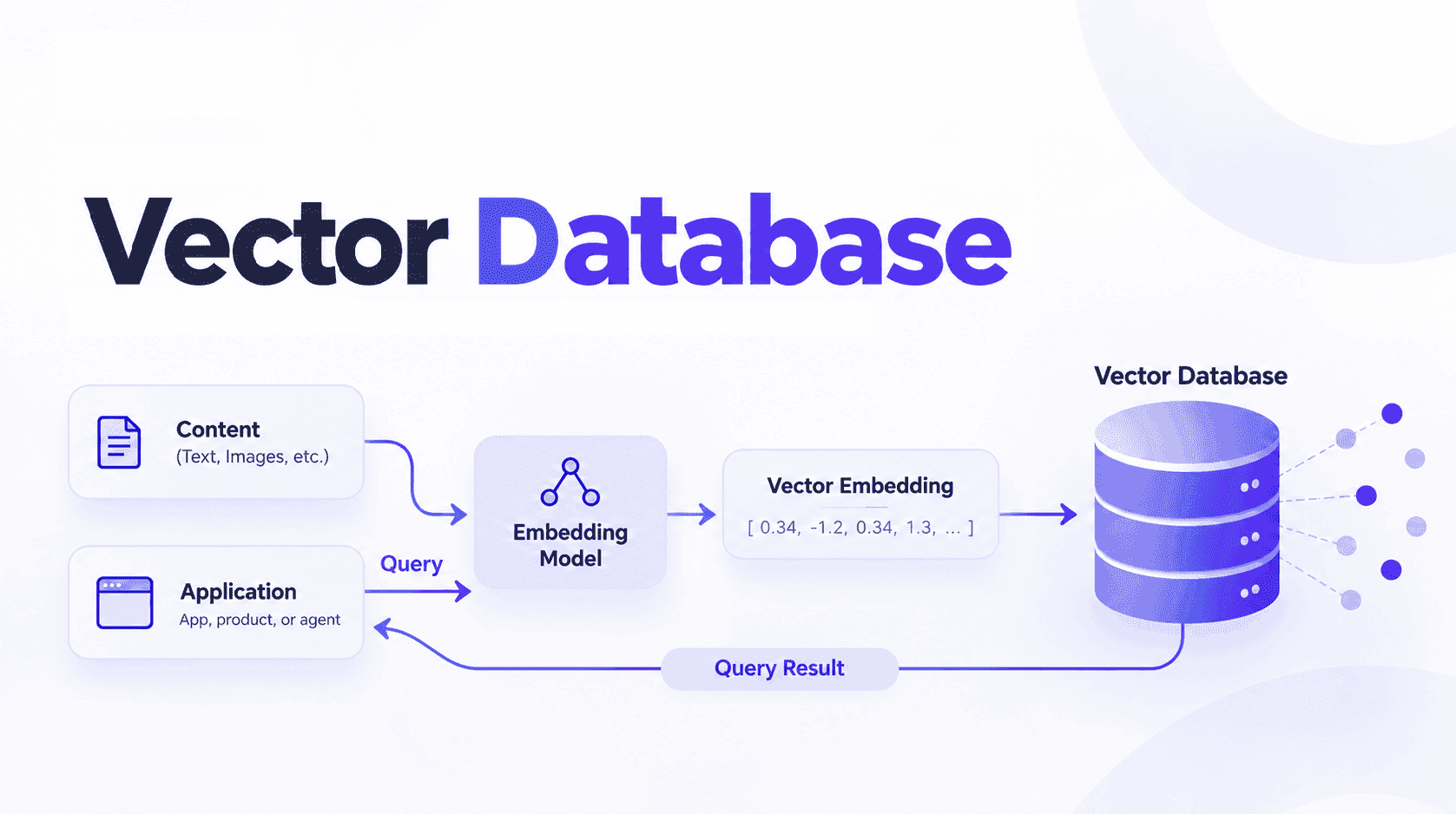
Vector databases store embeddings and enable Approximate Nearest Neighbor (ANN) search. Each memory unit is converted into a high-dimensional vector representation, often 1536 dimensions when using OpenAI's embedding models. These vectors are indexed using structures such as HNSW, which allows sub-linear search over millions of entries.
In a typical production setup, you might configure: 1536-dimensional embeddings, HNSW indexing, top-k retrieval set to 20, and sub-50ms latency even at multi-million scale.
Vectors excel at semantic similarity, allowing the system to retrieve memory based on meaning rather than keyword matching. A well-configured vector index can scale beyond 100 million entries while maintaining acceptable recall and latency.
However, vectors have important limitations. They do not inherently encode relationships between memory units and struggle with structured dependencies and multi-hop reasoning. For example, if you store "User prefers Python" and "Python is used for backend services," a vector store may retrieve both independently, but it cannot reason about their relationship without additional logic. Vectors answer "what is similar?" They do not answer "how are these related?"
Graph Storage
Graph databases approach memory from a structural perspective. Instead of embedding text into dense vectors, graphs encode explicit relationships between entities.
In a graph representation, you might model:
Node:
user_u123Node:
pref_pythonEdge:
has_preference(weight 0.95, updated_at timestamp)
This structure enables direct traversal queries. If a user asks "What language does u123 prefer for backend services?" the graph traverses: user → preference → language → Python.
Graphs are particularly effective for relationship traversal, entity disambiguation, dependency resolution, and structured queries. However, graph systems require careful schema design, edge weighting logic, and traversal optimization. They also lack the fuzzy semantic flexibility of vector embeddings unless paired with text-based indexing.
Hybrid Approach
In practice, high-performance long-term AI memory systems combine both models. A hybrid architecture uses vector search for fast semantic retrieval and graph traversal for relational grounding:
Perform vector search to retrieve top-k candidate memories
Apply graph traversal to validate structural relationships
Fuse scores using a weighted model
A common scoring fusion:
Final score = 0.7 × vector similarity + 0.3 × graph traversal confidence
Vectors provide semantic flexibility while graphs provide relational integrity. This hybrid model significantly improves multi-hop reasoning accuracy in scenarios where agents must connect preferences, historical events, and procedural rules.
Mem0 implements this hybrid design to balance performance and structure. Vector embeddings ensure fast search, while graph memory prevents relational drift and improves multi-hop reasoning.
Retrieval at Inference Time
Retrieval is where memory becomes useful. The retrieval pipeline embeds the incoming query into a 1536D vector, searches the top k=20 candidates, scores by relevance × recency × type_weight (semantic: 0.6, episodic: 0.3, procedural: 0.1), and injects the top-5 results under 200 tokens into the prompt.
Retrieval is dynamic per user: u123 sees personalized facts, u456 sees generic context. Hybrid reranking via an LLM pass boosts multi-hop J-score by 15%. RAG searches static documents; memory retrieval adapts live.
Want to build this in practice? Learn how to create AI agents with long-term memory in our step-by-step guide, covering memory storage, retrieval, and implementation.
Architectural Implications
For senior developers, the storage decision determines how well your agent handles multi-hop reasoning, whether contradictions can be resolved structurally, how scalable your indexing strategy becomes, and how easily you can incorporate ranking logic.
Vectors excel in speed for simple queries but falter on relations. Graphs shine in expressiveness but add schema management overhead. Hybrids increase complexity while improving reasoning power.
Choose based on expected cognitive demands: vectors for preference retrieval, hybrids for entity and time-based reasoning.
How Does Mem0 Handle Long-Term Memory for Agents?
Mem0, which raised $24M to build the memory layer for AI, automates the full pipeline from input chat text to injected memories. Extraction uses lightweight LLM calls with minimal token overhead. Consolidation handles 10K memories per user with sub-100ms updates.
Graph memory (Mem0ᵍ) links entities for relational queries. Benchmarks on ECAI and LOCOMO show a 26% LLM-as-Judge gain over OpenAI Memory, 91% latency reduction, and 90% token savings.
Python quickstart:
Mem0 integrates with LangChain, CrewAI, and OpenAI Agents, and scales to 186M API calls quarterly.
Where Does Long-Term Memory Matter the Most?
Personal assistants maintain routines across time. "Gym Tuesdays, no dairy" persists across 90-day plans without requiring re-entry. Sessions that carry forward prior context build user trust faster than those that start fresh.
Customer support agents shorten resolutions. Recurring "login fail" queries pull "Prior fix: clear cache" directly from episodic memory. Repeat ticket volume drops by 40%.
Coding copilots adapt to team conventions. "Use pytest, not unittest" learned from 20 sessions shapes every subsequent suggestion. Debug history surfaces "Fixed similar OOM March" when relevant.
Over time, agents accumulate working knowledge across sessions, functioning as persistent collaborators rather than session-scoped tools.
Also read: Context Engineering Guide for AI Agents
Frequently Asked Questions
Q. What is long-term memory in AI agents?
Long-term memory is an AI agent's ability to store, consolidate, and retrieve information across sessions, turning a stateless model into a system that remembers facts, preferences, and past interactions over time, unlike short-term context, which resets when a session ends.
Q. How do AI agents store and retrieve long-term memory?
Through a four-stage pipeline: extraction pulls durable facts out of raw conversation, consolidation merges duplicates and resolves contradictions against existing memory, storage indexes the result in a vector store, graph, or both, and retrieval searches that index at inference time to surface only what's relevant to the current query, rather than replaying the full conversation history.
Q. What's the difference between long-term memory and a bigger context window?
A larger context window still resets at the end of a session and treats every token with equal priority, with no mechanism to deduplicate, update, or prioritize information. Long-term memory persists across sessions in external storage and is retrieved selectively based on relevance. Research on this specifically ("Lost in the Middle," Liu et al., 2023) also shows that even within a single long context, accuracy drops sharply when relevant facts sit in the middle of the prompt rather than at the start or end, so a bigger window doesn't just fail to persist across sessions; it can also retrieve less reliably within one.
Q. What's the difference between semantic, episodic, and procedural memory?
Semantic memory stores facts and preferences that hold across time, like a budget cap or a communication preference. Episodic memory stores specific past interactions with enough context to be useful later, like what was tried in a previous support ticket. Procedural memory stores learned behaviors and formatting rules built up from feedback, like a team's preferred code style. Each serves a different function: semantic memory answers what's true, episodic memory answers what happened, and procedural memory shapes how the agent responds.
Wrapping Up
For senior developers, long-term memory turns AI agents into stateful systems, not just bigger context windows. It demands pipelines to extract, consolidate, and index conversation signals via vectors, graphs, or hybrids, balancing latency, token costs, and relational fidelity.
Episodic memory anchors interactions, semantic memory stores facts and preferences, and procedural memory tracks behaviors. The result is persistent agents that accumulate knowledge across sessions, reducing token costs, improving retrieval precision, and enabling scalable multi-hop reasoning under production concurrency.
This infrastructure is required for reliable, efficient, and personalized AI.
More on Agent Memory

How to Read Memory Benchmarks
How to read AI memory benchmarks: what LoCoMo, LongMemEval, BEAM, and agentic tests measure, where scores go wrong, and how to find the correct benchmark for your use case.
20 min read

The Problem After Retrieval: Why Agents Misuse the Memories They're Given
Five papers show LLM agents often misuse the memories they retrieve. What the research says, how much to trust it, and what builders can do.
13 min read

What Is Memory Staleness in AI? Causes, Risks & Solutions
Understand memory staleness in AI agents, why outdated information leads to errors, and the best techniques to maintain accurate long-term memory.
9 min read



Start building with memory
Free tier, no card