
/
/
/
DeepSeek V4.1 Flash: 890 Bytes Per Token, Zero Bytes of Persistent Memory

·
15 min read

Key Takeaways
DeepSeek V4.1 Flash ships a new Causal Encoder-Decoder architecture that activates 8B parameters for input and 16B for output, from a 552B MoE backbone trained on 45 trillion multimodal tokens.
Its KV cache is compressed to 890 bytes per token, a 437x reduction from DeepSeek V1, making long context cheaper than ever at $0.15 per million input tokens off-peak.
Despite a 1M-token context window and 72-hour KV cache retention for prefix reuse, the model has zero cross-session persistence, i.e., every new API call starts blank.
Memory-augmented approaches achieve 91.6% accuracy at fewer than 7,000 tokens per query, compared to 72.9% at 26,000+ tokens for full-context stuffing, with 91% lower latency.
Long context is working memory, and memory is storage, but your production agents need both.
A 552B-parameter argument
You have probably had this conversation with your team at least once this year. Someone builds a multi-turn agent, but it starts losing track of user preferences after a few exchanges, and the first suggestion is always the same: "Just use a model with a bigger context window."
DeepSeek V4.1 Flash is the strongest version of that argument anyone has shipped so far. It is a 552B-parameter Mixture-of-Experts model that supports up to 1M tokens of context, processes input at 8B active parameters, generates output at 16B, and costs $0.15 per million input tokens at off-peak rates. For cached input, that drops to $0.003 per million tokens. To put that in perspective, feeding the same tokens to Claude Opus 5 costs $5.00 per million, and GPT-5.6 Sol charges roughly the same. V4.1 Flash is 30x cheaper on input and 40x cheaper on output than the leading closed-source alternatives.
As for the performance on agentic benchmarks, where models must operate tools, write code, and navigate multi-step workflows, V4.1 Flash beats several frontier models. On Terminal-Bench 2.1, it scores 90.6, ahead of Opus 5 at 89.1 and GPT-5.6 Sol at 88.8. On DeepSWE v1.1, a real-world software engineering benchmark, it resolves 74.2 percent of issues, surpassing Opus 5 at 74.0 and Sol at 73.0.
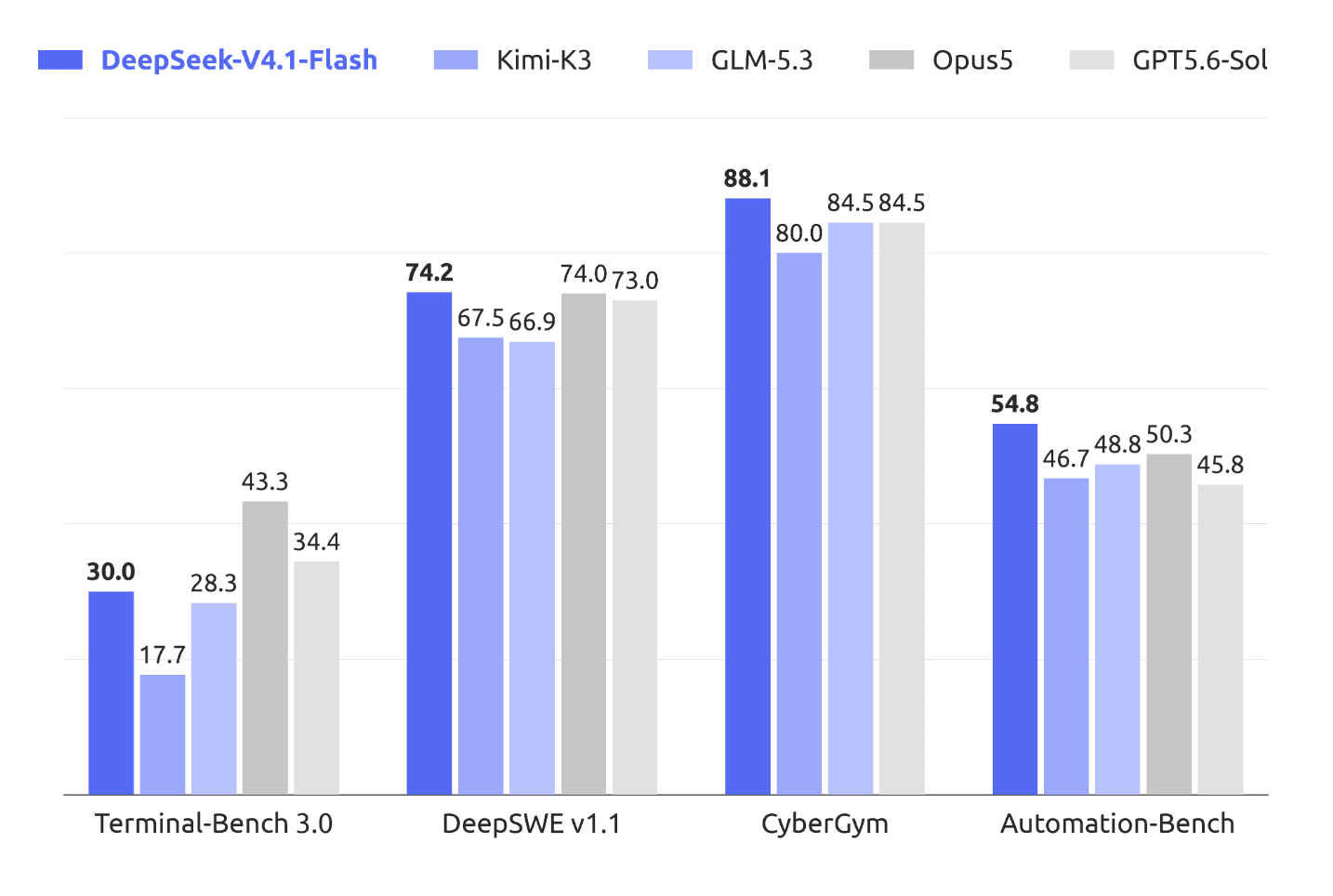
Figure: Bar chart comparing V4.1-Flash against Kimi-K3, GLM-5.3, Opus 5, and GPT-5.6 Sol across Terminal-Bench 3.0, DeepSWE v1.1, CyberGym, and AutomationBench. Source
The technical report frames V4.1 Flash explicitly around long-horizon agent workloads. The paper defines the problem as "The widespread adoption of long-horizon agents has made model workloads increasingly input-heavy." The architecture, the training, and the deployment decisions all follow from that premise. This is a model designed from the ground up for the scenario where you throw a massive context window at an agent and let it work.
So the question is: if you can fit a million tokens into context for $0.15 per million, and the model handles agentic tasks at frontier-level accuracy, do you even need a memory layer?
The rest of this article is about why the answer is still YES!!
The architecture behind the efficiency
Every major LLM released since GPT-2 has used a decoder-only transformer. The decoder-only design activates the same number of parameters whether the model is reading your input or generating its response. DeepSeek V4-Flash, the predecessor to V4.1, activated 13B parameters for both prefill (processing input) and decode (generating output).
The problem is that agent workloads are lopsided. A coding agent reads thousands of lines of source code and tool output, then generates a short patch. A customer support agent ingests an entire conversation history and ticket context, then writes a two-paragraph reply.
Causal Encoder-Decoder (CED) is V4.1 Flash's answer to this imbalance. The model's 40 transformer layers are split into a 20-layer causal encoder and a 20-layer decoder. During prefill, only the encoder runs, activating 8B parameters per token. During decode, the full model runs at 16B active parameters. The decoder does not compute its own global key-value cache from scratch. Instead, it projects the KV cache directly from the encoder's final hidden states, reusing the work the encoder already did. This design reduces prefill complexity from O(NL) to approximately O(NL/2), effectively halving the cost of processing input while keeping the encoder causal so it still works in a standard left-to-right streaming pipeline.
As a result, V4.1 Flash cuts prefill compute by 38 percent compared to V4-Flash (8B vs 13B active) while actually increasing output quality by giving the decoder more capacity (16B vs 13B).
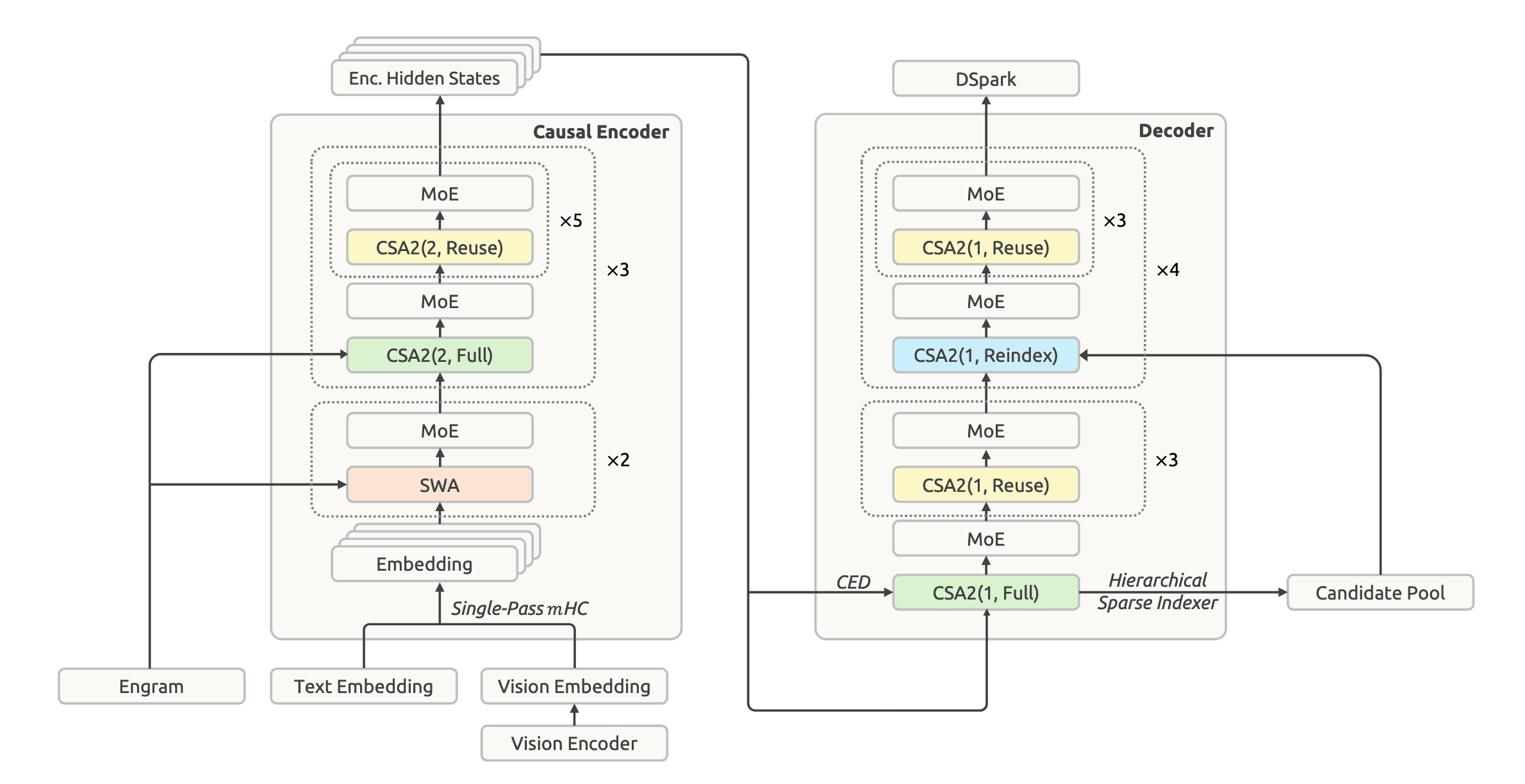
Figure: Architecture diagram showing the CED split: 20-layer causal encoder (with SWA and CSA2 layers) feeding into a 20-layer decoder (with CSA2 modes and Hierarchical Sparse Indexer).
Each MoE layer contains 384 routed experts and 1 shared expert, with 6 experts activated per token. A notable design choice for multimodal support: the model maintains separate routing biases for image tokens and text tokens, so the two modalities do not compete for the same expert slots. DeepSeek-ViT, a custom vision encoder with 2D rotary position embeddings and 3x3 pixel-unshuffle downsampling, was integrated from the start of pretraining on 45 trillion tokens, making V4.1 Flash the first natively multimodal model in the DeepSeek family.
The full parameter breakdown: 551.6B in the MoE backbone, 196.9B in Engram, 14.2B in DSpark, and 0.5B in the vision encoder, totaling roughly 763B parameters. Of those, only 8B to 16B are active on any given token.
You can read more about the architecture in the DeepSeek technical report.
How does V4.1 Flash makes long context cheap?
A million-token context window is only useful if you can actually afford to fill it. The bottleneck is the KV cache, the stored keys and values that let the model attend to earlier tokens without recomputing them. As context grows, the KV cache grows with it, consuming GPU high-bandwidth memory (HBM) for active inference and SSD storage for persistent caching between sessions.
V4.1 Flash compresses its global KV cache to 890 bytes per token. For comparison, DeepSeek V1 needed 389,120 bytes per token, DeepSeek V3.2 needed 48,068, and V4-Flash needed 3,514. The progression from V1 to V4.1 Flash is a 437x reduction across four model generations.
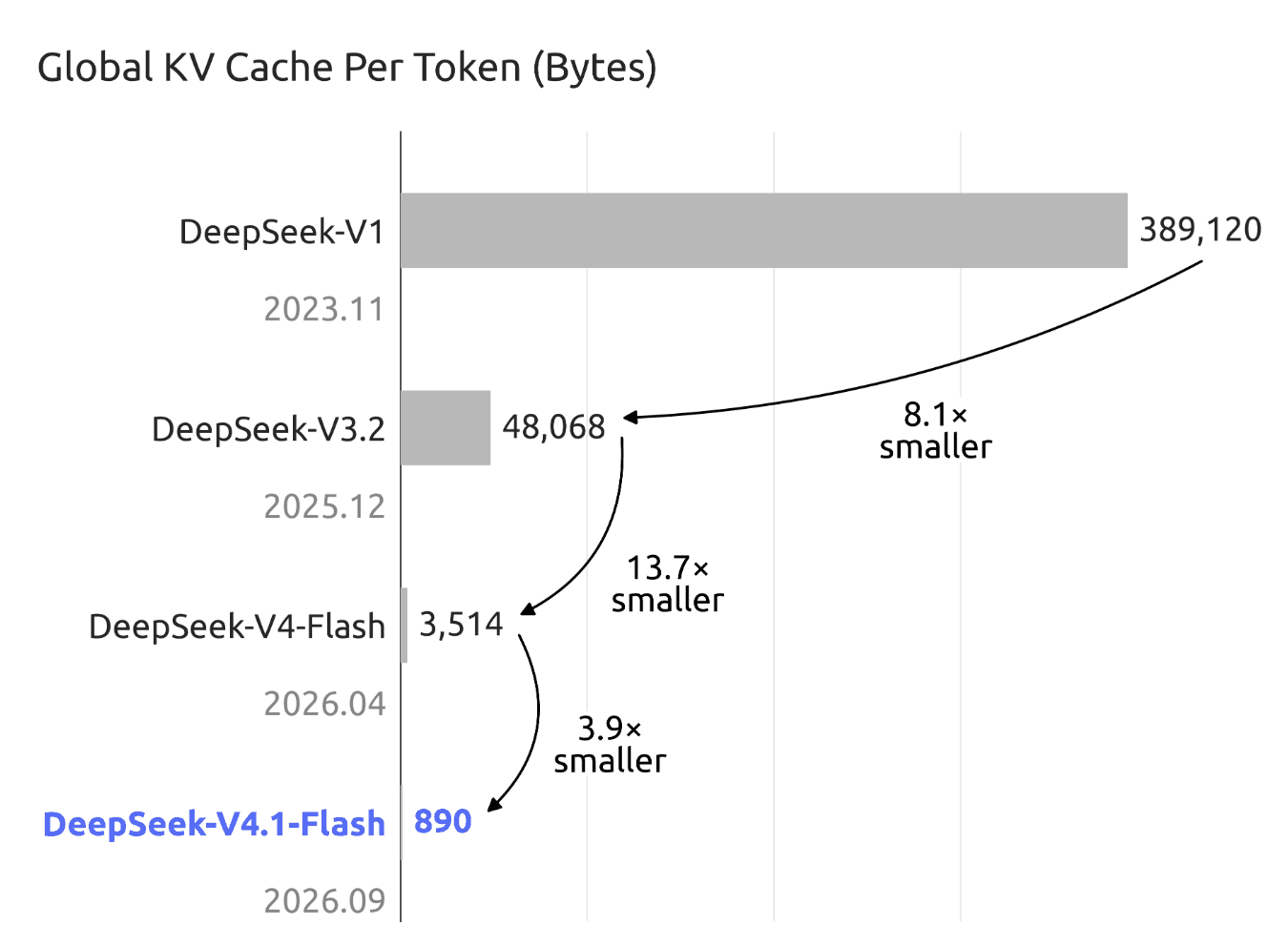
Figure: Horizontal bar chart showing KV cache per token (bytes) across generations: V1 at 389,120, V3.2 at 48,068, V4-Flash at 3,514, V4.1-Flash at 890. Each step labeled with the fold reduction.
Three techniques work together to achieve this compression:
CSA2 (Compressed Sparse Attention 2): It groups attention layers and assigns each layer one of three modes:
Full mode computes fresh keys, values, and sparse indices
Reindex mode reuses keys and values from a preceding Full layer but recomputes which tokens to attend to
Reuse mode inherits everything.
A Hierarchical Sparse Indexer further restricts deeper layers to a candidate pool of 16,384 positions selected by the first Full layer, keeping per-query cost bounded regardless of context length.
FP4 KV caching : This ****quantizes the main KV cache to 4-bit precision using the E2M1 format. Unlike post-training quantization that introduces errors after the fact, this precision is baked in through quantization-aware training (QAT), so the model learns to work within FP4 constraints from the start.
SWA Bounded Replay: It addresses the sliding-window attention caches. Instead of persisting these local caches to SSD (which consumed nearly half the persistent storage in V4), V4.1 Flash simply replays the most recent window of tokens when needed. The paper reports negligible quality loss from this approximation, and it eliminates the SSD round-trip entirely.
Together, these optimizations reduce runtime KV cache (HBM) to roughly one-quarter of V4-Flash and persistent KV cache (SSD) to roughly one-eighth.
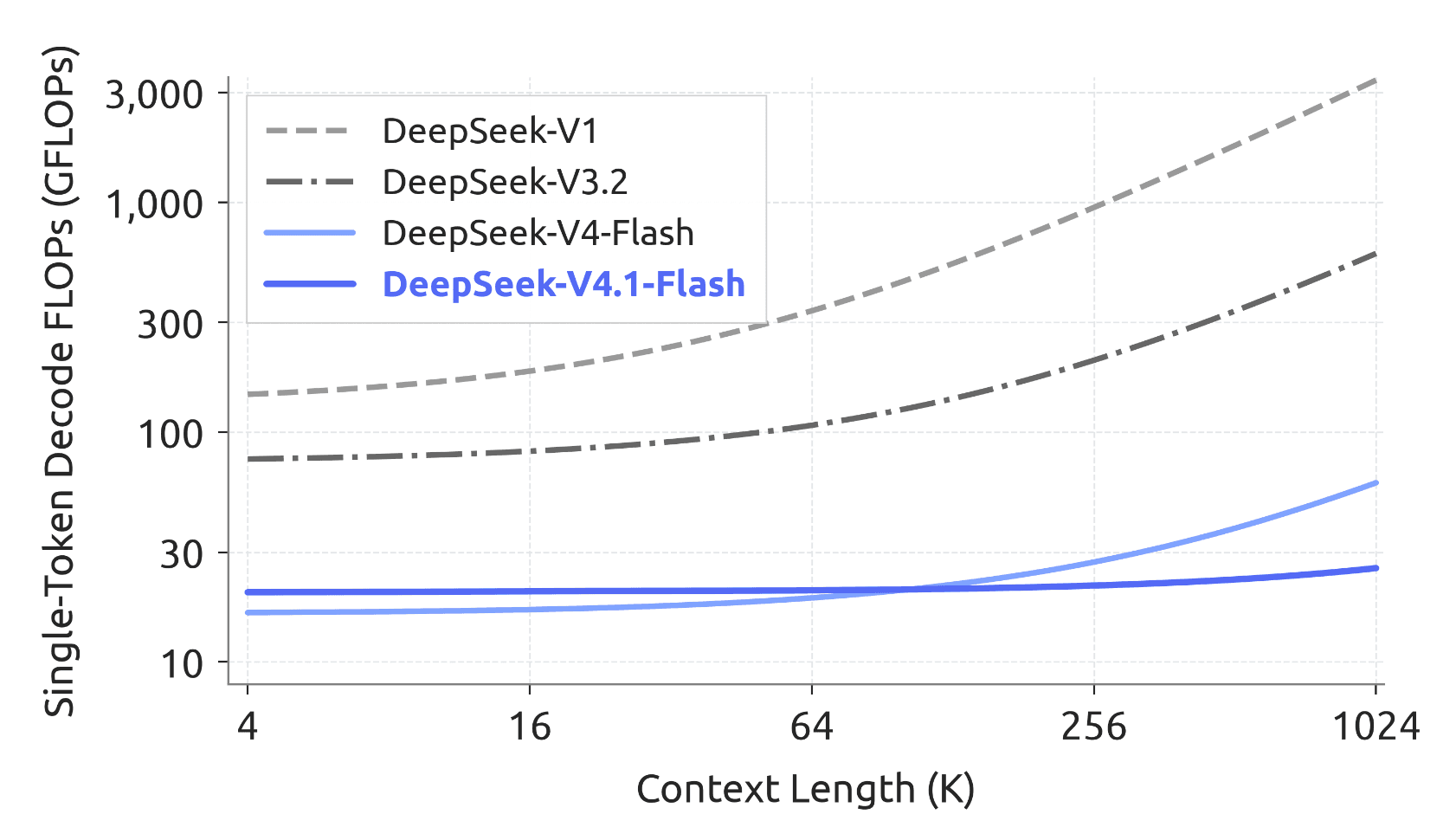
Figure: Line chart showing single-token decode FLOPs vs. context length (4K to 1M) for DeepSeek V1, V3.2, V4-Flash, and V4.1-Flash. V4.1-Flash stays nearly flat while older models spike upward.
The pricing makes the economic case even more compelling. Here is a quick look at pricing of major frontier models:
Model | Input (cache miss) | Input (cached) | Output |
|---|---|---|---|
V4.1-Flash (off-peak) | $0.15/M | $0.003/M | $0.60/M |
V4.1-Flash (peak) | $0.30/M | $0.006/M | $1.20/M |
Claude Opus 5 | $5.00/M | $0.50/M | $25.00/M |
GPT-5.6 Sol | ~$5.00/M | — | ~$30.00/M |
The model also maintains a persistent KV cache on SSD with a 72-hour retention window. If a user returns within three days with the same conversation prefix, the cached tokens are served at the $0.003 rate instead of the $0.15 rate. For multi-turn agents that process the same system prompt and conversation history across turns, this makes long context extremely attractive.
At these economics, "just stuff everything into context" is more tempting than it has ever been.
Where a million tokens still break down
Here is the uncomfortable truth that no amount of KV cache compression changes: when the API call ends, the context window is gone. V4.1 Flash's 72-hour KV cache retention is a deployment optimization for prefix reuse within active sessions. It is not semantic memory. It does not know that a user prefers email over phone calls. It does not remember that the same person switched from the Pro plan to Enterprise last month. It does not carry forward the decision your agent made in yesterday's debugging session. Every new session starts from absolute zero.
This is not a V4.1 Flash limitation. It is a fundamental property of context windows. The context window is RAM, not storage.
RAM is volatile: The moment a process ends, RAM is cleared. Context windows work the same way. Preferences stated at turn 1, constraints set at turn 5, decisions confirmed at turn 12, all of it evaporates when the session closes.
RAM is expensive to scan: Every inference call re-processes the entire context window. If you want a returning user's agent to "remember" their last 10 conversations, you have to stuff all 10 conversations into every single API call. At 2,500 tokens per conversation, that is 25,000 tokens of context consumed before the agent even reads the current query. Multiply that by thousands of users making multiple requests per day, and the cost advantage of $0.15 per million tokens starts to erode quickly.
RAM treats all data equally: Attention mechanisms assign weight based on position and learned patterns, not importance. A throwaway comment about the weather competes for attention with a critical constraint about the user's allergy to peanuts. In a 10,000-token context, both get the same shot at influencing the response.
Full-context approaches achieve 72.9 percent accuracy while consuming 26,000+ tokens per query with a latency of 17.12 seconds. Memory-augmented approaches achieve 91.6 percent accuracy at fewer than 7,000 tokens per query with a latency of 1.44 seconds. That is an 18.7 percentage-point accuracy improvement, a 4x token reduction, and a 91 percent latency reduction, all at the same time.
Metric | Full Context | Memory (Mem0) |
|---|---|---|
Accuracy | 72.9% | 91.6% |
Tokens per query | 26,000+ | <7,000 |
Latency | 17.12s | 1.44s |
The pattern holds regardless of how cheap or capable the underlying model is. V4.1 Flash is the best model yet for long single-session work. But the moment your application needs to recognize a returning user, carry forward learned preferences, or maintain state across agent sessions, the context window alone is not enough.
Side-by-side demo: token economics with and without Mem0
The claim is that memory saves tokens, cost, and latency while improving response quality. Both approaches use DeepSeek V4.1 Flash via OpenRouter and answer the same returning-user query.
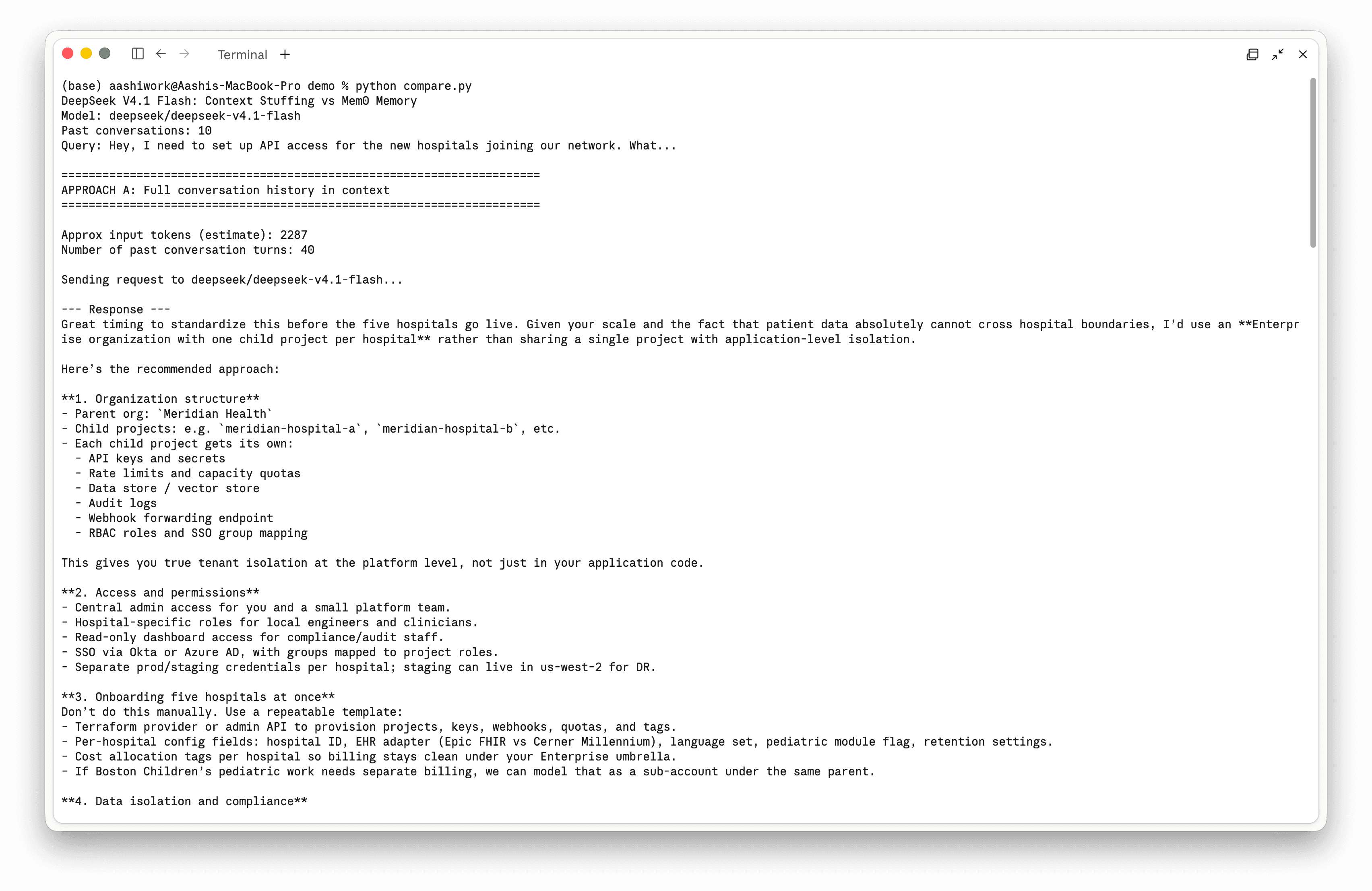
Approach A stuffs the full conversation history into context.
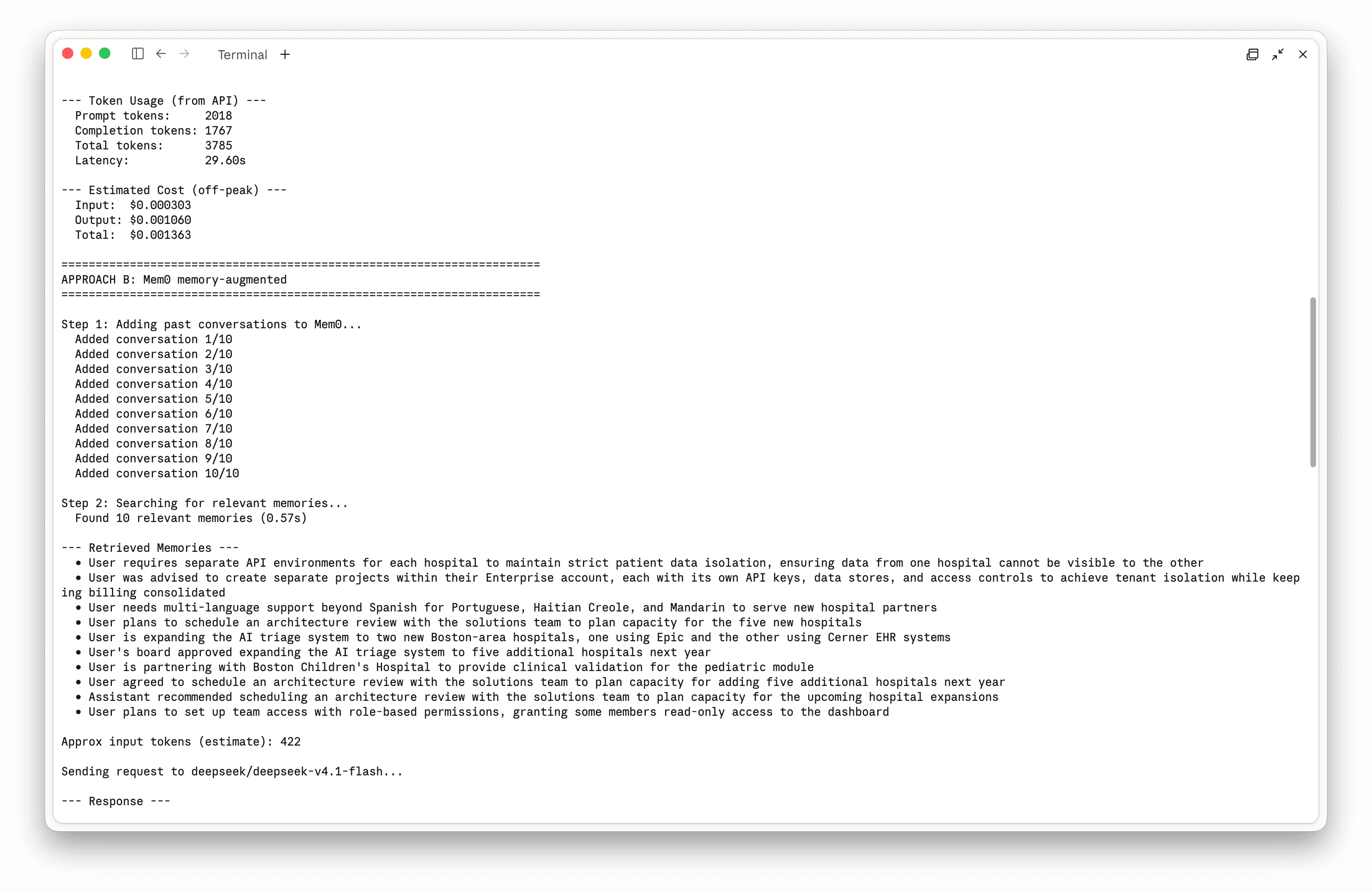
Approach B uses Mem0 to extract and store memories, then retrieves only the relevant ones.
The demo simulates a customer support agent for a healthtech startup. Ten past conversations cover topics from HIPAA compliance and latency optimization to multi-hospital expansion and pediatric triage. The returning user asks about onboarding five new hospitals with data isolation.
Setup:
Create a .env file with your API keys:
Get a free Mem0 key and a OpenRouter API key to get started!
Then run:
The script runs both approaches sequentially and prints a comparison table with exact token counts, latency, and cost estimates from the API response.
When to use context, when to use memory, and when to use both
The choice between context and memory is not either-or. Each solves a different problem, and the best production systems combine both.
Use raw context when the task is self-contained within a single session. Document QA, where you feed a contract or codebase and ask questions about it, is a pure context task. Long reasoning chains where the model needs to reference earlier steps in its own thought process belong in context. These tasks have no cross-session component, and the information the model needs is right there in the input.
Use memory when information must persist across sessions or across users. User preferences, dietary restrictions, communication style, plan tier, timezone, and past decisions are all memory. Agent state that needs to survive session boundaries (what was tried, what failed, what the user approved) is memory.
Use both when your agent needs to do serious work for returning users. The context window holds the current task, say, the code file being reviewed, the current conversation, and the tool outputs. The memory layer injects the relevant user context, such as their preferences, constraints, and prior decisions. The model gets everything it needs for the current task without re-processing an entire relationship history.
Adding Mem0 to an existing DeepSeek V4.1 Flash setup takes fewer than 20 lines of working code:
A free Mem0 API key is all you need for the memory layer. Get a free Mem0 key.
Code Run:
Approach A: It stuffs the full conversation history into context
Approach B: It uses Mem0 to extract and store memories, then retrieves only the relevant ones.
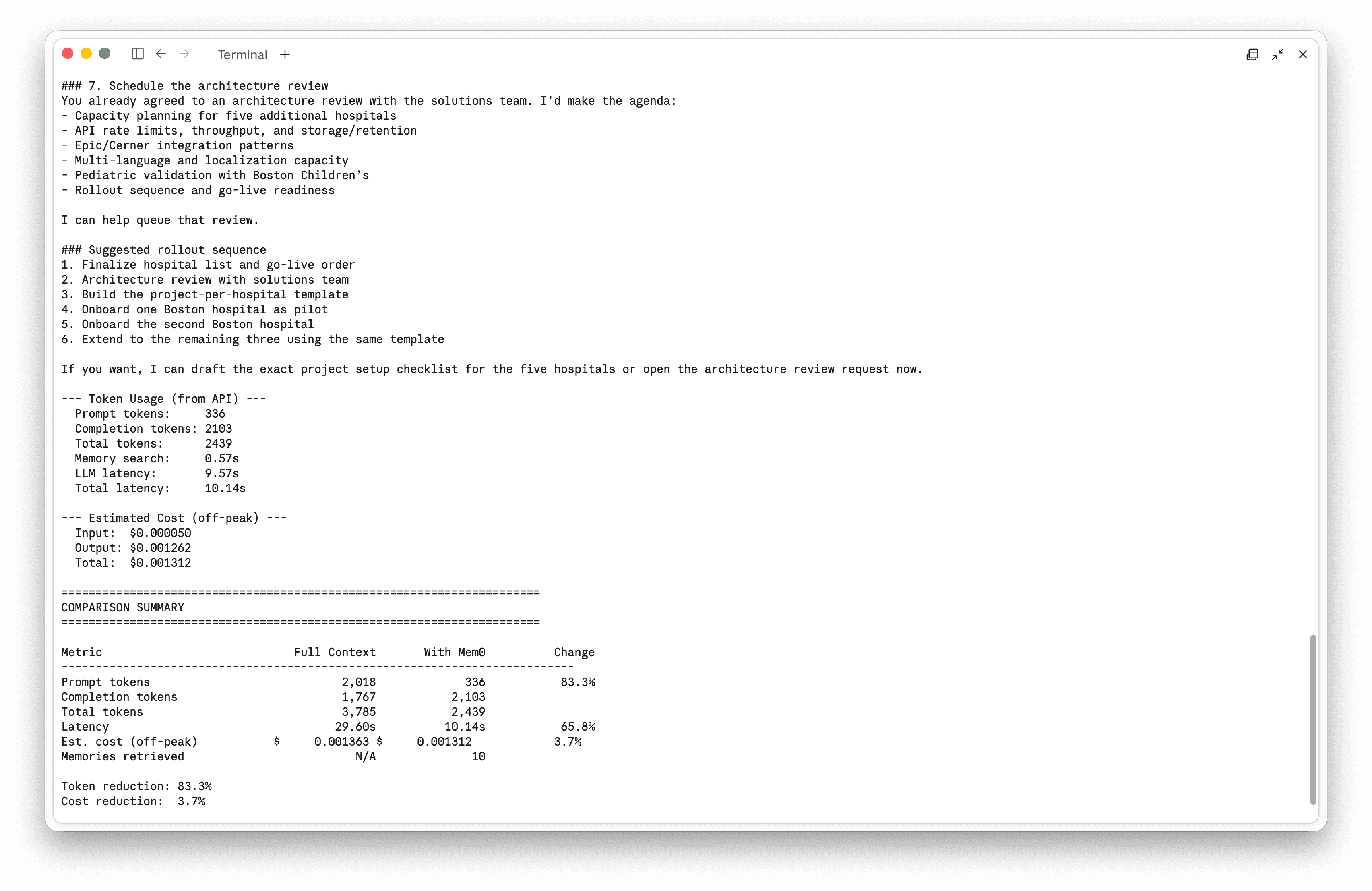
Comparison summary
The memory.search call adds roughly 100 to 200 milliseconds of latency, but it replaces tens of thousands of tokens of context stuffing. The net effect on end-to-end response time is almost always a reduction because the model processes a much shorter input.
Results
Metric | Full Context (A) | With Mem0 (B) | Change |
|---|---|---|---|
Prompt tokens | 2,018 | 336 | 83.3% reduction |
Completion tokens | 1,767 | 2,103 | +19% (more detailed response) |
Total tokens | 3,785 | 2,439 | 35.6% reduction |
Latency | 29.60s | 10.14s (incl. 0.57s memory search) | 65.8% faster |
Est. cost (off-peak) | $0.001363 | $0.001312 | 3.7% cheaper |
Memories retrieved | N/A | 10 |
The input token reduction is dramatic. Mem0 used 336 prompt tokens compared to 2,018 for full-context stuffing (83.3% reduction). This translates into a 65.8 percent latency improvement, from 29.60 seconds down to 10.14 seconds, including the 0.57-second memory search. The cost difference at this scale is modest (3.7 percent) because output tokens dominate the bill when conversations are short.
In production, where returning users accumulate dozens or hundreds of past conversations rather than ten, the input token gap compounds. A user with 100 past conversations would stuff roughly 20,000 tokens into every request, while Mem0 would still retrieve the same 10 relevant memories at 336 tokens.
The qualitative difference matters just as much. Both responses correctly referenced hospital-specific details like Epic versus Cerner integration, multi-language requirements for Portuguese, Haitian Creole, and Mandarin, and the Boston Children's pediatric validation partnership. But Approach B retrieved these as discrete, ranked memories rather than forcing the model to find them buried in 40 conversation turns. The Mem0 response was more structured, covered more ground, and produced a longer completion (2,103 tokens versus 1,767) because the model spent its attention budget on generating a thorough answer rather than sifting through history.
—
Mem0 is an intelligent, open-source memory layer designed for LLMs and AI agents to provide long-term, personalized, and context-aware interactions across sessions.
Get your free API Key here: app.mem0.ai or self-host mem0 from our open-source GitHub repository.
—
Frequently Asked Questions
Q. Doesn't the 72-hour KV cache solve persistence?
No. The persistent KV cache described in the V4.1 Flash technical report is a deployment-level optimization for prefix reuse. If a user returns within 72 hours with the same conversation prefix, the system reuses the cached KV entries instead of recomputing them, serving those tokens at the $0.003 cached rate. This is a cost optimization for repeated prefill, not a memory system. It does not extract facts, it does not rank relevance, and it does not carry forward any semantic understanding of the user. If the conversation prefix changes by even one token, the cache miss rate goes back to baseline.
Q. Isn't RAG already solving this?
RAG (Retrieval-Augmented Generation) retrieves chunks of documents from a vector store and injects them into the context. Memory retrieves distilled facts about users and interactions. They are complementary, not competing. RAG answers "What does document X say about topic Y?" while memory answers "What do we know about this specific user and their history with our system?" A production agent serving returning users typically needs both: RAG for knowledge retrieval and memory for personalization and continuity.
Q. Is Mem0 compatible with DeepSeek V4.1 Flash?
Yes. Mem0 has native DeepSeek support through its LLM provider system and also works through OpenRouter via the OpenAI-compatible SDK. The demo in this article uses the OpenRouter path, which requires only swapping the base URL and model name in the standard OpenAI Python client. Mem0's platform SDK handles memory extraction, storage, and retrieval independently of which LLM you use for generation.
Q. How much does memory add to latency?
A Mem0 search call typically adds 100 to 200 milliseconds. But it removes 10,000 to 50,000 tokens of context that the model would otherwise need to process during prefill. Since prefill latency scales with input length, the net effect is usually a significant reduction in total response time. The Mem0 benchmark data shows end-to-end latency dropping from 17.12 seconds (full context) to 1.44 seconds (memory-augmented) on representative workloads.
Further Reading
More on LLMs & Models

Perplexity Pricing 2026: Pro, Max, Computer & API Costs
Compare Perplexity Free, Pro, Max, and Enterprise prices in 2026. Understand Computer credits, API charges, and which plan fits your usage and budget.
10 min read
Gemini API Pricing 2026: Models, Tokens, and Costs
Compare Gemini API prices by model, learn how caching and Batch affect costs, and calculate the cost of 1,000 requests or a monthly chatbot workload.
12 min read

OpenAI API Pricing (Oct 2026): Models, Token Costs, How to Save
Compare OpenAI API pricing including model rates, token costs, caching, and Batch discounts, with practical cost examples.
17 min read



Aashi Dutt
She is a senior technical content writer at Mem0. She covers agent memory architecture and the engineering decisions behind building agents that actually remember. She experiments with new features and turns research into posts developers can put straight to use.
Start building with memory
Free tier, no card