

·
14 min read
On this page
Continual learning turns a one-off agent into a system that improves with every task. Instead of treating each request as a fresh conversation, a continual learning agent remembers what worked, what failed, and why. Over time, it adapts its behavior based on accumulated experience, not just prompt engineering.
Most LLM agents today still act like stateless chatbots. They depend on prompts, few-shot examples, and context windows to fake memory. That pattern fails once tasks span days or weeks, or when thousands of small interactions must inform the next decision.
This post explains how to build a continual learning agent that stores structured outcomes after each task, retrieves relevant outcomes before the next similar task, and uses them to refine its strategy. Mem0 provides the persistent memory layer that makes this pattern practical.
What is a Continual Learning Agent?
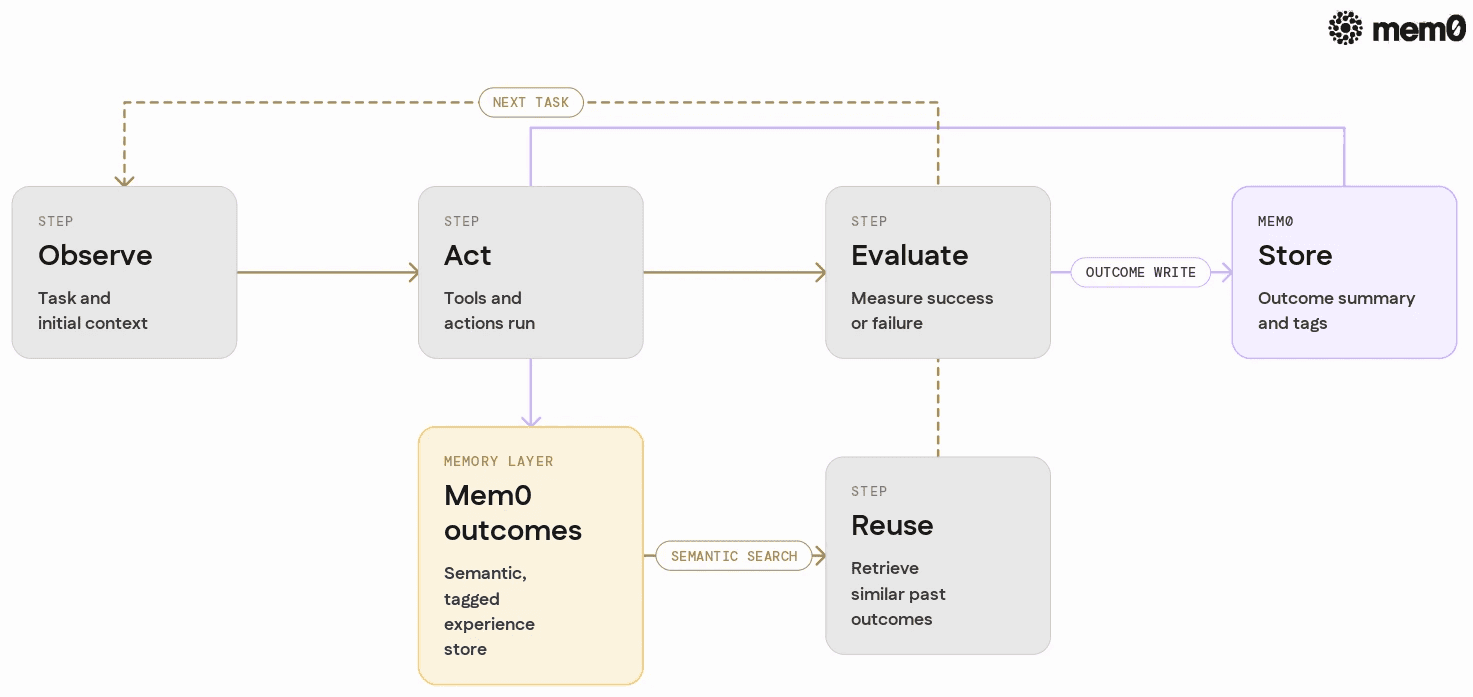
A continual learning agent is an LLM-driven system that updates its behavior based on experience collected across many episodes. Each task produces an outcome, the agent stores that outcome, and future tasks retrieve and reuse those outcomes as context.
A useful way to think about this pattern:
Observe: The agent receives a task and initial context.
Act: It plans, runs tools, and executes actions.
Evaluate: It measures results, records successes and failures, and captures key lessons.
Store: It writes a compact summary of the outcome into long-term memory.
Reuse: Before future tasks, it retrieves similar past outcomes to guide decisions.
The agent shifts from a purely prompt-driven system to one driven by accumulated knowledge. Mem0 sits between the agent and the LLM as the memory substrate that stores, indexes, and retrieves these outcomes.
Why Stateless Agents Hit a Wall?
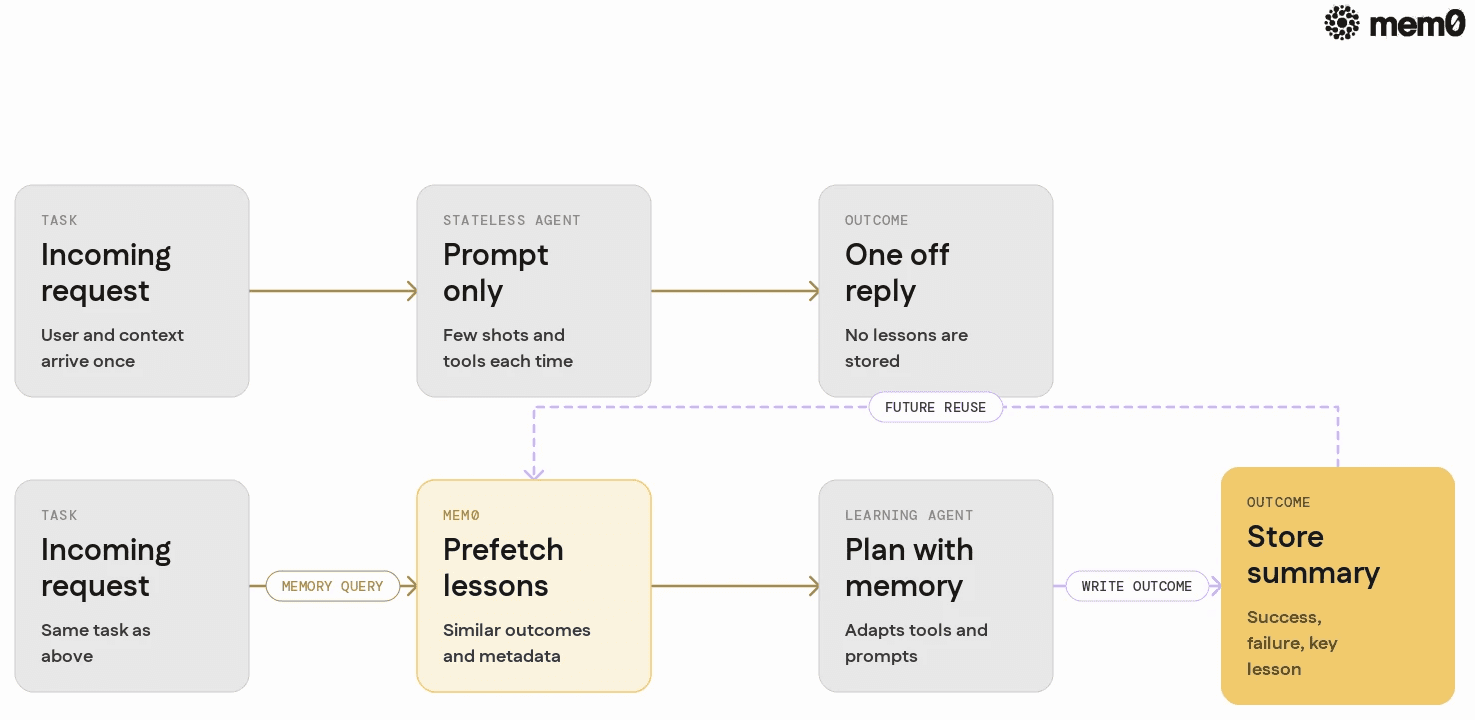
Production agents that ignore experience suffer from several recurring problems:
Repeated mistakes: The agent tries the same failing pattern because it cannot remember past failures.
Token overuse: Teams attempt to encode "lessons" directly into prompts, which inflates prompt size and still cannot adapt fast enough.
No personalization: Per-user behaviors and preferences vanish between sessions.
Limited experimentation: A/B testing or policy changes cannot accumulate into long-term behavior changes without state.
Common "memory-ish" workarounds, such as adding the last few messages to the context, only capture short-term conversation history. They do not store structured outcomes like "tool X failed for this type of task" or "this prompt template improved success rate for report generation."
A genuine continual learning agent needs a dedicated layer that can:
Store structured, queryable records tied to tasks and outcomes.
Support similarity search over semantic content.
Allow metadata-based filtering, for example, by outcome type, user, or tool.
This is the problem Mem0 is designed to address.
Core Design of a Continual Learning Agent
A practical continual learning agent needs a clear architecture for how experience flows through the system.
A typical pattern contains these components:
Task intake: Receives an incoming request with metadata, for example, user ID, task type, and environment.
Memory prefetch: Queries Mem0 for relevant past outcomes based on task description and metadata tags.
Planning and execution: Uses the LLM, tools, and retrieved memories to plan and run actions.
Outcome evaluation: Generates an outcome record that captures what happened, including success or failure.
Memory writeback: Stores the outcome record in Mem0 with semantic content and structured metadata.
The lifecycle ensures that every executed task can influence the next similar task. Mem0 handles the "store and retrieve" steps and keeps outcome data consistent across agents, users, and sessions.
The rest of this post will walk through each step with concrete patterns and code.
Mem0 as the Memory Layer
Mem0 provides a persistent memory layer specifically tailored to LLM agents and continual learning. It supports semantic search, metadata tags, and user-scoped memory, which make it suitable for storing task outcomes and lessons.
Key concepts in Mem0 that matter for continual learning:
User: A logical identity for scoping memory, for example, a human user, tenant, or agent ID.
Memory: A stored item containing content, optional metadata, and embeddings for semantic retrieval.
Metadata tags: Structured key-value fields, for example
{"outcome_type": "success", "task_type": "report_generation"}.Collections or namespaces: Logical grouping to separate different kinds of knowledge, for example, "outcomes" vs "user_profile".
These features map directly to the continual learning pattern. Outcome records become Mem0 memories. Outcome types and task categories become metadata tags that support filtering.
Example Outcome Schema
A typical outcome record might look like:
content: Short natural language summary of what happened and what the agent learned.metadata:outcome_type:"success"or"failure"or"partial".task_type: A high-level category, for example"email_drafting".tool_name: The key tool used.timestamp: When the outcome occurred.run_idorsession_id: To link to logs.tags: Optional custom labels.
Mem0 stores this record, creates embeddings for the content, and makes it available for semantic search combined with metadata filters.
Storing Task Outcomes with Mem0
The first integration step is writing outcome records into Mem0 reliably and consistently. The agent should write memory at clear points in the lifecycle: typically after evaluation and before the final response is returned.
Assume a basic Mem0 Python client and an LLM agent loop. The code below shows a minimal integration where the agent stores outcomes tagged by outcome type and task type.
👉Wanna give it a try? Get a Mem0 API Key and try it yourself.
This pattern does not depend on any specific evaluation logic. The key points:
The evaluation loop produces a summary plus an outcome_type.
Mem0 stores the summary and tags it with rich metadata.
The collection
"task_outcomes"separates these records from other memory types.
Once these outcomes exist in Mem0, the agent can retrieve them for future tasks.
Retrieving and Reusing Past Outcomes
Retrieval is where continual learning produces real behavior changes. Before the agent plans its next action, it fetches relevant past outcomes and supplies them to the LLM as additional context.
The simplest retrieval pattern uses:
A semantic query built from the current task.
Metadata filters based on task type and outcome type.
For instance, before handling a new report_generation task, the agent might fetch the last five successful and failed outcomes for that task type. It can then instruct the LLM to adapt its plan accordingly.
In production, this retrieval process can include:
Time windows, for example, the last 30 days only.
Per-tool filtering, for example, outcomes that used a specific tool.
Explicit separation of user-specific versus global lessons.
Mem0 metadata tags make these filters straightforward and efficient.
Metadata Tagging Strategies for Outcomes
Metadata tagging is the key mechanism that makes Mem0 useful for continual learning agents. Consistent tagging allows the agent to slice and query its experience in targeted ways.
Recommended metadata fields:
outcome_type
Values:"success","failure","partial","unknown".task_type
High-level category, for example"sql_query_debug","sales_email","support_triage".severity(optional)
To differentiate minor failures from critical ones.tool_name
When the outcome is tied to a specific tool or toolchain.user_scope
"global"or"user_specific"when outcomes are meant to generalize or stay local.version
Agent or policy version that produced the outcome.
These tags enable patterns such as:
Retrieve only failures for
task_type="sql_query_debug"to avoid repeating broken fixes.Retrieve only successes for
"sales_email"to guide content style.Retrieve global lessons plus user-specific lessons for personalized behavior.
Tagging Scheme vs. Retrieval Behavior
The table below outlines how different metadata strategies influence retrieval:
Metadata field | Purpose | Example filter | Behavior impact |
|---|---|---|---|
| Separate successes and failures |
| Focuses on what to avoid or replicate |
| Group similar tasks |
| Keeps lessons relevant to the current task |
| Track tool-specific issues |
| Helps avoid tools that fail on certain tasks |
| Distinguish local vs. global lessons |
| Enables per-user personalization |
| Handle agent evolution |
| Limits lessons to those from compatible versions |
Thoughtful metadata design is critical. Without it, retrieval either returns noisy results or fails to find important lessons when they are needed.
Architectures for Continual Learning Agents
The continual learning pattern can appear in several architectural styles. The choice depends on latency requirements, complexity, and the number of agents.
Inline Learning Loop
In this design, the main request-response path includes both retrieval and writeback. The agent:
Prefetches outcomes from Mem0.
Plans and executes the task.
Evaluates and writes back outcomes before returning.
This pattern is simple and keeps agent logic centralized.
Asynchronous Outcome Processing
For more complex systems, outcome evaluation and storage may move into an asynchronous pipeline:
The agent publishes execution logs and outputs.
A background worker or separate service evaluates outcomes using LLMs or metrics.
The worker writes outcomes into Mem0 with rich metadata.
Retrieval still happens synchronously at request time, but writeback is decoupled. This approach can handle heavier evaluation workloads without slowing down user-facing requests.
Global vs. Local Memory Layers
Some systems differentiate between:
Per-user memory: Experiences and preferences specific to a single user.
Global memory: Lessons that generalize across users and environments.
Mem0 can represent both by using different user_id values or collections. For example:
user_id = "<real_user_id>"for user-specific outcomes.user_id = "global"for shared best practices.
The agent can query both scopes and combine them, for example retrieve global successes and user-specific failures for a given task type.
Limitations of Continual Learning Agents
Continual learning patterns add complexity and carry some inherent limitations.
Noise and Conflicting Lessons
Not all outcomes contain reliable information. Early iterations may capture outcomes from unstable models or noisy metrics. If the agent blindly trusts past lessons, it can reinforce poor behavior or outdated strategies.
Mitigation strategies:
Track agent or policy version in metadata.
Weight recent outcomes more than older ones.
Use confidence metrics or human labels when available.
Evaluation Quality Bottlenecks
Outcome evaluation is often the hardest part. Automatic heuristics may misclassify outcomes, and LLM-based evaluators can introduce bias or hallucinations. If evaluation quality is low, the memory will be polluted with misleading summaries.
Mitigations:
Start with coarse-grained labels (success vs failure) and gradually add nuance.
Incorporate human feedback when possible.
Store raw logs alongside summaries for future reprocessing.
Latency and Token Limits
Retrieving many past outcomes and inserting them into every prompt increases latency and token usage. Indiscriminate retrieval will quickly hit context limits and degrade user experience.
Mitigations:
Limit retrieved outcomes to the top k by relevance and recency.
Summarize multiple outcomes into concise meta-lessons.
Use hierarchical retrieval, for example fetch summaries of summaries.
Domain Drift and Stale Knowledge
As external systems, tools, or policies change, past outcomes may lose relevance. The agent must avoid applying outdated lessons in contexts where they no longer apply.
Mitigations:
Include temporal metadata, for example timestamps and version tags.
Apply time-based decay or archiving.
Periodically re-evaluate or resummarize old memories.
These limitations are inherent in continual learning patterns. They require careful system design and monitoring but do not prevent practical deployment.
Where Mem0 Fits in the Stack
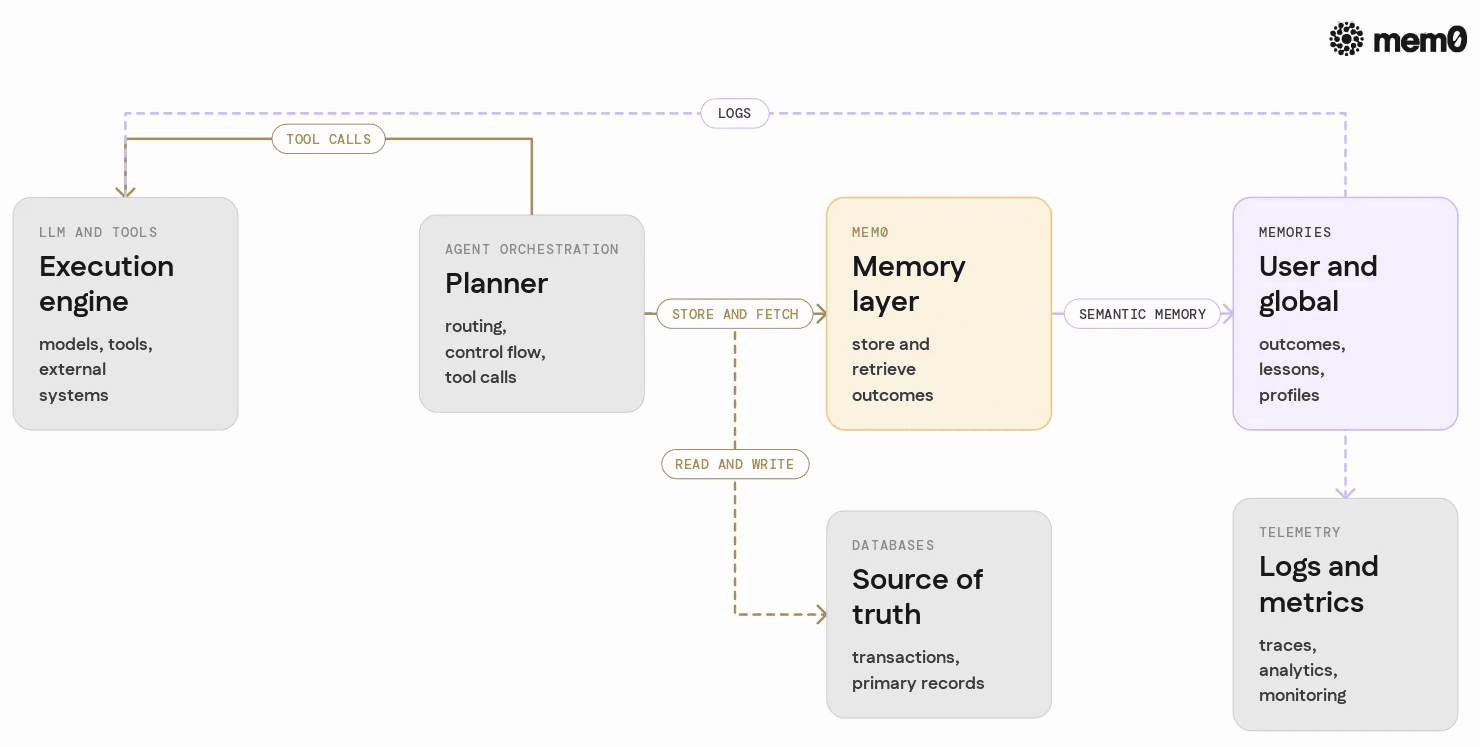
Mem0 focuses on the core memory problem for agents: storing and retrieving semantically meaningful, structured knowledge across sessions and users. In a continual learning agent, it occupies the middle layer between the LLM planner and the rest of the stack.
Typical production stack:
LLM and tools: Execution engine and external capabilities.
Agent orchestration: Planning, routing, tool calling, and control flow.
Mem0 memory layer: Long-term store for outcomes, user profiles, knowledge snippets, and derived lessons.
Databases and telemetry: Source-of-truth systems, observability, and metrics.
Mem0 does not replace core databases or logs. Instead, it complements them:
Logs provide detailed traces. Mem0 stores distilled lessons derived from those traces.
Databases store transactional data. Mem0 stores semantic summaries and user-specific behavior patterns.
By standardizing memory operations through Mem0, teams gain:
Consistent APIs for storing and retrieving outcomes.
Unified metadata tagging across agents and services.
Clear separation between stateless LLM orchestration and stateful experience.
The Python code earlier shows how Mem0 integrates into an agent loop with minimal changes. Once integrated, the agent naturally evolves from a stateless chatbot into a continual learning system that improves over time.
Frequently Asked Questions
Q. What is a continual learning agent in practical terms?
A continual learning agent is an LLM-based system that updates its behavior based on past outcomes. It logs results of tasks, stores them in a memory layer, and retrieves them to influence future decisions, instead of treating each request independently.
Q. How does Mem0 differ from just saving data in a database?
Mem0 provides semantic search, embedding-based retrieval, and metadata-aware filtering tailored to LLM workflows. A general database can store raw data, but Mem0 is optimized for retrieving concise, context-ready memories that plug directly into prompts and agent planning.
Q. When should an engineering team add continual learning to an agent?
Continual learning becomes valuable when agents handle recurring tasks where repeated mistakes are costly, or when personalization is important. If an agent often revisits similar problems, or must adapt to specific users, continual learning can improve reliability and efficiency.
Q. How does Mem0 help the agent avoid repeating failures?
Mem0 stores outcomes with metadata tags such as outcome_type="failure" and task_type. Before running a new task, the agent retrieves prior failures for similar tasks and includes them in the prompt, enabling the LLM to explicitly avoid previous broken patterns and strategies.
Q. What types of outcomes should be stored in Mem0?
Agents should store concise summaries of what happened, why it succeeded or failed, and what should change next time. Metadata can capture the task type, tools used, severity, and user scope, which later allows selective retrieval of the most relevant lessons.
Q. How does this pattern scale across many users and agents?
Mem0 supports user-scoped and global memories through user IDs and collections. Agents can query both per-user and global outcomes, which enables shared learning across users while preserving personalization, and it allows new agents to bootstrap from existing knowledge.
Further Reading
Codex Mem0 MCP Build A Coding Agent That Remembers Your Codebase
How Perplexity Style Memory Works And How To Build It With Mem0
—
Mem0 is an intelligent, open-source memory layer designed for LLMs and AI agents to provide long-term, personalized, and context-aware interactions across sessions.
Get your free API Key here: app.mem0.ai or
Self-host mem0 from our open source github repository.
—
More on Agent Memory

How to Read Memory Benchmarks
How to read AI memory benchmarks: what LoCoMo, LongMemEval, BEAM, and agentic tests measure, where scores go wrong, and how to find the correct benchmark for your use case.
20 min read

The Problem After Retrieval: Why Agents Misuse the Memories They're Given
Five papers show LLM agents often misuse the memories they retrieve. What the research says, how much to trust it, and what builders can do.
13 min read

What Is Memory Staleness in AI? Causes, Risks & Solutions
Understand memory staleness in AI agents, why outdated information leads to errors, and the best techniques to maintain accurate long-term memory.
9 min read




Aashi Dutt
She is a senior technical content writer at Mem0. She covers agent memory architecture and the engineering decisions behind building agents that actually remember. She experiments with new features and turns research into posts developers can put straight to use.
Start building with memory
Free tier, no card