
/
/
/
Semantic vs Episodic vs Procedural Memory in AI Agents: A Complete Comparison

·
8 min read

On this page
An agent that treats memory as one flat bucket is guaranteed to serve every kind of memory with the same undifferentiated mechanism. That's not a guess; it's what happens mechanically once you actually separate all the major kinds of memories: a stated preference, a specific thing that happened last Tuesday, and a five-step routine that works, don't behave the same, don't fail the same way, and don't deserve the same storage or retrieval rules. If you've been searching for semantic vs episodic vs procedural memory AI comparisons, looking for the practical difference rather than the academic one, here it is: it's the difference between a memory system that serves each job well and one flat store that quietly underperforms at all three.
What is semantic memory?
Semantic memory is general knowledge, detached from when or where it was learned: "the user prefers dark mode," "this service talks to Postgres," "the developer uses four-space indentation." It's the closest thing to a durable profile an agent builds of a user or a project. Most of what teams build first, and often mistake for the whole of agent memory, is semantic.
It's stored as a fact, retrieved by relevance, and rarely needs to expire. Its characteristic failure is the missing clock: a fact that was true once and is silently wrong now, because semantic storage tempts you to drop the time dimension entirely.
If this got you Interested? Get yourself a Mem0 API Key and let's try it out.
Nothing exotic here, this is just Mem0's default add()/search(). That's the point: semantic memory is the baseline case Mem0's extraction is built around; no special parameter needed.
What is episodic memory?
Episodic memory is a specific experience, dated and situated: "on Tuesday, mocking the network failed to fix that test." It's stored as an event with a timestamp and retrieved by similarity to the current situation and by recency. It earns its place whenever an agent must not repeat itself, because the value lives in the particular, dated occurrence, not a generalized fact.
Its characteristic failure is keeping the fact but dropping the outcome: "tried mocking the network" survives, "it didn't work" doesn't, and the agent tries the same failed fix again.
Same add()/search() mechanism as semantic memory, the thing that actually makes this episodic is how you use it: a run_id scoping it to a specific session, and metadata that captures the outcome, not just the action.
What is procedural memory?
Procedural memory is a reusable skill or routine: a five-step deploy, a debugging checklist that consistently works. Done well, it's stored as a callable procedure and improved over time rather than merely recalled. It earns its place when the same multi-step job recurs and should get better with repetition, not just get remembered.
Its characteristic failure is a skill that outlives the world it encoded: a routine that keeps executing after the pipeline it was built for has changed, because it got reused without ever being revalidated.
Here's all three run back to back against a real hosted Mem0 account:
The semantic and episodic memories were rewritten and split by Mem0's extraction, that's infer=True, the default, pulling out the facts it thinks matter rather than storing your sentence verbatim. The procedural memory came back exactly as written, because infer=False tells Mem0 to skip extraction and store the input as-is, which is exactly what you want for a routine; you don't want a checklist quietly summarized.
Similarities across all three
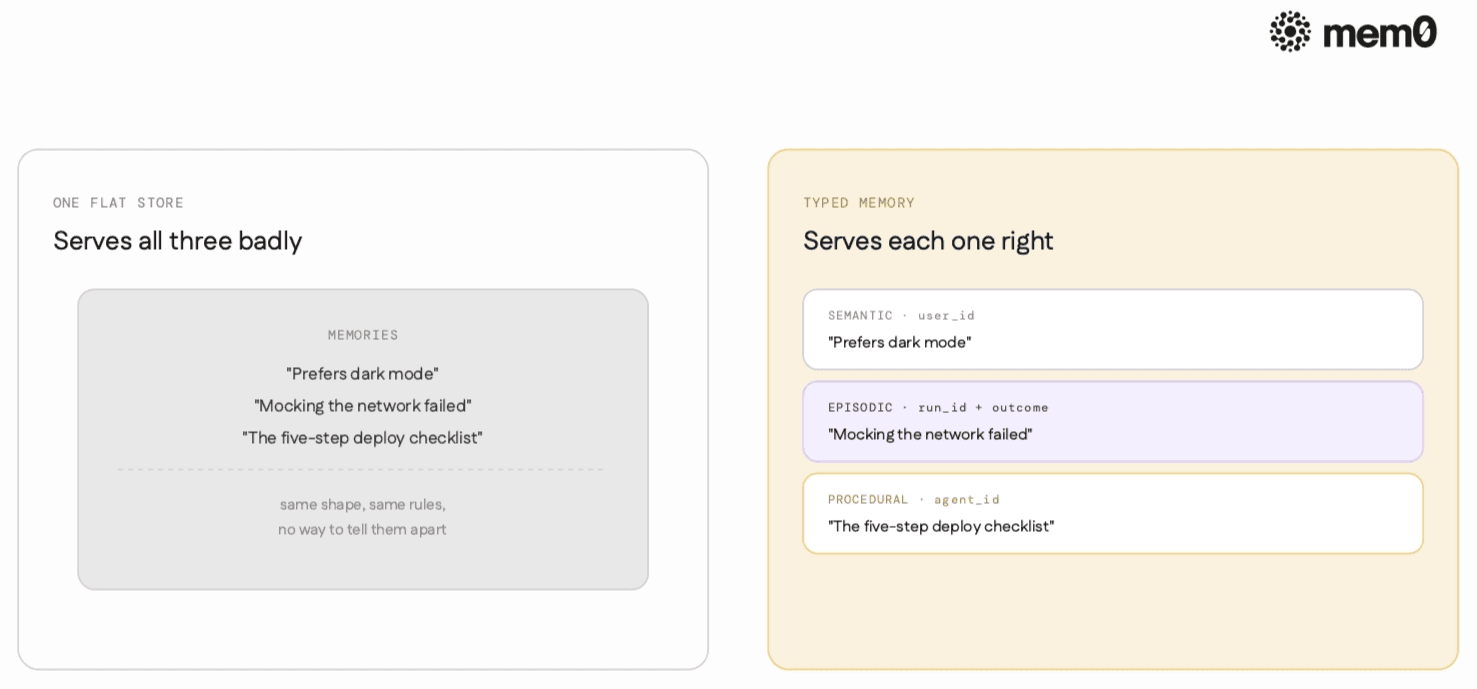
None of these three types has its own dedicated parameter in Mem0: not semantic, not episodic, not procedural. All three are the same add()/search() primitives underneath. What actually makes one "procedural" instead of "semantic" is which scope key you use and how you use it: user_id for a personal fact, run_id plus outcome metadata for a dated event, agent_id for a routine that belongs to the job, not to whoever taught it. That last part matters more than it looks, scoping a procedure to agent_id instead of user_id is exactly what lets one developer teach a convention once and a different developer benefit from it later without being told, since the memory belongs to the agent doing the work, not the person who happened to explain it.
Semantic vs episodic vs procedural memory
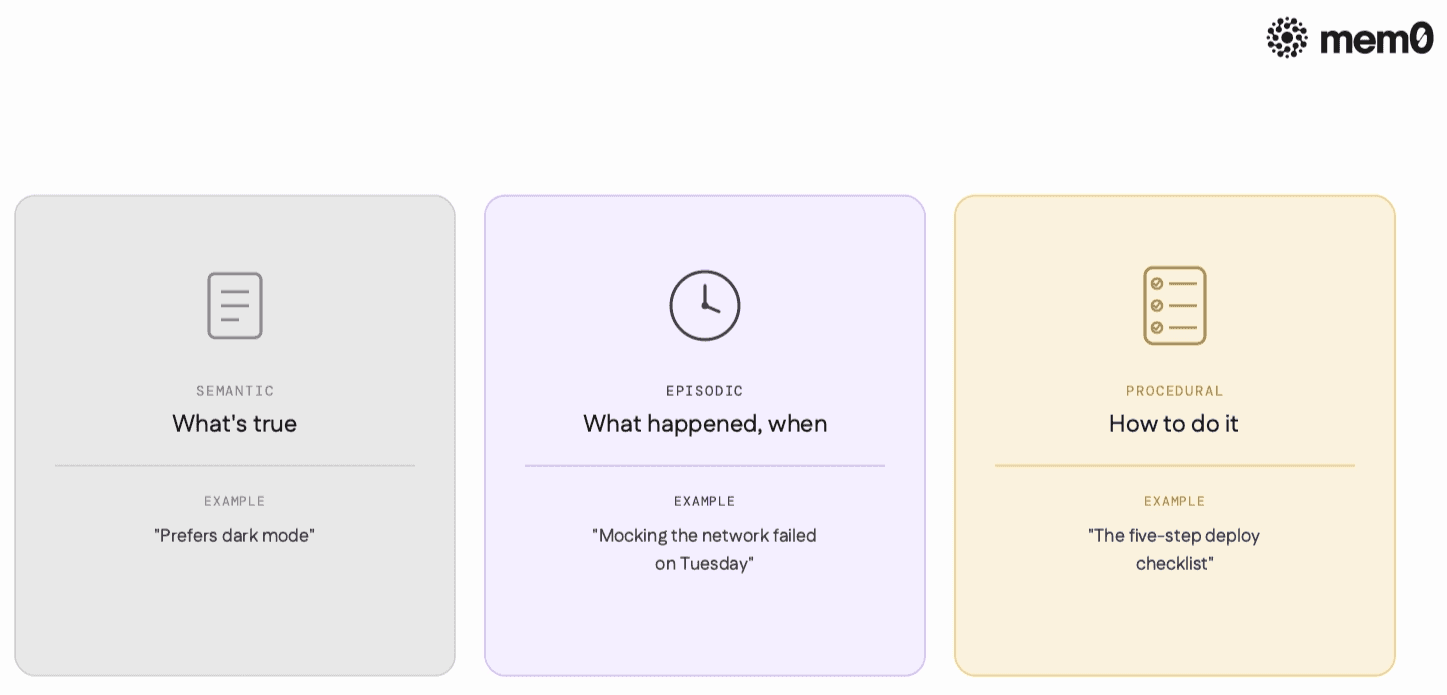
Semantic | Episodic | Procedural | |
|---|---|---|---|
Stores | General facts, detached from time | A specific, dated experience | A reusable skill or routine |
Example | "Prefers dark mode" | "Mocking the network failed on Tuesday" | "The five-step deploy process" |
Retrieved by | Relevance | Similarity plus recency | Direct call, by task |
Characteristic failure | Missing clock, stale but confidently stated | Fact kept, outcome dropped, mistake repeats | Outdated routine, reused without revalidation |
Mem0 mechanism |
|
|
|
Why an agent needs all three, not just one
Match the type to the behavior you actually want to improve. A stable preference is semantic. A failure to avoid repeating is episodic. A routine to reuse and refine is procedural. Reach for only one of these, and the other two behaviors don't disappear; they just get served badly by a mechanism that was never built for them: preferences that decay because nothing marks them as durable, mistakes that repeat because only the fact survived and not the outcome, or skills that never improve because they're stored the same way as a one-time note.
Wrapping up
Semantic vs episodic vs procedural memory in AI agents comes down to three different questions a memory has to answer: what's true, what happened, and how to do something. Mem0 doesn't hand you three separate features for these; it hands you one set of primitives, add(), search(), user_id, run_id, agent_id, metadata, flexible enough that the same mechanism cleanly serves all three jobs once you scope it deliberately, instead of one flat store trying to be all three at once.
Further Reading
—
Mem0 is an intelligent, open-source memory layer designed for LLMs and AI agents to provide long-term, personalized, and context-aware interactions across sessions.*
Get your free API Key here: app.mem0.ai or
Self-host mem0 from our open-source GitHub repository.
—
Frequently Asked Questions
Q. Semantic memory vs procedural memory: what's the difference?
Semantic memory stores what's true, general facts and preferences detached from when they were learned. Procedural memory stores how to do something, a reusable skill or routine that should improve with repetition. A user's dark mode preference is semantic; a five-step deploy checklist is procedural.
Q. What is semantic vs episodic vs procedural memory in AI agents?
Semantic memory answers "what's true." Episodic memory answers "what happened, when, and what was the outcome." Procedural memory answers "how do I do this?" All three are stored and retrieved differently, and an agent that only has one of them fails at the jobs the other two are meant for.
Q. Does an AI agent need all three memory types?
Yes, if it needs to be reliable across sessions. Skipping semantic memory means restating preferences every time. Skipping episodic memory means repeating mistakes because only the fact survived, not the outcome. Skipping procedural memory means never getting faster at a recurring task.
Q. Does Mem0 have a built-in parameter for each memory type?
No, none of the three has its own dedicated parameter. All three are Mem0's same add()/search() primitives, differentiated by convention: user_id scoping for a personal fact (semantic), run_id scoping plus outcome metadata for a dated event (episodic), and agent_id scoping with infer=False for a routine that belongs to the job rather than the person who taught it (procedural).
Q. What's the most common mistake teams make with agent memory types?
Treating memory as one flat bucket. It's the single most common way memory underdelivers: the type with the strictest requirement, a preference that must never expire, a mistake that must not repeat, a skill that must keep working, ends up served by the loosest common denominator, and the failure doesn't show up loudly; the agent just gets quietly worse over time.
More on Agent Memory

How to Read Memory Benchmarks
How to read AI memory benchmarks: what LoCoMo, LongMemEval, BEAM, and agentic tests measure, where scores go wrong, and how to find the correct benchmark for your use case.
20 min read

The Problem After Retrieval: Why Agents Misuse the Memories They're Given
Five papers show LLM agents often misuse the memories they retrieve. What the research says, how much to trust it, and what builders can do.
13 min read

What Is Memory Staleness in AI? Causes, Risks & Solutions
Understand memory staleness in AI agents, why outdated information leads to errors, and the best techniques to maintain accurate long-term memory.
9 min read



Aashi Dutt
She is a senior technical content writer at Mem0. She covers agent memory architecture and the engineering decisions behind building agents that actually remember. She experiments with new features and turns research into posts developers can put straight to use.
Start building with memory
Free tier, no card