Miscellaneous

Miscellaneous

How to Build a Code Review Agent Using Mem0

How to Build a Code Review Agent Using Mem0

Modern teams expect code review automation to be consistent, context-aware, and incremental. A static LLM prompt that comments on a single diff cannot meet those expectations. It ignores historical decisions, prior review feedback, and project-specific conventions.

A code review agent that operates in production needs a memory layer. It must remember comments across pull requests, recognize recurring patterns in a repository, and adapt to individual contributors. This article explains how to build such an agent, and how Mem0 solves the memory problem in that workflow.

The focus is practical. By the end, readers will have a working Python example that connects Mem0 to a code review loop and can be expanded into a production system.

👉Get a free API key at app.mem0.ai to follow along (free tier, no credit card, includes all the add() and search() calls shown below).

The Problem Space for Code Review Agents

Code review agents usually start simple. They receive a diff, call an LLM with a generic prompt, and output comments. This works for toy examples and fails in live repositories.

Key gaps emerge:

  • The agent does not know the repository’s history or prior decisions

  • The agent repeats the same comments to the same developer

  • The agent cannot track long-running refactors or epics

  • The agent cannot adapt to evolving style guides or architecture

Most of these issues are not about the model. They are about memory. Without a persistent state across sessions, every review is treated as a clean slate, which is the opposite of how human reviewers operate.

Persistent memory lets the agent:

  • Accumulate repository knowledge over time

  • Encode explicit decisions, such as "we accept this pattern here"

  • Track developer-specific feedback and learning progress

  • Improve its suggestions as it sees more code

This is the core role Mem0 plays.

What Mem0 Is in the Context of Code Review

Mem0 is an open-source memory layer for LLMs and agents. In practice, for a code review agent, it acts as three things:

  1. A long-term memory store across pull requests

  2. A context retrieval mechanism for each new review

  3. A structured way to tag and query memories by project, file, and developer

Instead of storing arbitrary JSON blobs, Mem0 stores semantically indexed memories of:

  • Review comments

  • Final decisions or resolutions

  • Repository-specific rules and heuristics

  • Metadata about files, services, and modules

Each memory can be attached to:

  • A repository ID

  • A file path or module path

  • A developer or team identity

  • The nature of the issue (security, style, performance)

Mem0 sits between the code review integration layer (for example, a Git hosting platform webhook) and the LLM engine. It gives the agent historical context and gives engineers a clear interface to inspect and manage what the agent remembers.

Architecture of a Mem0-Powered Code Review Agent
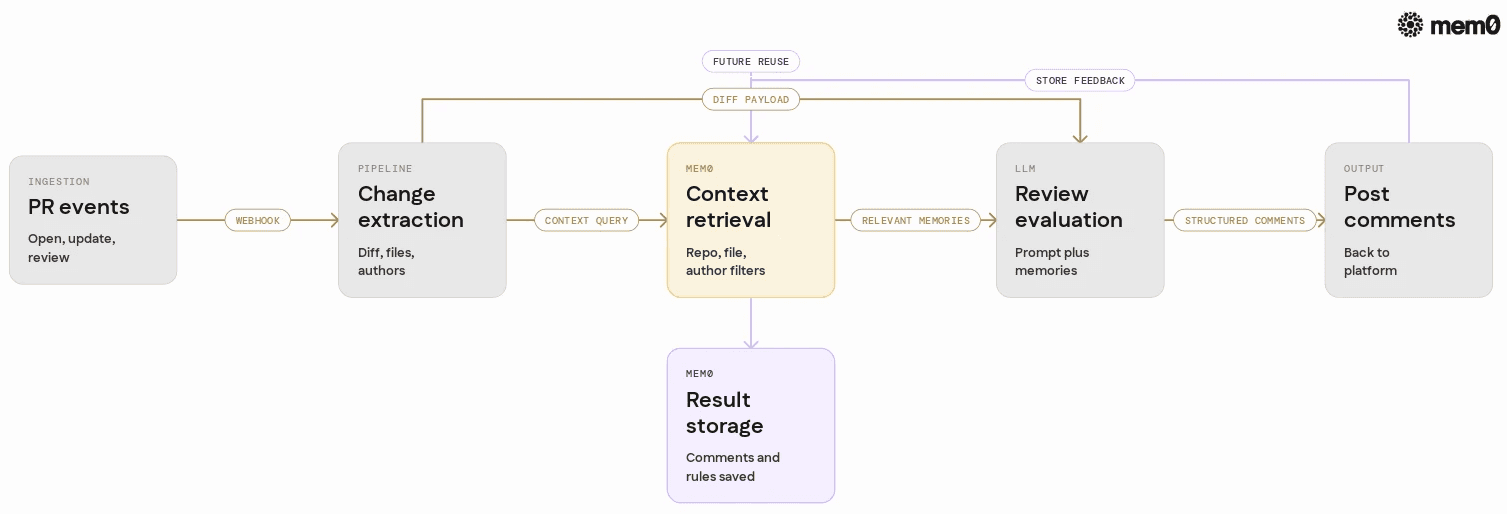
Visualizes where Mem0 fits into the multi step code review pipeline so readers can see how ingestion, retrieval, LLM evaluation, and result persistence connect.

A production code review agent has several moving parts. The memory layer must fit into a pipeline that looks roughly like this:

  1. Event ingestion

    • Pull request opened or updated

    • Commit pushed to a branch

    • Review requested

  2. Change extraction

    • Compute diffs

    • Extract file paths and metadata

    • Identify authors and reviewers

  3. Context assembly

    • Query Mem0 for relevant memories

    • Gather repo-level rules and prior feedback

    • Aggregate examples of similar issues

  4. LLM evaluation

    • Build a prompt containing diff and retrieved context

    • Call the LLM for suggestions and comments

    • Parse structured responses

  5. Result persistence

    • Post comments back to the code hosting platform

    • Write new memories to Mem0

    • Tag those memories for future retrieval

  6. Iteration

    • On future pull requests, retrieve and reuse prior decisions

    • Adapt over time as new patterns emerge

Mem0 primarily affects steps 3 and 5. It must be cheap and straightforward to:

  • Store new review events as memories

  • Query by repository, file, and developer

  • Filter and rank memories for the current diff

  • Keep the retrieved context within token limits

The remaining sections walk through how to implement these pieces with real Python code.

Setting Up Mem0 in a Python Code Review Agent

This example uses Python, an OpenAI model, and Mem0 as the memory layer. Installation can be done via pip:

The example assumes environment variables for:

  • MEM0_API_KEY

  • OPENAI_API_KEY

A minimal Mem0 client setup:

👉Wanna give it a try? Get a Mem0 API Key and try it yourself.

import os
from mem0 import Memory
from openai import OpenAI

MEM0_API_KEY = os.environ["MEM0_API_KEY"]
OPENAI_API_KEY = os.environ["OPENAI_API_KEY"]

mem0_client = Memory(api_key=MEM0_API_KEY)
llm_client = OpenAI(api_key=OPENAI_API_KEY)

MODEL_NAME = "gpt-4o-mini"  # or any compatible model
import os
from mem0 import Memory
from openai import OpenAI

MEM0_API_KEY = os.environ["MEM0_API_KEY"]
OPENAI_API_KEY = os.environ["OPENAI_API_KEY"]

mem0_client = Memory(api_key=MEM0_API_KEY)
llm_client = OpenAI(api_key=OPENAI_API_KEY)

MODEL_NAME = "gpt-4o-mini"  # or any compatible model
import os
from mem0 import Memory
from openai import OpenAI

MEM0_API_KEY = os.environ["MEM0_API_KEY"]
OPENAI_API_KEY = os.environ["OPENAI_API_KEY"]

mem0_client = Memory(api_key=MEM0_API_KEY)
llm_client = OpenAI(api_key=OPENAI_API_KEY)

MODEL_NAME = "gpt-4o-mini"  # or any compatible model

Next, define a small configuration object to capture repository and developer identities. This simplifies memory tagging and retrieval.

from dataclasses import dataclass

@dataclass
class ReviewContext:
    repo_id: str
    pr_id: str
    author_id: str
    files_changed: list[str]
from dataclasses import dataclass

@dataclass
class ReviewContext:
    repo_id: str
    pr_id: str
    author_id: str
    files_changed: list[str]
from dataclasses import dataclass

@dataclass
class ReviewContext:
    repo_id: str
    pr_id: str
    author_id: str
    files_changed: list[str]

In a production integration, repo_id, pr_id, and author_id would be derived from webhook payloads from the code hosting provider.

Storing Review Memories with Contextual Metadata

The power of Mem0 for code review agents comes from structured memory. Each memory entry should contain:

  • Natural language content summarizing what happened

  • A set of metadata fields, such as repo_id, file_path, issue_type, and author_id

Suppose the agent generates a comment on a diff. After posting it to the code hosting platform, store it in Mem0:

def store_review_comment(
    ctx: ReviewContext,
    file_path: str,
    line_number: int,
    issue_type: str,
    comment_text: str,
    resolution: str | None = None,
):
    """
    Store a structured memory of a review comment in Mem0.
    """
    memory_text = (
        f"Repository: {ctx.repo_id}\n"
        f"Pull request: {ctx.pr_id}\n"
        f"Author: {ctx.author_id}\n"
        f"File: {file_path}\n"
        f"Line: {line_number}\n"
        f"Issue type: {issue_type}\n"
        f"Comment: {comment_text}\n"
        f"Resolution: {resolution or 'unknown'}"
    )

    metadata = {
        "repo_id": ctx.repo_id,
        "pr_id": ctx.pr_id,
        "author_id": ctx.author_id,
        "file_path": file_path,
        "issue_type": issue_type,
        "line_number": line_number,
    }

    mem0_client.add(memory_text, metadata=metadata)
def store_review_comment(
    ctx: ReviewContext,
    file_path: str,
    line_number: int,
    issue_type: str,
    comment_text: str,
    resolution: str | None = None,
):
    """
    Store a structured memory of a review comment in Mem0.
    """
    memory_text = (
        f"Repository: {ctx.repo_id}\n"
        f"Pull request: {ctx.pr_id}\n"
        f"Author: {ctx.author_id}\n"
        f"File: {file_path}\n"
        f"Line: {line_number}\n"
        f"Issue type: {issue_type}\n"
        f"Comment: {comment_text}\n"
        f"Resolution: {resolution or 'unknown'}"
    )

    metadata = {
        "repo_id": ctx.repo_id,
        "pr_id": ctx.pr_id,
        "author_id": ctx.author_id,
        "file_path": file_path,
        "issue_type": issue_type,
        "line_number": line_number,
    }

    mem0_client.add(memory_text, metadata=metadata)
def store_review_comment(
    ctx: ReviewContext,
    file_path: str,
    line_number: int,
    issue_type: str,
    comment_text: str,
    resolution: str | None = None,
):
    """
    Store a structured memory of a review comment in Mem0.
    """
    memory_text = (
        f"Repository: {ctx.repo_id}\n"
        f"Pull request: {ctx.pr_id}\n"
        f"Author: {ctx.author_id}\n"
        f"File: {file_path}\n"
        f"Line: {line_number}\n"
        f"Issue type: {issue_type}\n"
        f"Comment: {comment_text}\n"
        f"Resolution: {resolution or 'unknown'}"
    )

    metadata = {
        "repo_id": ctx.repo_id,
        "pr_id": ctx.pr_id,
        "author_id": ctx.author_id,
        "file_path": file_path,
        "issue_type": issue_type,
        "line_number": line_number,
    }

    mem0_client.add(memory_text, metadata=metadata)

Certain patterns benefit from storing higher level decisions as separate memories. For example, when a team agrees on a custom rule, store that as a reusable memory.

def store_repo_rule(repo_id: str, rule_text: str, category: str):
    """
    Store a reusable repository rule, for example style or security guidance.
    """
    memory_text = f"Repository {repo_id} rule ({category}): {rule_text}"

    metadata = {
        "repo_id": repo_id,
        "type": "repo_rule",
        "category": category,
    }

    mem0_client.add(memory_text, metadata=metadata)
def store_repo_rule(repo_id: str, rule_text: str, category: str):
    """
    Store a reusable repository rule, for example style or security guidance.
    """
    memory_text = f"Repository {repo_id} rule ({category}): {rule_text}"

    metadata = {
        "repo_id": repo_id,
        "type": "repo_rule",
        "category": category,
    }

    mem0_client.add(memory_text, metadata=metadata)
def store_repo_rule(repo_id: str, rule_text: str, category: str):
    """
    Store a reusable repository rule, for example style or security guidance.
    """
    memory_text = f"Repository {repo_id} rule ({category}): {rule_text}"

    metadata = {
        "repo_id": repo_id,
        "type": "repo_rule",
        "category": category,
    }

    mem0_client.add(memory_text, metadata=metadata)

Over time, these entries form a knowledge base of the repository and its norms. Each new review can be retrieved from this base.

Retrieving Relevant Context for Each Review

Retrieval is where Mem0 directly improves the quality of code review comments. For each file or diff chunk, query for the most relevant historical memories.

Key filters and query patterns:

  • Limit by repo_id for repository-specific context

  • Filter by file_path or prefix for module-specific patterns

  • Filter by author_id to recall personal feedback

  • Filter by issue_type when focusing on a specific class of issue

A sample retrieval function:

def retrieve_review_context(
    ctx: ReviewContext,
    file_path: str,
    max_results: int = 8,
):
    """
    Retrieve memories relevant to the given repository and file path.
    """
    # The query text can be simple here, Mem0 uses embeddings internally.
    query_text = (
        f"Previous review comments and rules for repository {ctx.repo_id} "
        f"and file {file_path}"
    )

    filters = {
        "repo_id": ctx.repo_id,
        "file_path": file_path,
    }

    results = mem0_client.search(
        query=query_text,
        filters=filters,
        limit=max_results,
    )

    # Normalize to simple text snippets for LLM context
    snippets = []
    for item in results:
        content = item.get("memory") or item.get("content") or ""
        if content:
            snippets.append(content)

    return snippets
def retrieve_review_context(
    ctx: ReviewContext,
    file_path: str,
    max_results: int = 8,
):
    """
    Retrieve memories relevant to the given repository and file path.
    """
    # The query text can be simple here, Mem0 uses embeddings internally.
    query_text = (
        f"Previous review comments and rules for repository {ctx.repo_id} "
        f"and file {file_path}"
    )

    filters = {
        "repo_id": ctx.repo_id,
        "file_path": file_path,
    }

    results = mem0_client.search(
        query=query_text,
        filters=filters,
        limit=max_results,
    )

    # Normalize to simple text snippets for LLM context
    snippets = []
    for item in results:
        content = item.get("memory") or item.get("content") or ""
        if content:
            snippets.append(content)

    return snippets
def retrieve_review_context(
    ctx: ReviewContext,
    file_path: str,
    max_results: int = 8,
):
    """
    Retrieve memories relevant to the given repository and file path.
    """
    # The query text can be simple here, Mem0 uses embeddings internally.
    query_text = (
        f"Previous review comments and rules for repository {ctx.repo_id} "
        f"and file {file_path}"
    )

    filters = {
        "repo_id": ctx.repo_id,
        "file_path": file_path,
    }

    results = mem0_client.search(
        query=query_text,
        filters=filters,
        limit=max_results,
    )

    # Normalize to simple text snippets for LLM context
    snippets = []
    for item in results:
        content = item.get("memory") or item.get("content") or ""
        if content:
            snippets.append(content)

    return snippets

For a broader context, for example, repository-level rules, call search with only repo_id filter and a different query text. Combine both sets of memories when building the LLM prompt.

def retrieve_repo_rules(repo_id: str, max_results: int = 10):
    filters = {"repo_id": repo_id, "type": "repo_rule"}

    results = mem0_client.search(
        query="repository rules and guidelines",
        filters=filters,
        limit=max_results,
    )

    return [r.get("memory") or r.get("content") or "" for r in results]
def retrieve_repo_rules(repo_id: str, max_results: int = 10):
    filters = {"repo_id": repo_id, "type": "repo_rule"}

    results = mem0_client.search(
        query="repository rules and guidelines",
        filters=filters,
        limit=max_results,
    )

    return [r.get("memory") or r.get("content") or "" for r in results]
def retrieve_repo_rules(repo_id: str, max_results: int = 10):
    filters = {"repo_id": repo_id, "type": "repo_rule"}

    results = mem0_client.search(
        query="repository rules and guidelines",
        filters=filters,
        limit=max_results,
    )

    return [r.get("memory") or r.get("content") or "" for r in results]

The agent now has both file-specific and repository-wide context for each review.

Generating Context-Aware Code Review Comments

With retrieval in place, the next step is constructing prompts that integrate Mem0 context with the current diff. The pattern below uses the OpenAI Python SDK with a structured system and user prompt.

SYSTEM_PROMPT = """
You are a senior software engineer performing code review.
Respect repository-specific rules and prior decisions provided in context.
Prefer concise, actionable comments. Avoid repeating already accepted patterns.
"""

def build_review_prompt(diff_text: str, ctx: ReviewContext, file_path: str):
    file_memories = retrieve_review_context(ctx, file_path)
    repo_rules = retrieve_repo_rules(ctx.repo_id)

    memory_section = "\n\n".join(
        ["[Memory] " + m for m in file_memories + repo_rules]
    )

    user_prompt = f"""
Context from past reviews and rules:

{memory_section or 'No prior context found.'}

Current diff for file {file_path}:

{diff_text}

Task:
1. Review the changes for correctness, security, readability, and style.
2. Respect repository rules in the context.
3. Avoid commenting on patterns that were previously accepted, unless they are dangerous.
4. Output a list of comments in this JSON schema:

[
  {{
    "line": <line number or null>,
    "severity": "info" | "warning" | "error",
    "issue_type": "style" | "bug" | "security" | "performance" | "design",
    "comment": "human readable feedback"
  }}
]
"""

    return user_prompt
SYSTEM_PROMPT = """
You are a senior software engineer performing code review.
Respect repository-specific rules and prior decisions provided in context.
Prefer concise, actionable comments. Avoid repeating already accepted patterns.
"""

def build_review_prompt(diff_text: str, ctx: ReviewContext, file_path: str):
    file_memories = retrieve_review_context(ctx, file_path)
    repo_rules = retrieve_repo_rules(ctx.repo_id)

    memory_section = "\n\n".join(
        ["[Memory] " + m for m in file_memories + repo_rules]
    )

    user_prompt = f"""
Context from past reviews and rules:

{memory_section or 'No prior context found.'}

Current diff for file {file_path}:

{diff_text}

Task:
1. Review the changes for correctness, security, readability, and style.
2. Respect repository rules in the context.
3. Avoid commenting on patterns that were previously accepted, unless they are dangerous.
4. Output a list of comments in this JSON schema:

[
  {{
    "line": <line number or null>,
    "severity": "info" | "warning" | "error",
    "issue_type": "style" | "bug" | "security" | "performance" | "design",
    "comment": "human readable feedback"
  }}
]
"""

    return user_prompt
SYSTEM_PROMPT = """
You are a senior software engineer performing code review.
Respect repository-specific rules and prior decisions provided in context.
Prefer concise, actionable comments. Avoid repeating already accepted patterns.
"""

def build_review_prompt(diff_text: str, ctx: ReviewContext, file_path: str):
    file_memories = retrieve_review_context(ctx, file_path)
    repo_rules = retrieve_repo_rules(ctx.repo_id)

    memory_section = "\n\n".join(
        ["[Memory] " + m for m in file_memories + repo_rules]
    )

    user_prompt = f"""
Context from past reviews and rules:

{memory_section or 'No prior context found.'}

Current diff for file {file_path}:

{diff_text}

Task:
1. Review the changes for correctness, security, readability, and style.
2. Respect repository rules in the context.
3. Avoid commenting on patterns that were previously accepted, unless they are dangerous.
4. Output a list of comments in this JSON schema:

[
  {{
    "line": <line number or null>,
    "severity": "info" | "warning" | "error",
    "issue_type": "style" | "bug" | "security" | "performance" | "design",
    "comment": "human readable feedback"
  }}
]
"""

    return user_prompt

Then the call to the LLM:

import json

def run_review(diff_text: str, ctx: ReviewContext, file_path: str):
    prompt = build_review_prompt(diff_text, ctx, file_path)

    response = llm_client.chat.completions.create(
        model=MODEL_NAME,
        messages=[
            {"role": "system", "content": SYSTEM_PROMPT.strip()},
            {"role": "user", "content": prompt.strip()},
        ],
        temperature=0.1,
    )

    content = response.choices[0].message.content
    try:
        comments = json.loads(content)
    except json.JSONDecodeError:
        # Fallback: wrap raw text in a single comment
        comments = [{
            "line": None,
            "severity": "info",
            "issue_type": "design",
            "comment": content.strip(),
        }]

    return comments
import json

def run_review(diff_text: str, ctx: ReviewContext, file_path: str):
    prompt = build_review_prompt(diff_text, ctx, file_path)

    response = llm_client.chat.completions.create(
        model=MODEL_NAME,
        messages=[
            {"role": "system", "content": SYSTEM_PROMPT.strip()},
            {"role": "user", "content": prompt.strip()},
        ],
        temperature=0.1,
    )

    content = response.choices[0].message.content
    try:
        comments = json.loads(content)
    except json.JSONDecodeError:
        # Fallback: wrap raw text in a single comment
        comments = [{
            "line": None,
            "severity": "info",
            "issue_type": "design",
            "comment": content.strip(),
        }]

    return comments
import json

def run_review(diff_text: str, ctx: ReviewContext, file_path: str):
    prompt = build_review_prompt(diff_text, ctx, file_path)

    response = llm_client.chat.completions.create(
        model=MODEL_NAME,
        messages=[
            {"role": "system", "content": SYSTEM_PROMPT.strip()},
            {"role": "user", "content": prompt.strip()},
        ],
        temperature=0.1,
    )

    content = response.choices[0].message.content
    try:
        comments = json.loads(content)
    except json.JSONDecodeError:
        # Fallback: wrap raw text in a single comment
        comments = [{
            "line": None,
            "severity": "info",
            "issue_type": "design",
            "comment": content.strip(),
        }]

    return comments

Each comment from run_review can then be posted to the code hosting platform and stored in Mem0 via store_review_comment. This closes the loop and ensures that future reviews inherit current decisions.

Aligning Mem0 Memory with Code Review Workflows
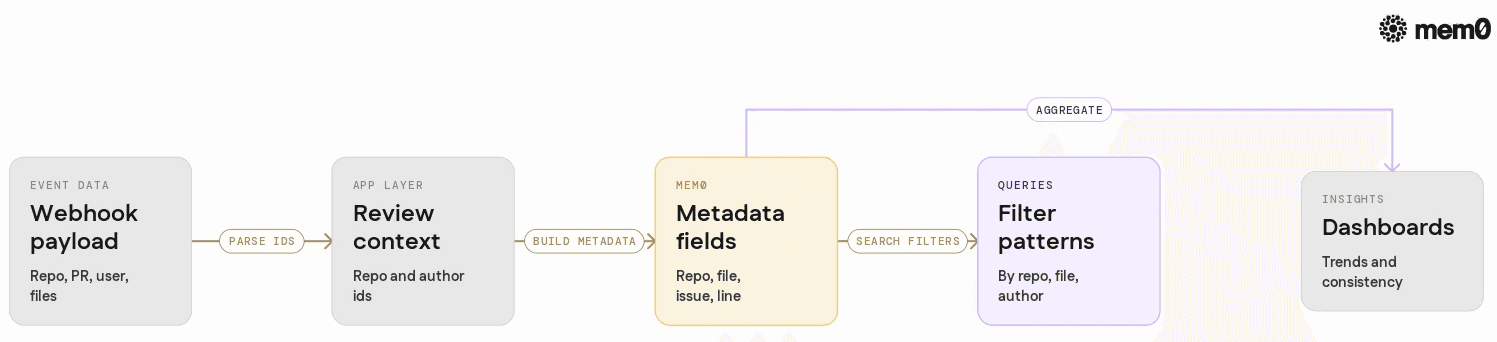
Illustrates how review events map into Mem0 metadata fields so engineers can see the relationship between webhook payloads and query filters.

Mem0 must align with real workflows, not theoretical ones. In practice, that means mapping Mem0 metadata to key concepts in the code review lifecycle:

  • repo_id maps to the repository or project slug

  • pr_id maps to the pull request or merge request ID

  • commit_id can be stored when needed for debugging

  • author_id and reviewer_id map to users in the code hosting platform

  • file_path and optional module fields map to paths in the repository

Example metadata design:

metadata = {
    "repo_id": ctx.repo_id,
    "pr_id": ctx.pr_id,
    "author_id": ctx.author_id,
    "file_path": file_path,
    "issue_type": issue_type,
    "line_number": line_number,
    "kind": "review_comment",
}
metadata = {
    "repo_id": ctx.repo_id,
    "pr_id": ctx.pr_id,
    "author_id": ctx.author_id,
    "file_path": file_path,
    "issue_type": issue_type,
    "line_number": line_number,
    "kind": "review_comment",
}
metadata = {
    "repo_id": ctx.repo_id,
    "pr_id": ctx.pr_id,
    "author_id": ctx.author_id,
    "file_path": file_path,
    "issue_type": issue_type,
    "line_number": line_number,
    "kind": "review_comment",
}

This design enables:

  • Filtering out memories that belong to other repositories

  • Clustering feedback by file or module

  • Analyzing per-author trends, for example, recurring security issues

  • Building dashboards or metrics on top of Mem0 content

The same structure allows the agent to adapt to different code hosting providers. The Mem0 layer remains unchanged while the ingestion and posting layers are swapped out.

Comparison of Stateless vs Mem0-Based Code Review Agents
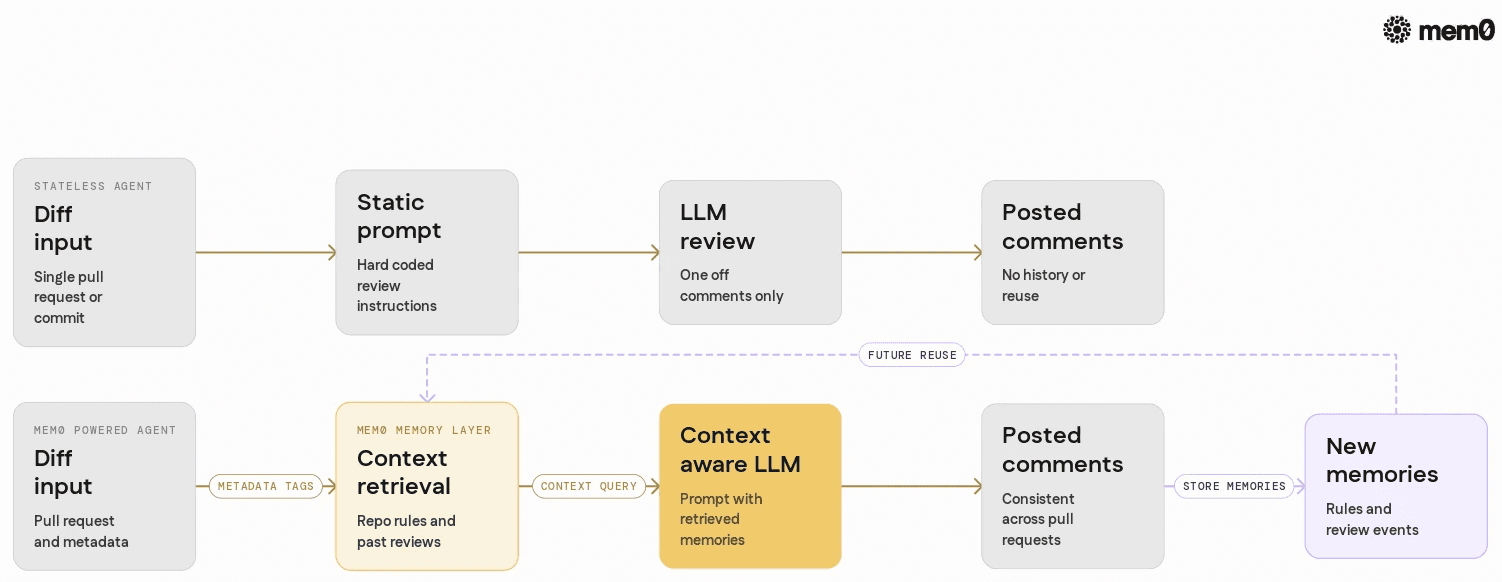
Shows the contrast between a simple stateless code review agent and a Mem0 powered agent, making clear how the memory layer changes the flow without changing the core LLM.

The main difference between a naive code review agent and one using Mem0 is not the model. It is the persistence and reuse of knowledge.

Aspect

Stateless LLM Review Agent

Mem0-Powered Review Agent

Awareness of past decisions

None, every review is fresh

Remembers previous comments, resolutions, and rules

Repository-specific rules

Hard-coded or prompt-only, easy to drift out of sync

Stored as memories, updated organically via reviews

Consistency across PRs

Inconsistent, depends on prompt phrasing and model state

High, the model is guided by retrieved historical context

Developer personalization

Not possible

Per-author memories enable tailored feedback

Handling of long-running work

Does not track refactors or epics

Can recall prior phases and align with earlier guidance

Token usage

All context baked into one prompt

Compact prompt plus retrieved, relevant memories

Operational observability

Difficult to reason about model behavior

Mem0 content acts as an audit log of agent reasoning

Evolution over time

Static unless prompts are manually updated

Learns from the accumulated repository history

For production AI engineers, the key benefit is predictability. The Mem0 layer turns the code review agent into a system that converges to stable behavior rather than producing one-off responses.

Limitations of Code Review Agents with Persistent Memory

Adding Mem0 solves the memory gap, but it does not make a code review agent omniscient. Certain limitations remain important.

First, the agent can only reason about what it sees. If the diff omits context or tests, the model might miss issues. Mem0 can store prior context, but it still operates within token budgets and the quality of retrieved memories.

Second, memory selection matters. Poor filters or overly broad queries can flood the prompt with irrelevant history. This can distract the model or increase latency. Engineers must tune filters to balance recall and precision.

Third, performance and latency are non-trivial. Large repositories and high review volume can create significant memory traffic. Caching and batching retrieval or storing higher level summaries can mitigate this, but the design must treat Mem0 as a critical dependency.

Fourth, human oversight remains necessary. The agent can provide consistent, context-aware feedback, but it can also propagate bad rules or decisions if those were stored in memory. Processes should exist to edit or remove incorrect memories and to align the system with updated policies.

Finally, domain-specific correctness is still challenging. Highly specialized codebases, such as numerical libraries or hardware interfaces, might require domain knowledge beyond what the model and memory can provide. In such cases, Mem0 can assist but not replace expert human review.

Frequently Asked Questions

Q. What is the main benefit of adding Mem0 to a code review agent?

Mem0 provides persistent, queryable memory across pull requests and sessions. This lets the agent remember past comments, repository-specific rules, and developer patterns, which yields more consistent and context-aware reviews over time.

Q. How does Mem0 differ from just using a database for logs?

A traditional database stores structured records but does not provide semantic search for natural-language content. Mem0 stores memories with embeddings and metadata, so the agent can retrieve relevant past context based on meaning, not just exact matches or IDs.

Q. When should a team introduce Mem0 into a code review workflow?

Mem0 becomes valuable once the repository and team reach a scale where consistency and history matter. This typically happens when multiple reviewers are involved, custom standards evolve over months, or recurring issues appear that the agent should recognize and remember.

Q. How does Mem0 handle multi-repository setups or microservices?

Each repository can be assigned a distinct repo_id so memories remain scoped properly. Teams can also tag services or modules in metadata, which allows the agent to reuse patterns across related repositories while still separating unrelated projects.

Q. What models work with Mem0 in this code review pattern?

Mem0 is model-agnostic. Any LLM that can accept text prompts and return text responses can be integrated, whether via OpenAI, local models, or enterprise providers, as long as the agent code passes Mem0’s retrieved context into the prompt.

Q. Why store both review comments and rules in Mem0 instead of only rules?

Rules capture explicit decisions, but review comments reflect real-world application of those rules and exceptions. Storing both gives the agent a richer set of examples to reference, which helps it understand nuance and avoid overly rigid or repetitive feedback.

Further Reading

Mem0 is an intelligent, open-source memory layer designed for LLMs and AI agents to provide long-term, personalized, and context-aware interactions across sessions.

Get your free API Key here: app.mem0.ai or

Self-host mem0 from our open source GitHub repository.

GET TLDR from:

Summarize

Website/Footer

Summarize

Website/Footer

Summarize

Website/Footer

Summarize

Website/Footer