

·
10 min read

On this page
Say you ask your agent to remember your bank locker PIN. Simple enough! But not until you ask the four questions, nobody bothers asking about a stored password until something's already gone wrong. Who's actually allowed to see it, just you, or your spouse too, or anyone else with access to the account? Who put it there, and were they the right person to do that? If it ever gets changed, can you prove who changed it and when? And when you rotate it, does the old one actually disappear, or is it still sitting somewhere waiting to resurface?
Of course, these are not just questions for your agent’s memory, but for the boundaries of your agent’s memory. In this blog, I’ll cover everything about memory governance, its boundaries, retention rules, audit trails, and provenance. I'll walk through all four using that one locker PIN example, with real Mem0 primitives for each, because governance isn't one feature you turn on; it's how you compose the features you already have.
If you haven’t checked out Mem0 yet! Start exploring at https://mem0.ai/
What does memory governance actually mean?
Here's a way to think about it that made this click for me. A memory system has a lifecycle: something happens, it gets written, it sits there, it gets retrieved later, and eventually it gets updated or removed. Governance isn't a step in that lifecycle. It's a set of rules that apply at every step, because write can store something it shouldn't, or retrieval can cross into someone else's data, or a delete operation doesn't actually delete the required data.
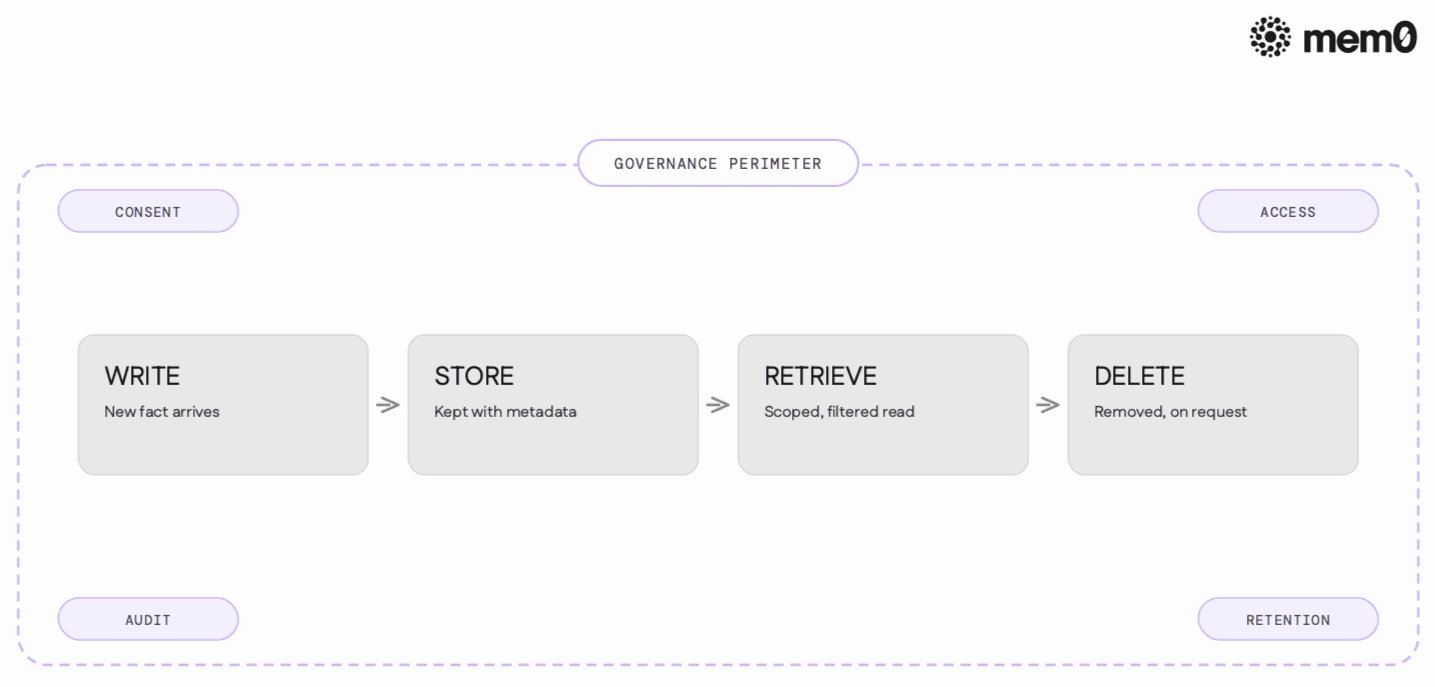
If you try to add governance after the fact, whether read or written, then no boundaries would make sense, simply because the things governance needs (who this memory belongs to, why it was allowed to be stored, a record of every change, a rule for when it goes away) have to be designed into the system, not sprinkled on top later.
That's the whole thesis of this post: governance is four boring, composable pieces, not one big feature.
Access control: who's allowed to see the memory
Here's where I want to be honest about a mismatch. When people say "agent memory permissions," they usually picture something like a spreadsheet's sharing settings, an owner, an editor, a viewer. Mem0 doesn't have that model, and honestly, most memory layers don't yet. What it does have is scoping, and scoping is what actually enforces the boundary today.
Every memory gets written and read against an identity: user_id, agent_id, app_id, run_id. These aren't just labels; they're the boundary. A query scoped to one user's user_id cannot see another user's memories, full stop, that's enforced at the storage layer, not by convention.
Back to the locker PIN. Say, you store your PIN with your household assistant, so you and your spouse can both ask your assistant for it, but your kid's homework-helper agent has no business anywhere near it. To set this kind of boundary within your agent’s memory layer, every memory in Mem0 gets written and read against an identity, user_id, agent_id, app_id, run_id. These aren't just labels; they are the boundary. A query scoped to one identity cannot see another identity's memories. That’s it.
If this got you Interested? Get yourself a Mem0 API Key and let's dive deeper.
If you genuinely need role-based permissions, viewer versus editor versus owner, that logic has to live in your own application layer, deciding which scopes a given role's token is allowed to query. Mem0 gives you the boundary primitives, including user_id, agent_id, app_id, run_id, and the AND/OR filter logic to combine them. It doesn't ship a role system on top, and pretending it does is how teams end up with a false sense of security.
Consent and provenance: who wrote the memory, and why
A memory without a record of why it exists is a liability. Who said this? Were they allowed to say it about themselves or about someone else? What's it for? All these questions surface when setting a boundary for an agent’s memory. Mem0's metadata field is where that record lives and keeps attached to the memory even at the write time.
A memory that carries its own "why" is auditable and correctable. A memory that's just a bare fact with no provenance is a black box that occasionally acts on something nobody can explain or challenge later, including, for something like a shared PIN, nobody being able to say for sure it wasn't guessed or scraped from somewhere it shouldn't have come from.
Audit trail: who changed the memory, and when
This is the piece most teams skip entirely, and it's the one that turns "we think this is fine" into "we can prove this is fine." Say your spouse rotates the locker PIN three months later. So, every add, update, and delete against a memory should be traceable to who did it and when. Mem0 keeps this natively; you don't have to build your own logging table for it.
Here, history() returns every ADD, UPDATE, and DELETE event for that memory, with the old value, the new value, and a timestamp. That's the actual answer to "who deleted this and when," directly from a queryable record(memory).
Note: If you've got Mem0’s Dream feature turned on, then more outcomes exist that don't show up as an history() event: a memory that gets superseded by a newer, contradicting fact, or merged into a duplicate. Those aren't logged as an "event" type; they're tracked as a status on the memory record itself. A superseded memory points to whatever replaced it; a merged one just gets hidden from normal reads unless you ask for it. history() method works as your audit trail for direct writes. Supersede and merge status is a separate thing to check if you need the full picture of why a memory looks the way it does.
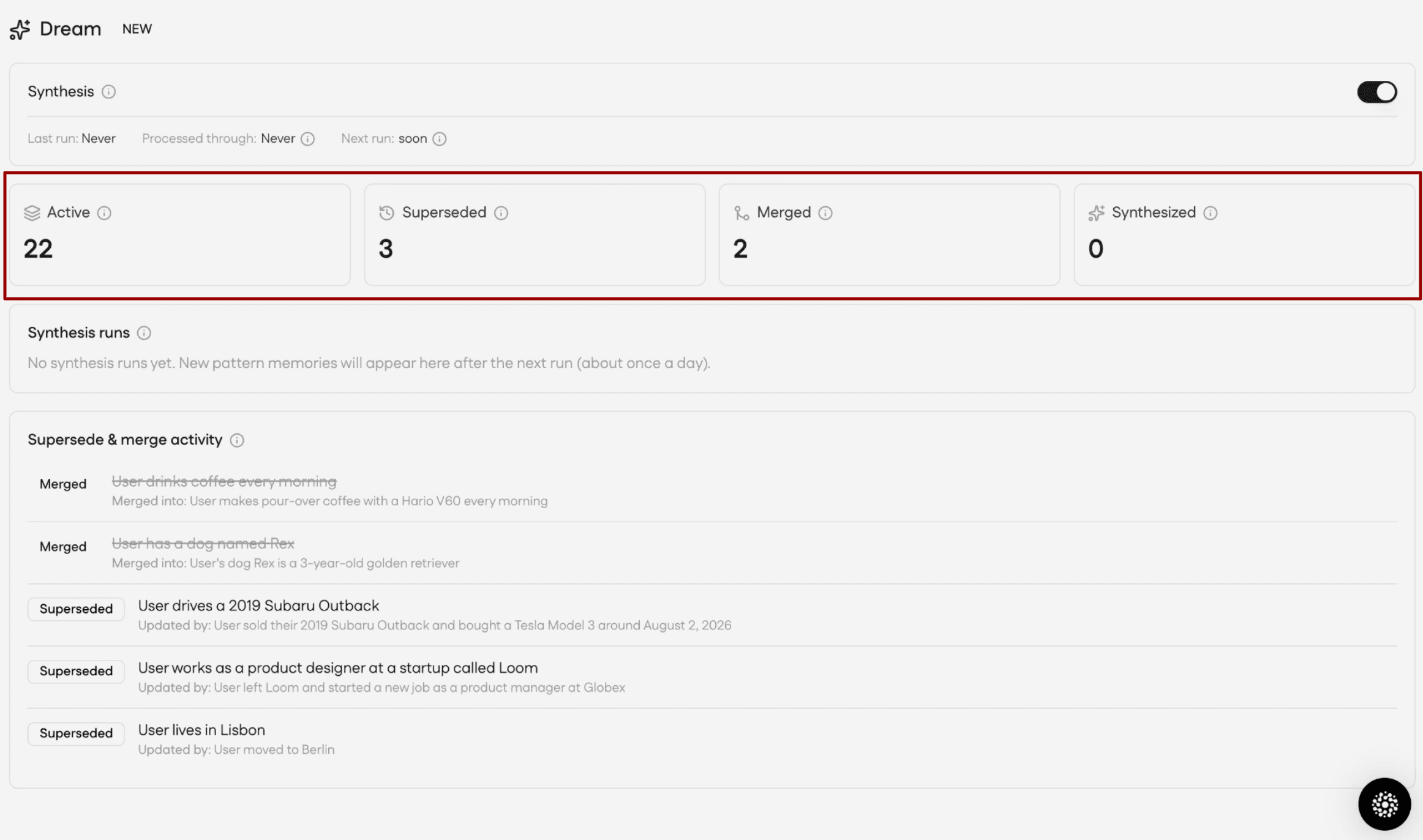
Retention and deletion: Does the memory actually go away
Good password hygiene means rotating the locker PIN every six months, not leaving the same one in place forever. I've written about the decay and expiry mechanics in more depth in a separate post on memory staleness, so I won't re-cover that here, but the short version for governance purposes:
You should set
expiration_dateparameter to six-month at write time, along with when the PIN actually gets rotated,Use
delete()operation withdelete_linked=Trueparameter to make sure the old PIN is actually gone.
Retention also has a session-level shortcut worth knowing: if everything tied to one identity needs to go at once, you don't have to hunt down individual IDs:
Nuances worth knowing
None of these four pieces work as a substitute for the others. Scoping keeps a query inside its boundary, but it says nothing about why a memory was written in the first place; that's what metadata and consent are for. An audit trail tells you what happened, but it doesn't stop something bad from happening; it just makes it provable after the fact. Retention rules clean up what should age out, but they don't help if the write never should have been scoped or consented to begin with. Governance is what you get when all four are actually composed together, not when you've implemented one of them well and called it done.
The honest caveat: Mem0 gives you the boundary primitives, the metadata field, the history log, and the retention mechanics. It doesn't hand you a finished "governance" feature with that name on it. Building actual memory governance means deciding, deliberately, how your application uses those primitives together, and that decision is yours to make, not the memory layer's.
Wrapping up
Memory governance isn't a feature you switch on; it's the discipline of treating every stage of a memory's life, whether it’s write, read, update, or delete.
Scope who can see what with real identity boundaries,
Attach consent and provenance to every write,
Keep a real audit trail instead of hoping you'll remember, and
Make sure deletion actually finishes the job.
Do these four things deliberately, and you have memory governance. Skip any one of them, and you have a memory system that works fine in the demo and quietly can't answer the one question that actually matters later: who let this happen?
Further reading
—
Mem0 is an intelligent, open-source memory layer designed for LLMs and AI agents to provide long-term, personalized, and context-aware interactions across sessions.*
Get your free API Key here: app.mem0.ai or
Self-host mem0 from our open-source GitHub repository.
—
Frequently Asked Questions
Q. What is AI agent memory governance?
It's the set of rules and mechanisms that control who can read, write, update, or delete an agent's stored memories, and whether those actions are traceable. It covers access boundaries, consent and provenance, audit trails, and retention, applied consistently across every stage of a memory's life, not added on after the system already works.
Q. What is AI memory access control?
In practice, it's scoping. Memories are written and read against identities like user_id, agent_id, app_id, and run_id, and a query scoped to one identity can't see another's data. It's enforced at the storage layer, which is different from a role-based permission system. Mem0 gives you the boundaries, not a viewer/editor/owner model.
Q. Does Mem0 support agent memory permissions like roles?
Not natively as a built-in role system. If you need viewer/editor/owner-style permissions, that logic lives in your application layer, deciding which scopes a given role is allowed to query. Mem0's user_id/agent_id/app_id/run_id scoping and filter logic are the primitives you'd build on top of.
Q. How do you audit changes to an agent's memory?
Call client.history(memory_id=...). It returns every ADD, UPDATE, and DELETE event for that memory, including the old value, the new value, and a timestamp, so "who changed this and when" has an actual answer instead of a guess.
Q. How does retention fit into memory governance?
Retention decides how long a memory should live and what happens when it's no longer wanted. expiration_date parametersets a shelf life at write time, and deleting with delete_linked=True makes sure a removal reaches whatever that memory had superseded, not just the newest layer. Retention without that second part can leave an older, outdated fact still sitting in the store after the newer one is gone.
More on Agent Memory

How to Read Memory Benchmarks
How to read AI memory benchmarks: what LoCoMo, LongMemEval, BEAM, and agentic tests measure, where scores go wrong, and how to find the correct benchmark for your use case.
20 min read

The Problem After Retrieval: Why Agents Misuse the Memories They're Given
Five papers show LLM agents often misuse the memories they retrieve. What the research says, how much to trust it, and what builders can do.
13 min read

What Is Memory Staleness in AI? Causes, Risks & Solutions
Understand memory staleness in AI agents, why outdated information leads to errors, and the best techniques to maintain accurate long-term memory.
9 min read




Aashi Dutt
She is a senior technical content writer at Mem0. She covers agent memory architecture and the engineering decisions behind building agents that actually remember. She experiments with new features and turns research into posts developers can put straight to use.
Start building with memory
Free tier, no card