

·
12 min read
On this page
Healthcare is full of repetitive, information-heavy workflows. Intake triage, care coordination, discharge planning, prior authorization, patient follow-up, and clinical documentation all depend on accurate recall of patient context across time and channels.
LLM-based agents are good at local reasoning over the current prompt. They are bad at stable, long-term memory. Tokens expire, chat context resets, and different tools see different slices of the story. In healthcare, that gap is not a minor annoyance. It is a safety and compliance risk.
Mem0 targets this exact gap. It acts as an external memory layer that sits beside the LLM, persists context across sessions, and exposes a clean API for storing and retrieving structured patient and workflow memory. For AI engineers, it is a way to build agents that remember without rebuilding an EHR.
👉Get a free API key at app.mem0.ai to follow along (free tier, no credit card, includes all the
add()andsearch()calls shown below).
What Mem0 brings to healthcare agents
Mem0 is an open source memory layer for LLMs and agents. In healthcare scenarios, it gives three practical capabilities:
Long-term recall of multi-session interactions and facts.
Structured memory objects aligned with healthcare entities such as patient, encounter, and task.
Consistent retrieval APIs that can be wired into tools, RAG pipelines, and orchestrators.
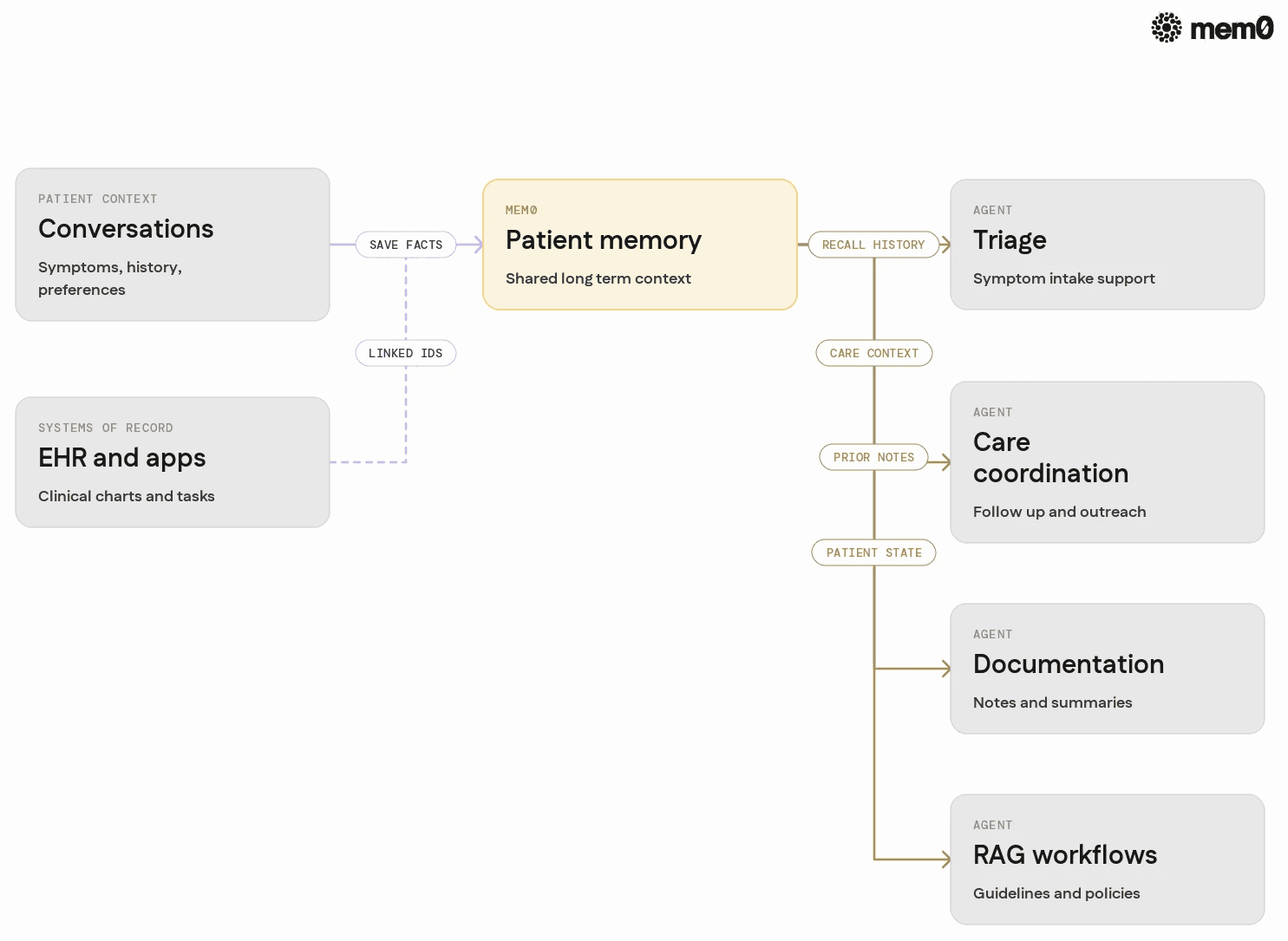
This shifts healthcare agents from being single-conversation utilities to persistent assistants. A triage bot can remember prior symptoms. A care coordinator agent can track the evolving care plan. A documentation assistant can recall prior notes and diagnoses when generating new summaries.
Mem0 does not replace clinical systems of record. Instead, it provides a memory layer that is LLM native and works well with unstructured text, conversational logs, and ephemeral decisions that rarely reach an EHR but still matter for AI behavior.
Core architecture for healthcare memory
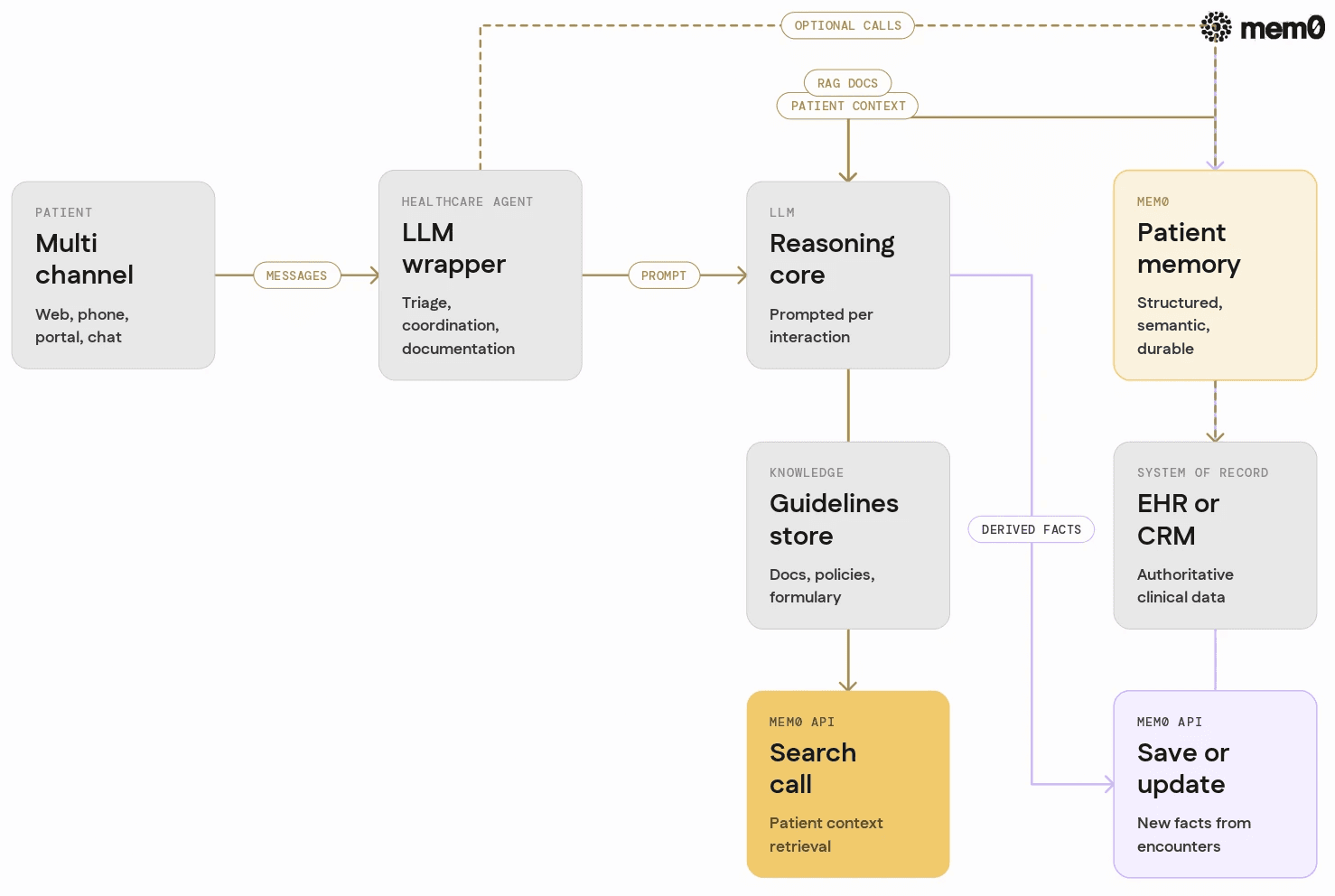
At a high level, Mem0 provides three primitives:
saveto store memory objects, usually extracted from conversations or documents.searchto retrieve relevant memories by text, metadata, or embeddings.updateanddeleteto maintain memory hygiene and lifecycle.
Each memory item can carry:
Text content, such as “Patient reports daily headaches for 2 weeks”.
Metadata, such as
patient_id,encounter_id,source,timestamp.Vector embeddings for semantic retrieval.
Healthcare agents usually attach one or more of these identifiers to every memory:
patient_idfor longitudinal context.session_idfor specific encounters or calls.agent_rolesuch as “triage”, “billing”, or “care_plan”.compliance_tagssuch as “phi” or “deidentified”.
This structure enables precise queries like “all care_plan memories for patient 123 in the last 90 days” or “the last triage conversation with this phone number”. Mem0 handles the storage and search details, so engineers focus on extraction and integration.
Use case 1: Triage and symptom intake
Symptom triage is usually the front door for patient-facing healthcare agents. The LLM must ask clarifying questions, remember answers, and often reconnect with the same patient later. Relying only on chat context creates two problems:
Long histories blow up token budgets and slow down queries.
Channel switching, for example, web to phone, breaks the state.
Mem0 lets triage agents treat each intake as an evolving memory record. Every time the patient provides a relevant fact, the agent saves a structured memory tied to the patient and the current episode. Later calls can reconstruct the context without replaying every message.
Example patterns:
Persisting symptom history and red flag answers.
Remembering chronic conditions and allergies mentioned in prior triage calls.
Reusing prior triage outcomes when the same complaint returns.
Mem0 reduces over-questioning and inconsistent advice because the agent can quickly recall what it already knows about the current issue and the patient.
Use case 2: Care coordination and longitudinal context
Care coordination involves many touchpoints over months. Nurses, care managers, social workers, and patients all contribute information that rarely lives in a single system. An AI agent in this environment must balance up-to-date context with respect for clinical records and team workflows.
Mem0 fits as a coordination memory that tracks:
Follow-up commitments, such as “call patient after lab results”.
Barriers, such as “patient lacks transportation” or “language preference Spanish”.
Non-clinical notes, such as “prefers morning calls” or “daughter is primary contact”.
These details are often absent from structured EHR fields but matter a lot for agent decisions. By attaching patient_id and care_program_id metadata, Mem0 gives agents a coherent view of the patient journey without altering clinical records.
A care coordination agent can:
Summarize the key context for human staff before they call a patient.
Suggest next best actions based on prior commitments.
Avoid repeating questions that have already been answered.
This approach is particularly useful in chronic disease programs, remote monitoring, and post-discharge care.
Use case 3: Documentation assistance and narrative recall
Clinical documentation is an obvious target for LLMs. However, generating accurate notes depends on recalling prior encounters, problem lists, and clinician preferences. Copying everything into the prompt is expensive and brittle.
Mem0 allows documentation agents to cache:
Prior note summaries for the same patient and clinician.
Stable facts such as past medical history or procedures.
Custom instructions derived from a clinician’s past edits.
During a new encounter, the agent pulls from Mem0 instead of reconstructing history from scratch. For example, it can retrieve the last five visit summaries and use them as context for a new SOAP note. It can also recall how a specific clinician prefers phrasing and formatting.
Because Mem0 separates memory storage from the LLM, engineers can enforce retention policies and ensure certain items, such as full note text, are not duplicated across systems.
Use case 4: RAG over clinical knowledge with contextual memory
Retrieval augmented generation is common for clinical guidelines, formulary rules, and policy documents. In healthcare settings, retrieval alone is not enough. Agents must also remember how a patient’s context interacts with those knowledge sources over time.
Mem0 helps by:
Persisting in which guidelines or policies were applied to a patient.
Storing derived conclusions such as “patient meets criteria for therapy X” or “prior authorization required”.
Tracking unanswered questions that future encounters should revisit.
This memory layer works alongside a vector store that holds static knowledge. The RAG pipeline fetches documents from the knowledge base and relevant patient memory from Mem0, then the LLM reasons over both. When the agent reaches a conclusion or asks the clinician to decide, that outcome is saved back into Mem0.
The result is a loop where RAG is not stateless. Decisions and context accumulate and are available for downstream agents such as billing, utilization management, or quality reporting.
Use case 5: Administrative and revenue cycle workflows
Healthcare is full of administrative work that does not require full EHR integration but benefits from history and context. Typical areas include:
Eligibility verification and benefit explanation.
Prior authorization precheck.
Coding and claim preparation.
Patient financial counseling.
Mem0 can store:
Payer-specific rules discovered through interactions.
Patient benefit interpretations and constraints.
Claim specific commentary from prior calls or appeals.
An administrative agent can use these memories to prevent contradictory statements, avoid repeated data gathering, and guide patients more accurately through financial options. Because Mem0 is open source and API driven, it can be integrated with existing billing and CRM systems without restructuring them.
Integrating Mem0 with healthcare agents in Python
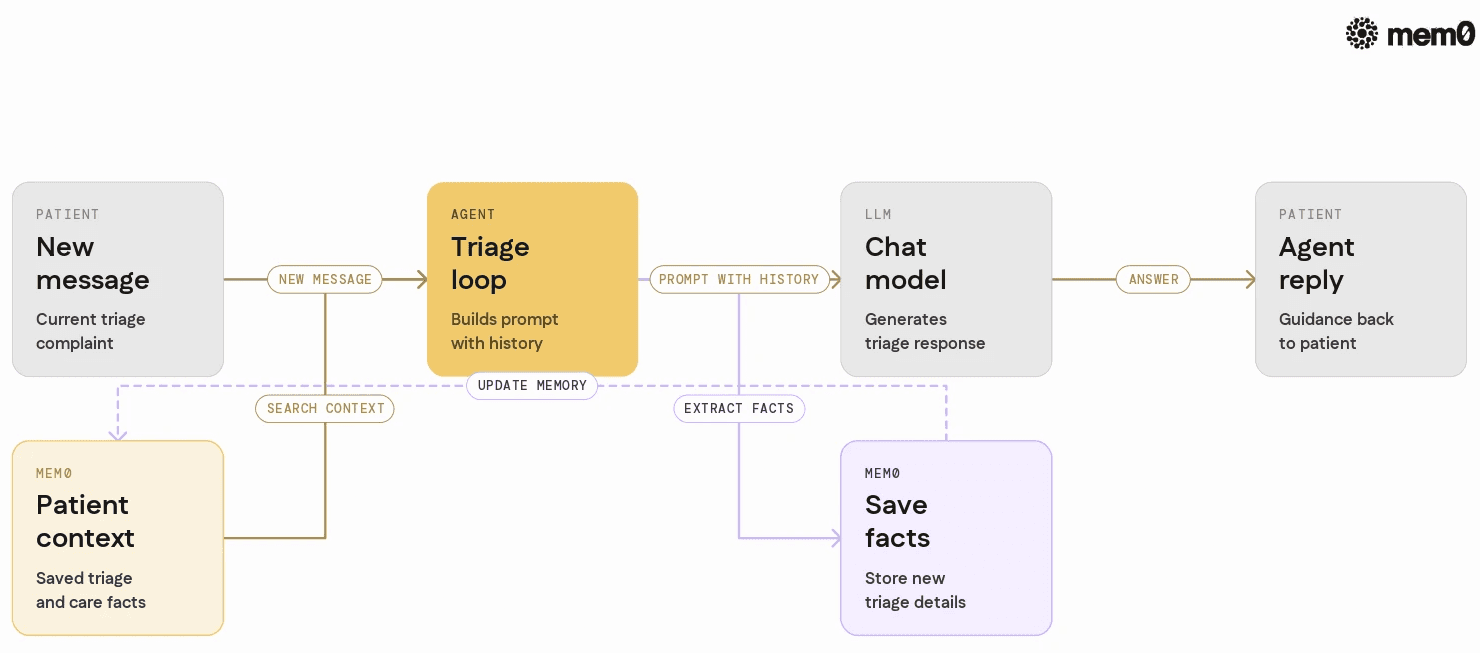
The following example shows a simple architecture where a healthcare triage agent uses Mem0 to persist patient context across sessions. This assumes access to the Mem0 Python client and any LLM provider.
👉Wanna give it a try? Get a Mem0 API Key and try it yourself.
This example is intentionally simple. In production, engineers usually add:
A dedicated extraction step that turns conversation text into structured memory fields.
Richer metadata such as
language,risk_score, orchannel.Security layers to align with organizational compliance requirements.
Mem0 acts as a shared memory store across all agents interacting with this patient, not just the triage agent.
Comparing Mem0-based memory with alternatives
AI teams in healthcare often start with ad hoc memory solutions or reuse existing infrastructure. The table below compares common patterns to a dedicated Mem0 layer.
Approach | Strengths | Weaknesses | Best-suited scenarios |
|---|---|---|---|
Chat history in the LLM context | Simple. No extra infra. | Expensive for long histories. Not cross-session. | Prototypes. Short single-channel interactions. |
Custom database with raw text | Full control. Fits existing infra. | Manual embedding, search, and ranking. Higher dev effort. | Single-agent designs. Narrow workflows. |
EHR as memory | Source of truth. Clinically complete. | Slow to change. Limited access. Not LLM native. | Regulated workflows with full IT involvement. |
Vector store without semantics | Strong semantic search. Good for documents. | Lacks structured metadata and lifecycle semantics. | Pure RAG over guidelines and literature. |
Mem0 as a dedicated memory layer | Purpose-built for agents. Structured and semantic. | Requires a new component. Needs integration planning. | Multi-agent, multi-channel clinical workflows. |
Mem0 does not prevent teams from using any of the other tools. It complements them by focusing on agent-friendly memory while leaving systems of record and document stores in place.
Limitations of this pattern in healthcare
Mem0-based memory solves the technical problem of long-term context for LLM agents, but there are important limits that engineers must respect in healthcare:
Not a clinical source of truth: Mem0 should not replace EHRs, LIS, RIS, or other systems that hold legally authoritative records. It is more appropriate for conversational context, derived insights, and agent-level decisions.
Regulatory boundaries still apply: Storing patient-related information in any external system triggers privacy and security constraints. Teams must configure Mem0 deployment, hosting, and access control to match HIPAA and local regulations. Technical memory support does not remove governance requirements.
Extraction quality drives memory quality: The value of stored memory depends on how well facts are extracted from conversations or documents. Poor extraction leads to noisy or incorrect memories that can mislead agents.
Lifecycle management is necessary: Unlimited retention of agent memory is rarely acceptable in healthcare. Engineers must implement retention policies, archiving, and deletion routines that match organizational policy.
Human oversight cannot be removed: Even with rich memory, healthcare agents must operate under human oversight. Clinicians and staff should review critical outputs, especially those based on long-term agent memory, before use in care decisions.
Mem0 enables better agent behavior, but safe deployment depends on disciplined extraction, governance, and oversight.
Frequently Asked Questions
Q. What kinds of healthcare use cases benefit most from Mem0?
Mem0 is most useful for workflows where agents interact with the same patient or case over multiple sessions, channels, or tools. Triage, care coordination, documentation assistance, and administrative support all fall into this category.
Q. How does Mem0 differ from using a standard vector database for memory?
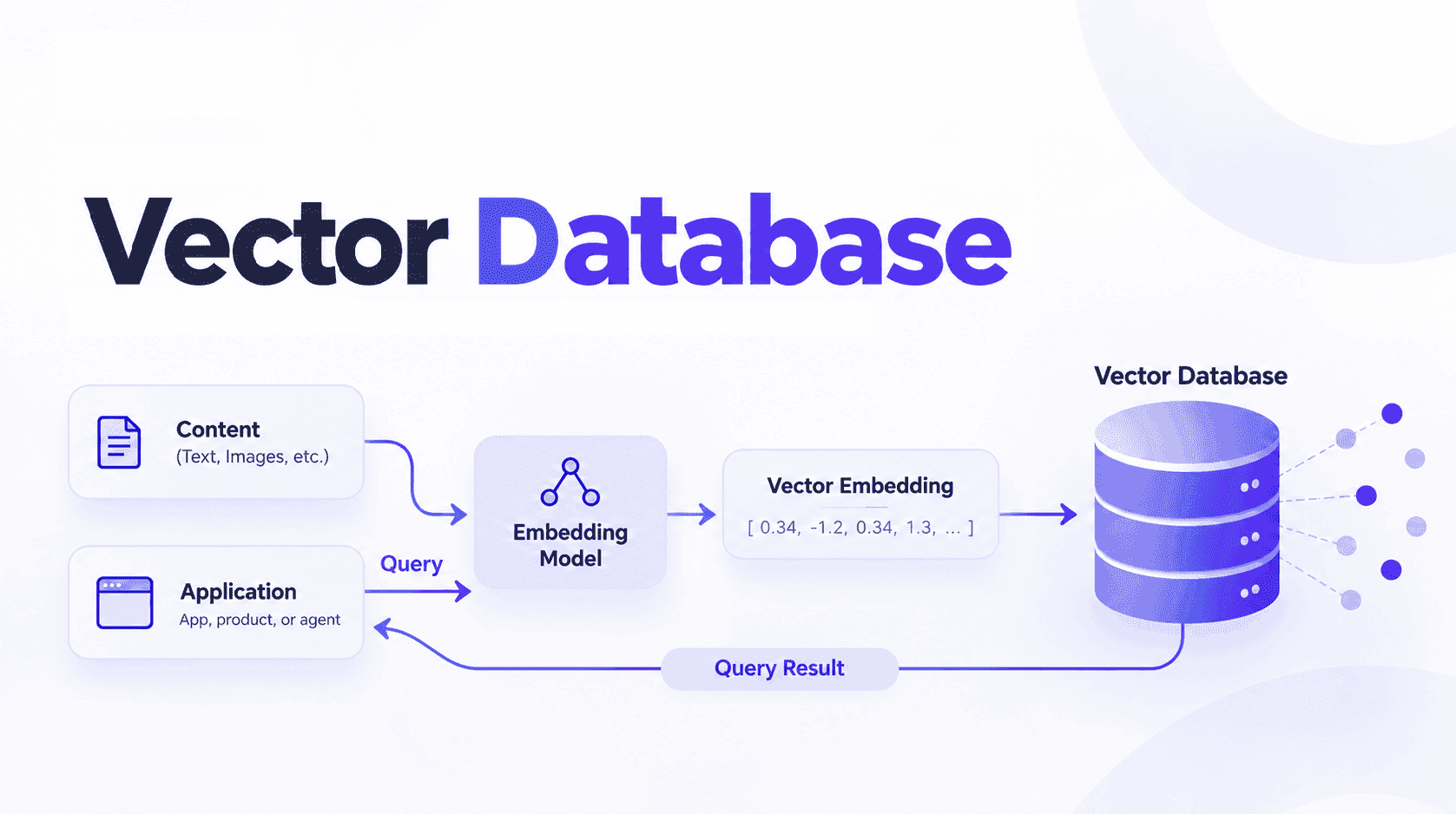
A vector database focuses on storing and searching embeddings, typically for documents. Mem0 focuses on agent-oriented memory, so it combines text, embeddings, and structured metadata, plus lifecycle operations such as update and delete that map well to conversational and workflow state.
Q. When should engineers avoid storing certain information in Mem0?
Engineers should avoid storing data that must only live in systems of record, such as full clinical notes, if organizational policy forbids duplication. They should also omit highly sensitive identifiers if deployment or hosting does not meet required security standards, and instead use stable pseudonyms or IDs.
Q. How can Mem0 be integrated with existing EHR or CRM systems?
Mem0 sits beside existing systems and uses identifiers, such as patient_id or encounter_id, that link back to them. Integration usually happens through service layers or middleware that map EHR events and fields into Mem0 memories and vice versa, without requiring changes to the EHR itself.
Q. Why use Mem0 instead of just extending the LLM context window?
Extending the context window increases cost and latency, and still does not solve the cross-session memory. Mem0 provides durable, queryable memory that survives across sessions, tools, and channels, which is essential when multiple agents and services collaborate on the same patient or workflow.
Q. How does Mem0 handle multi-agent setups in healthcare environments?
Mem0 uses metadata such as agent_role, service, or team to partition and filter memories. Different agents, such as triage and billing, can share patient context when appropriate and also maintain their own specialized memories, while engineers enforce access rules at the application layer.
Further Reading
—
Mem0 is an intelligent, open-source memory layer designed for LLMs and AI agents to provide long-term, personalized, and context-aware interactions across sessions.
Get your free API Key here: app.mem0.ai or self-host mem0 from our open source github repository.
—
More on Agent Memory

How to Read Memory Benchmarks
How to read AI memory benchmarks: what LoCoMo, LongMemEval, BEAM, and agentic tests measure, where scores go wrong, and how to find the correct benchmark for your use case.
20 min read

The Problem After Retrieval: Why Agents Misuse the Memories They're Given
Five papers show LLM agents often misuse the memories they retrieve. What the research says, how much to trust it, and what builders can do.
13 min read

What Is Memory Staleness in AI? Causes, Risks & Solutions
Understand memory staleness in AI agents, why outdated information leads to errors, and the best techniques to maintain accurate long-term memory.
9 min read



Aashi Dutt
She is a senior technical content writer at Mem0. She covers agent memory architecture and the engineering decisions behind building agents that actually remember. She experiments with new features and turns research into posts developers can put straight to use.
Start building with memory
Free tier, no card