

·
13 min read

On this page
Say, a technician pulls up to a house where the air conditioner has failed again. The scheduling system has the appointment. But somewhere in a past job note, a previous tech wrote that a repair did not hold. Somewhere in a call transcript, the homeowner said they wanted to see repair options before paying for a replacement.
All of that information exists. Now, the only question that matters on the doorstep is whether the right piece of it reached the person about to make the next decision. Usually, it does not. The note sits in a field nobody opens, the transcript lives in another system, and the new repairman starts from zero, re-diagnosing a fault that was already narrowed down and re-pitching a replacement the customer already pushed back on.
Key takeaways
Field agents start each visit from zero because what the business already knows sits in fields nobody reads. A memory layer carries it to the next person.
A live tool answers the same day-one work order twice. Without memory, a generic checklist. With memory, every specific trace back to a stored memory.
Memory is scoped per customer, property, and equipment, so one customer’s history never leaks into another. Isolation is enforced by the application, not by a model’s judgment.
Three P&Ls: The platform sells paid workflows, the contractor avoids rework, and the technician does less admin and ramps faster.
This is the problem a memory layer solves for software that runs the trades. A place where the facts worth keeping across visits, people, and workflows persist and come back when they are needed.
Use case: The technician handoff
In this section, we’ll explore how memory can help you solve the above-stated problem. Before a technician drives to a repeat visit, the agent hands them a short brief: what the last repair was, whether it worked, what is still open, and how the customer wants to be handled.
That’s the solution!
Example: Two things happen over the summer, a visit and a phone call, and each produces facts worth keeping. They get written to memory, scoped to the exact customer, property, and unit. Before the next visit, the agent reads what is still open and turns it into the brief.
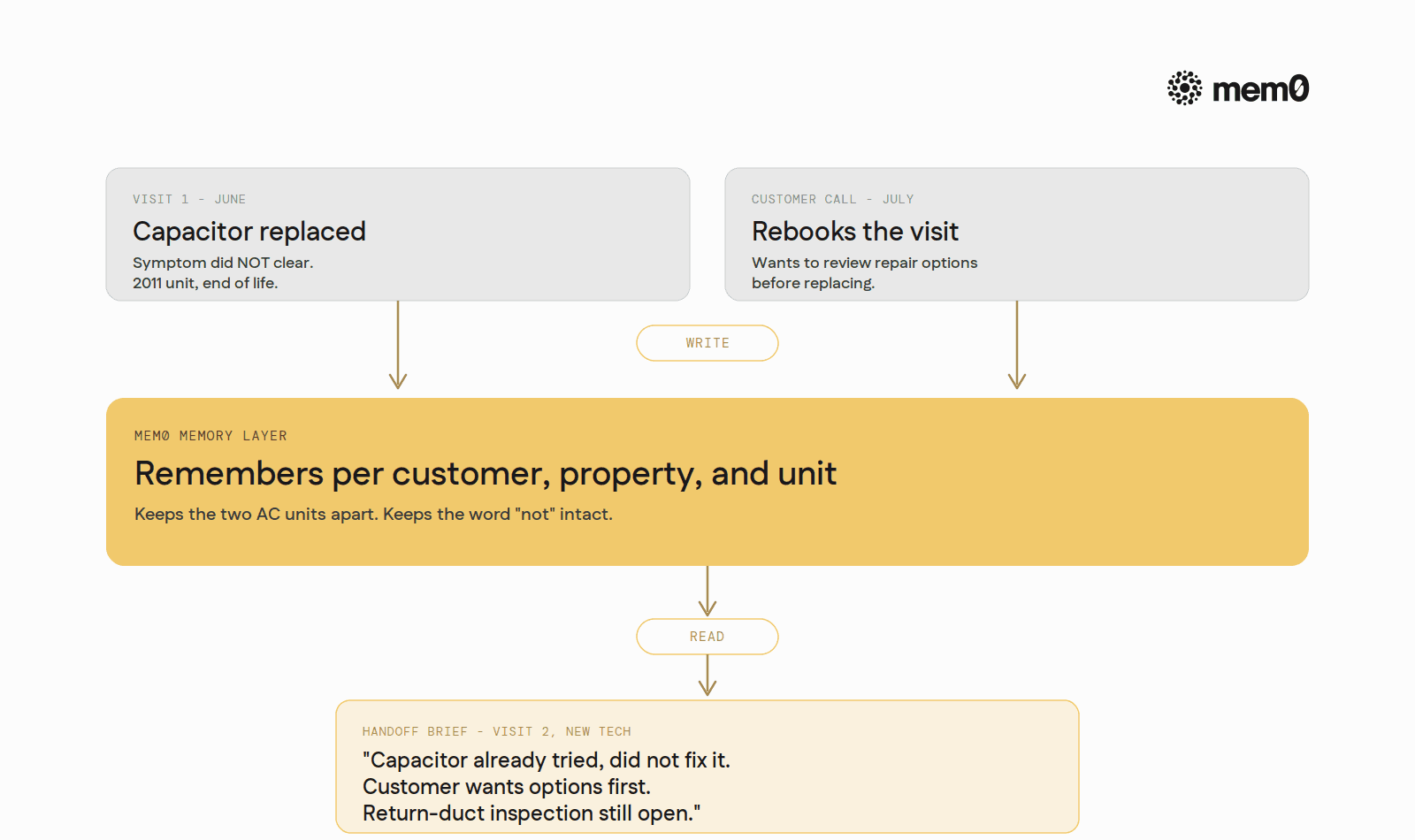
Here, the two hard parts are written right into the memory layer(Mem0), because they are what separate memory from a naive summary. The system has to keep two similar units at the same address from bleeding into each other, and it has to keep the word “not” intact, because a summary that quietly drops it turns “the capacitor did not fix it” into “the capacitor fixed it” and sends the next tech down exactly the wrong path.
What memory adds that a database and retrieval do not
A simple question arises here: Why not just use a work-order database with good search?
A work-order database records transactions. While a retrieval system finds relevant passages in manuals and transcripts. But a memory layer keeps a compact, selected set of facts that should outlive a single interaction and stay useful later, with temporal and update handling to keep them from going stale.
Consider three statements from three visits:
“A component was suspected faulty,”
“Replacing it did not clear the symptom.”
“A later inspection found a different cause.”
A useful memory system preserves that sequence and keeps hypothesis, intervention, and verified outcome distinct. A flattened summary that says “both components are faulty” is not just less useful; it actively misleads the next technician.
Calling something memory does not make it better than retrieval. The test is whether maintaining that compact representation produces better decisions at an acceptable cost or not.
Demo: One worker’s memory, the next worker’s day one
I built a small tool on hosted Mem0 and ran it live on synthetic data with real memory writes, reads, and model calls to Mem0.
The UI includes a dropdown at the top to pick the customer, and each customer gets its own isolated memory scope(switching customers and the memory switches with it). Nothing is shared. Two steps follow: an experienced worker logs what they learned for the selected customer, and a brand-new worker, assigned to the same customer, asks what to do and sees two answers side by side (Memory extracted and Model extracted(No Memory).
Here is the prompt that I used for an experienced worker, with the work order, customer, property, equipment, and part numbers in it:
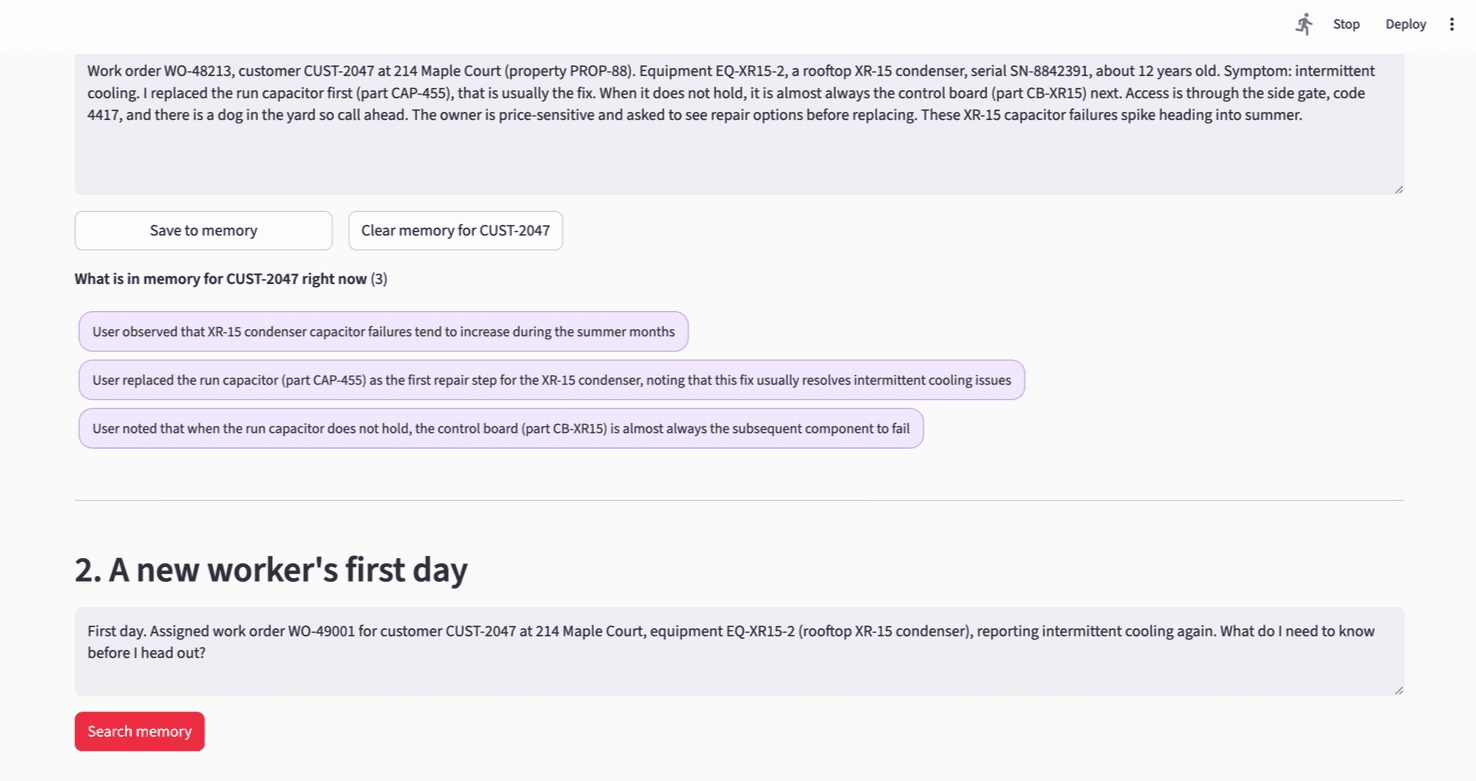
Prompt: Work order WO-48213, customer CUST-2047 at 214 Maple Court (property PROP-88). Equipment EQ-XR15-2, a rooftop XR-15 condenser, serial SN-8842391, about 12 years old. Symptom: intermittent cooling. I replaced the run capacitor first (part CAP-455), that is usually the fix. When it does not hold, it is almost always the control board (part CB-XR15) next. Access is through the side gate, code 4417, and there is a dog in the yard so call ahead. The owner is price-sensitive and asked to see repair options before replacing. These XR-15 capacitor failures spike heading into summer.

Hit Save to memory, and Mem0 turns that one messy sentence into structured, reusable memories, keeping each part number attached to the right step. You can see the extracted memories highlighted in purple below:
Then the new worker, who has never seen this property, gets a fresh work order (WO-49001) for the same customer and asks what to know before heading out.

Without memory:
The answer is a generic HVAC checklist, such as reviewing the work order, bringing basic tools, checking the thermostat, the condenser, the refrigerant, etc. It is what any assistant says with no context.
With memory:
The agent tells the new worker to bring a replacement run capacitor CAP-455 and a control board CB-XR15, to inspect the run capacitor first and move to the control board only if that is fine, and to lead with the cheaper fix because the owner is price-sensitive. Every one of those specifics traces back to a stored memory, and the tool lists which ones it pulled from CUST-2047 (Customer Id) underneath the answer.
Note: CAP-455 and CB-XR15 are not intelligence the model has. They exist only because a previous worker left them in memory for that customer, and they reached the next worker on the correct customer because the memory was scoped by identity rather than dumped into one shared pile.
Note: The demo in this post was run live against hosted Mem0 with synthetic data. No real contractor, customer, or job is represented, and no field results are claimed. Mem0’s own benchmark figures are cited from public sources.
Demo in code
The whole thing is a thin layer over two Mem0 calls, add and search, along with per-customer scoping. Here is the part that matters:
Each customer maps to its own memory scope, which is what keeps one customer’s history from leaking into another:
Saving the worker’s note is a single
add. With inference on, Mem0 extracts the structured memories from the free-text note rather than storing it verbatim:
Retrieval for the day-one worker is a scoped semantic
search, so it only ever sees memories for the customer on the work order:
Returning answers with and without memory. The “with memory” answer is just the model given those retrieved memories as context, while the “without memory” answer is the same model with an empty context:
That is the entire mechanism. The intelligence is not in the prompt engineering; it is in add forming durable memories and search returning the right ones for the right customer.
You can produce the same outputs from the complete code available on the GitHub repository. Get a free Mem0 API key to start building.
Three P&Ls: Who this actually pays off for
A memory-backed workflow is worth building only if someone’s economics improve. The mechanisms differ at each level, and a benefit that appears in three places is easy to count three times.
The platform: A field workflow that visibly remembers the business is a reason to adopt a paid capability, a reason to keep using it, and a way to lower the cost of serving each account, because the agent reconstructs its own context instead of a support agent doing it.
The contractor: For the business running the jobs, the opportunity is more complete, profitable work with less avoidable rework. Memory surfaces a previous failed repair so it is not blindly repeated, brings a promised inspection back before the tech closes the job, and checks likely parts against the truck before it leaves. A recovered hour only becomes revenue if there is demand, parts, and scheduling to fill it, so freed capacity is a real gain.
The technician: For the person doing the work, the wins are less unpaid admin, fewer callbacks, and a faster ramp. The agent drafts the write-up from what actually happened, a day-one hire walks in with the crew’s accumulated know-how instead of months of ramp, and first-time-fix rates climb because the tech is not repeating a failed fix or missing the real root cause.
Every job a single contractor runs makes their own agent sharper. The failed fixes, the customer preferences, the access quirks, and the equipment histories all accumulate and come back on the next visit. This is safe because the data never leaves that tenant, and it is directly testable as well.
How would you build it?
The engineering underneath is where a memory layer earns trust. Here is the real integration:
Identity first: Trades software needs several identities at once, such as a landlord owning multiple properties, a tenant requesting work without authorizing a replacement, one site having several near-identical units, and a technician changing employers. In Mem0 terms, the tenant maps to a project or app scope, the end user to a user ID, the agent to an agent ID, and a session to a run ID, with hard isolation so one tenant’s memory cannot leak based on a model’s judgment.
Write outside the live conversation: The write path starts from a committed business event, an approved job note, a reviewed transcript, an accepted estimate, and runs through a queue into an extraction and validation worker that resolves identity, minimizes sensitive fields, and writes only accepted facts. It is worth noting to keep the original evidence separate, because an extracted statement is a derived representation that may need correcting.
Retrieve under policy, then act through tools: Retrieval enforces authorization and exact-entity constraints first, then lets semantic similarity choose within the permitted set. For a failed-repair question, the exact equipment identity matters more than a high similarity score for a look-alike unit. Mem0’s hybrid of keyword, entity, and semantic search, along with its metadata filters and reranking, gives you the primitives, but the access control and business rules stay yours.
Handle change without erasing history: A replaced unit’s history still matters, but it must not show up as the currently installed asset. Mem0’s temporal metadata answers “where does this stand now” instead of returning a stale match; a latest-only read narrows a chain to the current answer; and its Dream consolidation supersedes and merges outdated memories while keeping the trail. Expiration hides a memory from ordinary search without deleting it, and pins protect the facts that must stay true regardless of age.
The case for Mem0
The reason to reach for a dedicated memory layer rather than rebuilding one is that the hard parts, temporal correctness, isolation, consolidation, and retrieval that know when a wrong memory is worse than none, are exactly what a memory product is built to get right. Mem0 reports top-tier accuracy on public long-memory benchmarks, 92.5% on LoCoMo and 94.4% on LongMemEval, at roughly 3 - 4x times fewer retrieval tokens than passing full history into the prompt, and it can run fully on-prem, which matters when the data is a platform’s competitive advantage. Those are the properties that let the demo above behave correctly, and they are the ones that decide whether this holds up inside a real field workflow instead of a slide.
Conclusion
The promise is narrow: the next technician receives the context the business has already earned. Everything else follows from it. The handoff brief is the smallest version; the interactive demo shows the mechanism working on real memory calls; the three P&Ls say who it pays off for, and the network effect is the same idea compounded across a whole platform, delivered as a governed pipeline rather than a shortcut.
If you build software for the trades and you are putting agents in the field, the practical next step is small. Pick one repeat-service workflow, wire a write point for verified observations and a retrieval point before the next visit, and compare your current setup against scoped memory on the same jobs. Agree on what accuracy, freshness, and cost you need before you start. The demo in this post is a working starting point, and Mem0 is built for exactly this shape of problem.
Further reading
—
*Mem0 is an intelligent, open-source memory layer designed for LLMs and AI agents to provide long-term, personalized, and context-aware interactions across sessions.*
Get your free API Key here: app.mem0.ai or self-host mem0 from our open-source GitHub repository.
—
Frequently Asked Questions
Q. How is this different from just storing job notes in a database?
A database records every transaction and hands it all back on request. A memory layer keeps a compact, selected set of facts that survive a single interaction, with the temporal handling to tell what is current versus historical and the consolidation to keep a failed fix from being repeated. The demo shows the difference: the same question, answered from a generic checklist versus from what was actually learned on the property.
Q. How does the “every contractor’s agent gets smarter” network effect stay private?
It is a governed promotion pipeline, not a shared pool of raw notes. Per-customer memory stays inside the contractor boundary. A separate permissioned process produces de-identified patterns with provenance and sample size, and only reviewed patterns are promoted. Removing names is not enough on its own, because rare equipment, location, and timing combinations can re-identify, so promotion needs its own data-rights review.
Q. What has to be exactly right, like an invoice amount or a warranty clause?
Anything where a paraphrase is a defect gets stored verbatim with inference off and flagged as immutable, and the system retrieves the versioned source record rather than a summary. Memory helps locate and explain those records, but financial amounts and contractual text come from the system of record and deterministic calculations, not from a generated memory.
Q. Where should a platform team start?
One repeat-service workflow, most naturally the technician handoff before a return visit, because its output is bounded and inspectable. Add a write point for verified observations and a retrieval point before the next visit, and compare your existing retrieval against scoped memory on the same job histories with accuracy, freshness, and cost gates agreed up front.
More on Agent Memory

How to Read Memory Benchmarks
How to read AI memory benchmarks: what LoCoMo, LongMemEval, BEAM, and agentic tests measure, where scores go wrong, and how to find the correct benchmark for your use case.
20 min read

The Problem After Retrieval: Why Agents Misuse the Memories They're Given
Five papers show LLM agents often misuse the memories they retrieve. What the research says, how much to trust it, and what builders can do.
13 min read

What Is Memory Staleness in AI? Causes, Risks & Solutions
Understand memory staleness in AI agents, why outdated information leads to errors, and the best techniques to maintain accurate long-term memory.
9 min read




Aashi Dutt
She is a senior technical content writer at Mem0. She covers agent memory architecture and the engineering decisions behind building agents that actually remember. She experiments with new features and turns research into posts developers can put straight to use.
Start building with memory
Free tier, no card