
/
/
/
Harness Comparison: How Claude Code, Cursor, Devin, and Antigravity Each Handle Memory

·
15 min read

On this page
AI coding harnesses have shifted from autocomplete tools to persistent collaborators. Claude Code, Cursor, Devin, and Antigravity each wrap an LLM in a workflow engine that tracks files, commands, and execution history.
The bottleneck is no longer model capacity but the quality of the harness memory stack. How context is collected, summarized, and reintroduced back into prompts determines whether the agent feels consistent or forgetful.
This post takes a systems view of how four popular harness styles approach memory, then shows how Mem0 adds durable, cross-session memory on top of any of them.
👉Get a free API key at app.mem0.ai to follow along (free tier, no credit card, includes all the
add()andsearch()calls shown below).
The core memory problem in coding harnesses
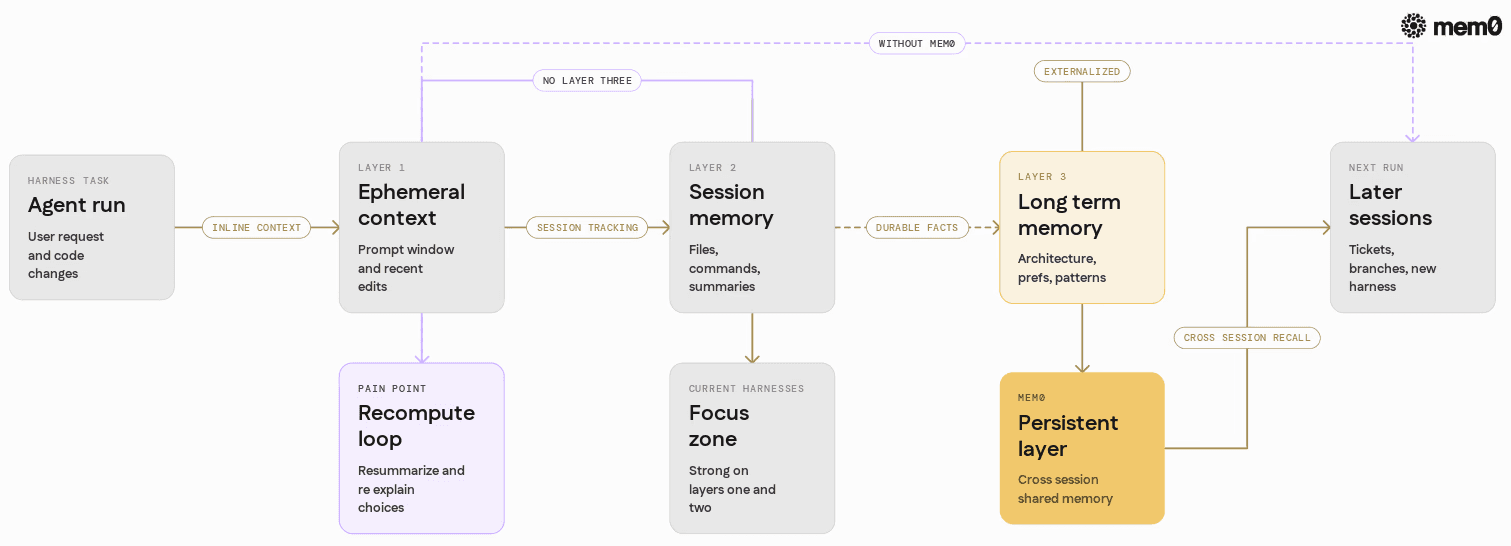
Coding harnesses operate over three distinct memory layers:
Ephemeral context: Immediate prompt window, inline code snippets, cursor location, and recent edits.
Session memory: Files opened, commands run, tests executed, temporary scratchpads, and intermediate summaries.
Long-term memory: Architecture decisions, past tickets, user preferences, and recurring patterns that should survive sessions.
Most harnesses excel at the first two layers. They track files and commands well, and they synthesize short-term summaries. The problem appears when:
The codebase exceeds a few megabytes of relevant context.
Multiple tickets, branches, or sessions interleave.
The same agent needs to resume work days or weeks later.
Without a dedicated long-term memory layer, the harness repeatedly recomputes the state. It resummarizes directories, re-explains the same architecture choices, and re-asks for preferences on tests, logging, or frameworks.
Mem0 exists to solve that specific gap.
Claude Code auto-compacting and hierarchical summarization
Claude Code-style harnesses build memory through aggressive summarization. The basic pattern looks like:
File-level summaries: Each open file is summarized into a condensed description, often at multiple granularities.
Workspace summaries: Directories and projects gain aggregate summaries that reference the file-level summaries.
Conversation summaries: The chat history is compacted periodically, with emphasis on decisions and constraints.
Auto compaction policy: Once token budgets are hit, low-value details are replaced with higher-level summaries.
Conceptually, the hierarchy is:
Raw code
Block summary
File summary
Project summary
Conversation summary
At the prompt time, the harness chooses the appropriate level for each component based on the task. Fixing a single function uses block summaries and raw code. High-level refactors use project and conversation summaries.
Strengths
Scales relatively well as codebases grow.
Supports multi-resolution context, which is important for both local fixes and global refactors.
Encourages a consistent vocabulary about the codebase that the model can reuse.
Weaknesses
Summaries are tightly coupled to a session or workspace snapshot.
Changing the codebase invalidates some of the hierarchy.
Long term decisions and the rationale behind them can get compacted away.
Hierarchical summarization solves transient context pressure, not multi-session continuity. The same project picked up next week often has to resummarize or re-explain key design choices.
Cursor raw stuffing and aggressive retrieval
Cursor-style harnesses prioritize raw context stuffing. Instead of aggressively summarizing early, they:
Index the workspace using embeddings or symbol graphs.
Retrieve the most relevant files or code blocks per query.
Stuff those directly into the prompt with minimal intermediate summaries.
Heavily annotate the prompt with file paths and code slices.
This design assumes that the best signal for the task is often the actual code and comments, not a derived summary. Any summarization is applied lazily, usually in the conversation history, not in the code context.
Strengths
The model sees real code, which improves correctness and reduces hallucination.
Retrieval is flexible and can adapt to changing codebases in near real time.
Debugging is transparent because the harness shows which files were injected.
Weaknesses
Prompt budgets cap the effective codebase size, especially for multi-file tasks.
Lack of durable summaries makes cross-session continuity dependent on re-indexing.
Repeated context fetching for similar queries wastes compute.
Raw stuffing excels at short to medium tasks but does not independently store long-term decisions. Repeated tasks on the same repo depend on embedding retrieval alone, which may miss nuance like "this team prefers dependency injection over singletons".
Devin checkpointing and execution state as memory
Devin-style harnesses introduce a more explicit notion of "checkpointed" memory. The harness treats agent progress like a build system:
Plan decomposition: The task is decomposed into steps and subgoals.
Checkpointing: After each meaningful step, the harness records:
Files changed.
Commands executed.
Tests run and their results.
Artifacts produced (logs, screenshots, outputs).
Recovery: On failure or interruption, the agent reloads the last checkpoint to reconstruct context.
Task-level history: Each task maintains its own sequence of checkpoints and progress notes.
This resembles long-running workflow engines. Memory is anchored in explicit milestones, not just chat history or file summaries.
Strengths
Strong resilience to interruptions and environment resets.
Clear replay and audit trail of what the agent has done.
Good alignment with CI and deployment pipelines.
Weaknesses
Memory is mostly scoped to a single task or ticket.
Checkpoints can be heavy and are rarely reused across unrelated tasks.
Long-term preferences and patterns do not naturally bubble up from checkpoints.
Checkpointing gives a persistent state within a task, but cross-task continuity is manual. An agent may forget that a previous project decided to standardize on a certain logging format.
Antigravity artifacts as memory
Antigravity-style harnesses treat artifacts as first-class memory units. An artifact can be:
A planning document.
A test report.
A code diff.
A design diagram.
A transcript segment.
The harness organizes these artifacts in a graph or workspace, and the agent interacts with them in a quasi-visual environment.
Artifact-centric memory has this loop:
The agent produces an artifact for each meaningful thought or deliverable.
Artifacts are versioned and linked.
The harness surfaces relevant artifacts for new tasks via:
Tag-based search.
Embedding similarity.
Structured queries on artifact metadata.
In effect, the agent "remembers" through the artifacts it leaves behind.
Strengths
Strong alignment with how human teams share knowledge.
Easy to inspect and reuse prior work by both humans and agents.
Provides a natural home for long-form design documents and rationales.
Weaknesses
Retrieval quality depends heavily on tagging and indexing discipline.
Many artifacts are task-specific and not normalized into reusable facts.
Cross-session continuity is implicit, not enforced by a memory API.
Artifacts as memory shift the burden from raw context or summaries to structured outputs. Without a separate memory layer that distills the durable parts of those artifacts, important patterns can still slip through.
Comparison of harness memory strategies
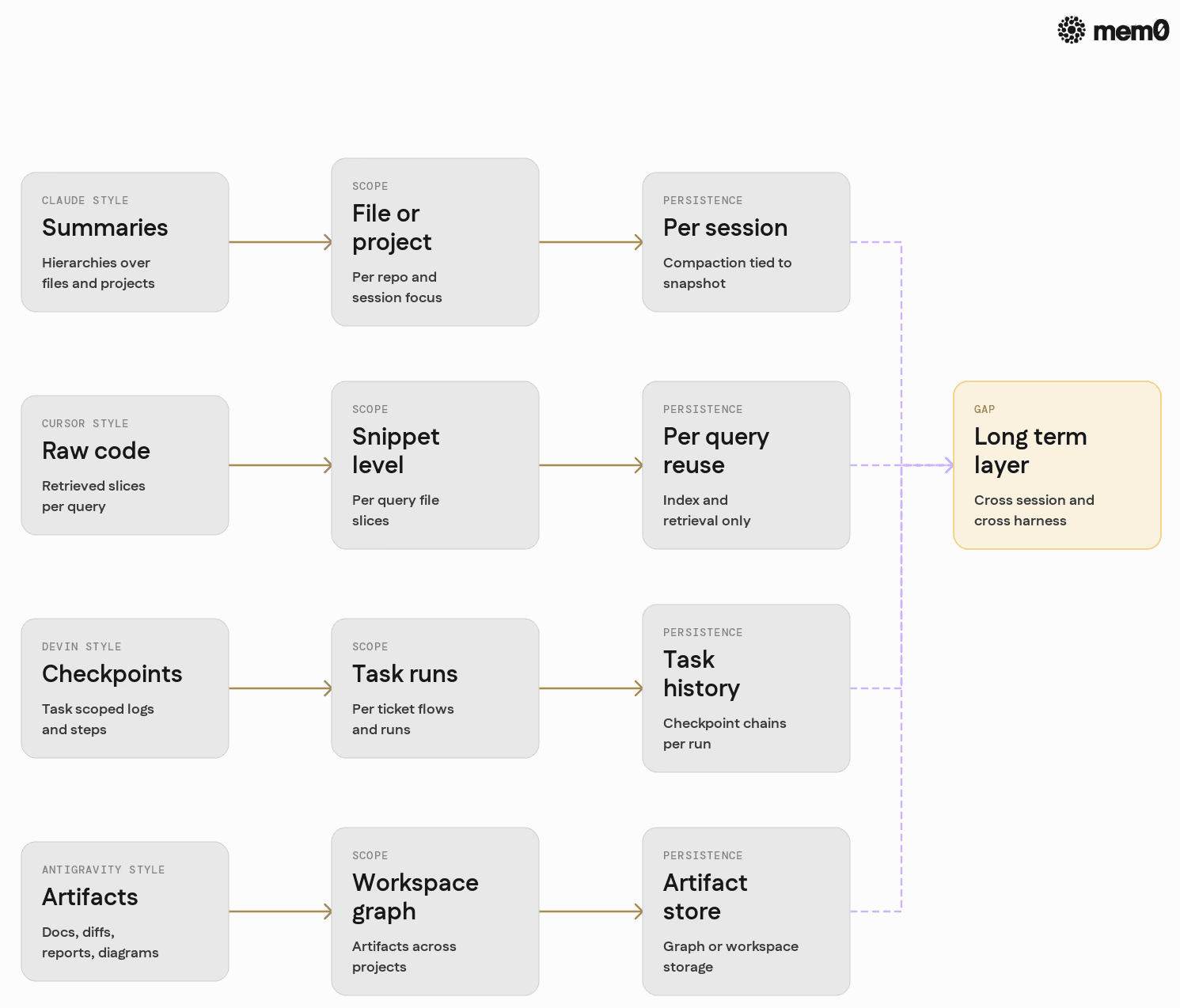
The four styles target different slices of the memory problem. The table below summarizes the tradeoffs through the lens of agent memory.
Harness style | Primary memory unit | Scope | Persistence model | Strength | Weakness |
|---|---|---|---|---|---|
Claude Code style | Hierarchical summaries | File and project | Auto compaction per session | Scales summaries over large codebases | Long term rationale can be compacted away |
Cursor style | Raw code context | File and snippet | Retrieval per query | Accurate view of current code | Limited cross-session continuity |
Devin style | Checkpoints and logs | Task | Task-scoped history | Strong within-task continuity | Weak reuse across tasks |
Antigravity style | Artifacts and documents | Workspace | Graph or workspace storage | Human-aligned knowledge representation | Retrieval depends on artifact quality |
Each harness partially solves context limits. None of them, by design, exposes a generic API for long-term personalized memory that is:
Independent of a single codebase or task.
Shared across sessions and environments.
Explicitly queryable and updateable by multiple agents.
This is the layer Mem0 is designed to fill.
How Mem0 fits as a dedicated memory layer
Mem0 treats memory as a first-class service that sits beside any harness. Instead of tying memory to a single chat window or repository, it exposes:
Write APIs: Agents can store structured memories with metadata (project, user, tags, timestamps).
Read APIs: Agents can query relevant memories by text, metadata filters, or vector similarity.
Identity and scope control: Memory can be scoped per user, per project, per agent, or shared.
Persistence and versioning: Memories survive across sessions and can be updated or merged.
For harnesses like Claude Code, Cursor, Devin, or Antigravity, Mem0 acts as an external spine:
Summaries, artifacts, and checkpoints become inputs to Mem0, not the final memory.
The harness itself remains stateless between sessions, delegating persistence to Mem0.
Multiple harnesses can share the same memory base if desired.
Critical behaviors that Mem0 enables in this context:
Cross-session recall of design decisions: The first time the agent decides on architecture, it stores those decisions. Future sessions reuse them automatically.
Personalization by user and team: Mem0 records styling preferences, code review patterns, and standard practices that apply across projects.
Multi-harness consistency: A user can move between harnesses while keeping a consistent memory layer.
Explicit forgetting and scope control: Derive new memories from artifacts but still delete or isolate sensitive content.
The same Mem0 base can absorb:
Claude-style hierarchical summaries of codebases.
Cursor-style retrieval traces.
Devin-style checkpoints and logs.
Antigravity-style artifacts.
Mem0 distills these into compact, queryable memories that survive beyond any single harness run.
A shared demo architecture with Mem0 on top
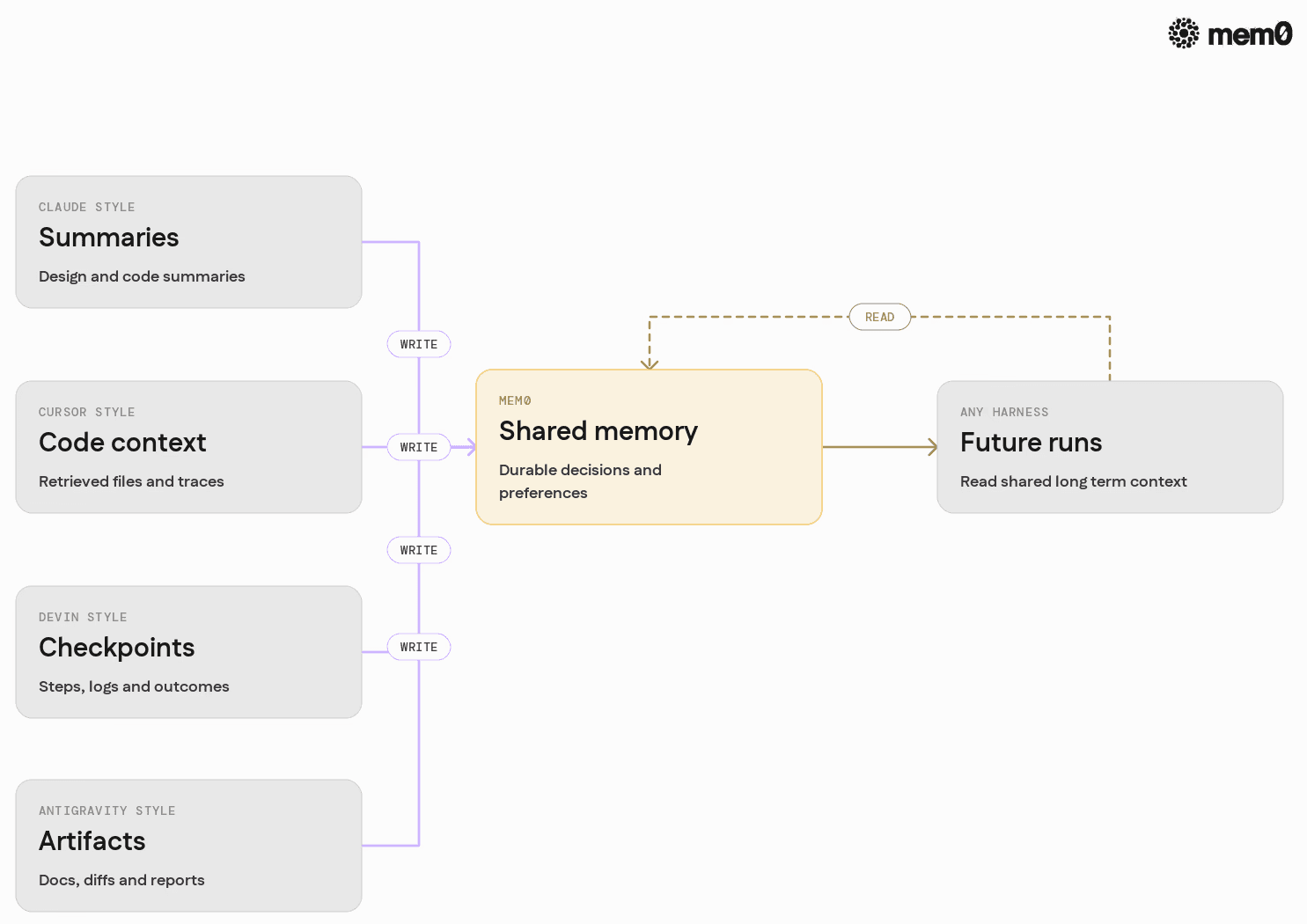
Consider a shared demo where all four harness styles interact with the same Mem0 instance.
The scenario:
An engineer uses a Claude-style harness to introduce a new service layout.
A Cursor-style harness then implements additional endpoints.
A Devin-style harness runs an end-to-end integration task.
An Antigravity-style harness creates architecture diagrams and documents.
With Mem0, the pipeline looks like:
Claude-style harness writes architecture decisions
High level structure: services, modules, and dependencies.
Naming conventions and directory layout.
Cursor-style harness reads Mem0 during code generation
Resolves ambiguous naming or directory placement via Mem0 queries.
Recalls team conventions or prior decisions.
Devin-style harness stores and reuses test and deployment outcomes
Logs the fact that a particular combination of flags is required for a certain CI pipeline.
On future tasks, it retrieves these constraints automatically.
Antigravity-style harness uploads artifacts into Mem0
Extracts key decisions from diagrams or documents and stores them as text memories.
Links artifacts metadata (like project, environment) to Mem0 scopes.
Every harness can keep its own internal memory structure, but all share a common, persistent, text-based memory API through Mem0.
Real Mem0 integration example in Python
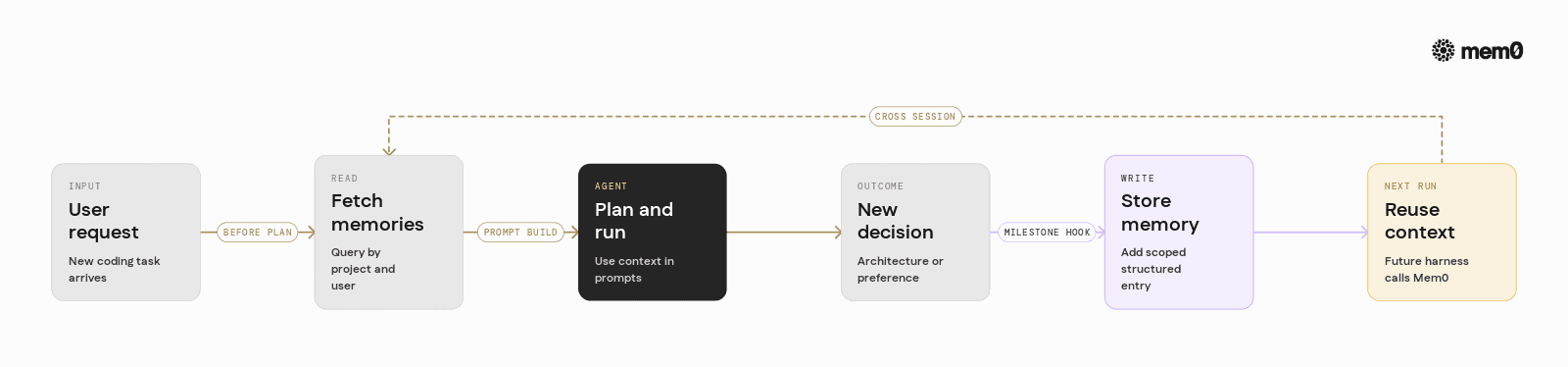
The following example shows how a simple harness-like agent can:
Pull relevant long term memories from Mem0 before planning.
Update Mem0 with new decisions after each run.
Assume:
The harness gets a
project_idanduser_id.It wants to remember architecture decisions and coding preferences.
👉Wanna give it a try? Get a Mem0 API Key and try it yourself.
This sample is intentionally minimal. In a real harness integration:
Claude-style harnesses would be called
store_architecture_decisionwhen finalizing a design summary.Cursor-style harnesses would call
fetch_project_memoriesbefore generating code, and embed the results into the system prompt.Devin-style harnesses would store checkpoint-level insights, such as optimal flags or environment quirks.
Antigravity-style harnesses would extract text from artifacts and write it as Mem0 memories with proper metadata.
Mem0 provides the shared memory spine that the harnesses currently lack.
Practical integration patterns with existing harnesses
Integrating Mem0 with existing harnesses follows a few repeatable patterns:
System prompt augmentation: Before each LLM call, fetch relevant memories from Mem0 and prepend them to the system or assistant message. This works for all four harness styles.
Memory hooks on key events: Define hooks for:
File creation or significant refactors.
Plan completion or subgoal completion.
Artifact creation (docs, diagrams).
Test or deployment success/failure.
Each hook calls Mem0 to add or update memories.
Scope by project and user: Use Mem0 metadata to segment memory:
project_idfor repo or service boundary.user_idfor personalization.agent_idorharness_typeif needed.
Summarization step before writing: Do not store raw logs or code. Instead:
Summarize the key decision or outcome.
Include links or identifiers to artifacts stored elsewhere.
Backfilling from existing artifacts: For harnesses that have been in use without a memory layer:
Scan existing design docs, ADRs, or reports.
Generate Mem0 memories from them.
Boot the agent with a populated memory base.
This approach lets Mem0 sit beside existing harnesses without invasive changes, while providing an external memory contract that can be shared across tools and sessions.
Limitations of harness memory patterns
Each harness memory pattern has clear limits that Mem0 does not attempt to replace, but instead complements:
Hierarchical summarization
Works well within a single project snapshot. It struggles with:Continuous refactors where summaries quickly get stale.
Capturing human intent behind code changes.
Sharing decisions across multiple projects.
Raw context stuffing
Keeps the model close to source truth, but:Cannot scale to very large monorepos at high granularity.
Tends to repeat similar context across sessions.
Depends heavily on retrieval quality for subtle decisions.
Checkpointing
Provides strong task-level reliability, yet:Checkpoints are not intrinsically queryable across tasks.
Many agents do not expose their checkpoints as reusable knowledge.
Sharing checkpoints between different harnesses is nontrivial.
Artifacts as memory
Aligns well with human workflows, though:Requires disciplined tagging and documentation practices.
Artifacts often contain more noise than reusable facts.
Not all harnesses can ingest arbitrary artifact formats as context.
Mem0 sits at a higher level of abstraction. It does not manage file diffs, full logs, or artifact UIs. Instead, it focuses on durable, text-based memories that express decisions, preferences, constraints, and lessons learned. Harnesses still need their internal mechanisms for code and execution level context.
Frequently Asked Questions
Q. What problem does Mem0 solve that harnessing memory alone does not?
Harnesses are excellent at managing short-term context inside a single session or task. Mem0 focuses on cross-session and cross-harness continuity by storing durable memories that express decisions, preferences, and constraints that outlive any single run.
Q. How should an AI engineer decide what to store in Mem0 versus the harness?
Use the harness for transient context, such as current file contents, logs, and intermediate prompts. Use Mem0 for any information that should still matter tomorrow, such as architecture decisions, coding standards, project invariants, and recurring gotchas.
Q. When is the right time to write to Mem0 during an agent run?
The most effective pattern is to write to Mem0 at milestones: when a design is accepted, a refactor is completed, a bug is diagnosed, or a deployment is stabilized. These points naturally produce summarized knowledge that is reusable and less noisy than raw logs.
Q. How does Mem0 interact with hierarchical summaries or artifacts?
Mem0 does not replace internal summaries or artifacts. Instead, agents extract key statements from those sources and store them as Mem0 memories with metadata. Hierarchical summaries and artifacts remain detailed, while Mem0 holds a compact, queryable layer of distilled knowledge.
Q. Why use a shared memory layer across different harnesses?
Many teams experiment with multiple harnesses or tools for different tasks. A shared memory layer ensures that decisions made in one context, such as architecture patterns or conventions, are available to agents in other tools, which reduces rework and prevents conflicting behaviors.
Q. Can Mem0 help with personalization for individual developers?
Yes. By scoping memories withuser_id, agents can remember individual preferences, such as code style tendencies, tooling choices, or typical workflows. This personalization persists across sessions and can be reused by different harnesses that integrate with the same Mem0 base.
Further Reading
—
Mem0 is an intelligent, open-source memory layer designed for LLMs and AI agents to provide long-term, personalized, and context-aware interactions across sessions.
Get your free API Key here: app.mem0.ai or self-host mem0 from our open source GitHub repository.
—
More on Coding Agents

Kimi K3 tutorial: build a vision coding agent with persistent memory
Kimi K3 has a 1M-token context window but no memory across sessions. We tested it with Mem0 and cut design regressions from 60% to 0%.
10 min read

Coding Agents Explained: What They Are and How They Differ from AI Assistants
Learn what coding agents are, how they work, and how they differ from AI assistants, chatbots, and autocomplete tools.
29 min read

OpenAI Codex vs Claude Code: Which AI Coding Agent Wins in 2026?
Codex leans toward parallel execution, isolated worktrees, cloud delegation, and reviewable task runs. Claude Code is terminal oriented and more engaging in long interactive sessions, and agent-to-agent coordination. OpenAI’s GPT-6 Astra and Anthropic’s Fable 5.1 have enhanced capabilities, but the harness determines how that intelligence is used. For serious repository work, the better choice is the one that performs more reliably on your codebase, constraints, and working style.
23 min read



Aashi Dutt
She is a senior technical content writer at Mem0. She covers agent memory architecture and the engineering decisions behind building agents that actually remember. She experiments with new features and turns research into posts developers can put straight to use.
Start building with memory
Free tier, no card